New England Landmark Realty covers the Vermont real estate market 

from the inside — market data, buyer strategy, seller timing, land 

use regulation, and the policy decisions shaping what homes cost and 

who can afford them.


Tony Walton has been working Vermont real estate since 1978. 

The analysis here reflects that depth.


Browse by topic below, or use the search to find what you need.

July 3, 2026

Opening Day and the Sacred New England Lie

Harris Vexley's Full Article (Unedited)


Every baseball season begins with the same sacred New England lie: this year will be different.

Quick Answer

Red Sox fans experience cyclical hope because Opening Day arrives before evidence. The season hasn't yet hardened into standings, the bullpen hasn't yet failed, and four generations of inherited optimism remain intact. By June, hope becomes educational.

We say it in March, when the snow is still retreating in dirty, humiliated piles and the Red Sox have not yet had the opportunity to harm us in a statistically meaningful way. The grass is green. The caps are clean. The broadcasters sound rested. Even the bullpen appears, from a distance, to be a professional organization.

This is the dangerous part.

Hope, in baseball, is not a feeling. It is a recurring medical condition.

I know this because I am from Vermont, where baseball is not so much watched as inherited. My great-grandfather was a Red Sox fan. My grandfather was a Red Sox fan. My father was a Red Sox fan. By the time I arrived, the family had already lost several decades, most of its emotional elasticity, and any reasonable expectation of late-inning competence.

Still, every Opening Day, we believed.

My great-grandfather believed by the radio, which hissed and crackled like it was trying to warn him. My grandfather believed through the newspaper box scores, circling batting averages with the tenderness of a man annotating scripture. My father believed from a recliner, issuing small tactical recommendations to men in Boston who could not hear him and, frankly, had their own problems.

I believe through my phone, which is worse.

A push notification has no bedside manner. It simply appears and says, "Three-run homer allowed," as if notifying me that the barn has burned down but the chickens remain optimistic.

Opening Day Harris is always a disgraceful romantic.

Opening Day Harris says things like, "I like the shape of this team."

June Harris replies, "This team has the shape of a folding chair."

Opening Day Harris says, "The rotation looks promising."

June Harris says, "The rotation appears to be a witness protection program for earned runs."

Opening Day Harris says, "The young players just need time."

June Harris says, "I would prefer they stop learning in public."

As of this week, the Red Sox are 27–39 and last in the American League East, which is less a record than a weather report: scattered concern, heavy bullpen, chance of muttering after dinner.

And yet I am not angry.

Anger is too simple. Red Sox fandom, properly practiced, requires a more artisanal suffering. A slow-roasted disappointment. The kind that pairs well with black coffee, porch silence, and saying, "Long season," in the tone of a man describing a minor roof leak that has become sentient.

Each generation of Vexley men had its own phrase for baseball despair.

My great-grandfather said, "Long season."

My grandfather said, "Plenty of games left."

My father said, "They'll get hot."

I say, "I have muted the app for my health."

This is progress, technically.

Baseball is the only sport patient enough to ruin you politely. Football kicks in the door. Basketball runs you breathless. Hockey crashes through the boards with dental consequences. But baseball sits beside you for three hours and gradually convinces you that a walk, a bloop single, and a throwing error constitute a philosophical event.

This is why we love it.

Also, because we are not well.

The great trick of Opening Day is that it arrives before evidence. Before the standings harden. Before the bullpen begins entering from right field with the energy of substitute teachers during a fire drill. Before someone says, "He's day-to-day," and you realize, with horror, that so are you.

On Opening Day, everyone is undefeated.

By June, some of us have become educational institutions.

Still, I will watch.

I will sit with my coffee, or my sandwich, or my inherited anxiety, and I will listen for the old rhythms. The crack of the bat. The murmur of the crowd. The announcer explaining that the tying run is on deck, which is baseball's way of offering emotional credit at a dangerous interest rate.

I will remember my father, who became his father, who became his father, all of them staring toward Boston with the grim patience of men waiting for a cow to apologize.

And next spring, I will believe again.

Not because I am foolish.

Because baseball is the only institution in America that can break your heart slowly enough to call it tradition.

Discover Vermont Real Estate with New England Landmark Realty

Whether you're buying your first home, selling a family property, or looking for your next Vermont adventure, New England Landmark Realty brings market expertise and genuine community knowledge to every transaction.


Ready to talk? Reach out today.

(802) 253-4711 · (866) 324-2427

If You Want to Explore Vermont Further

Harris Vexley's column reflects the deep roots and layered history of Vermont communities. If you're interested in understanding the character of Central Vermont neighborhoods, school systems, and the real costs of living here, start with these guides:

July 2, 2026

Iran Conflict, Inflation Spike, and Your Mortgage Rate Window in Central Vermont


This morning, the inflation data landed: May's CPI came in at 4.2%—the highest level since April 2023. The bond market sold off. Simultaneously, oil prices spiked as peace talks between Iran and the U.S. showed fresh signs of failure. WTI crude is trading around $89 per barrel, elevated and volatile.

Here's the question nobody wants to ask: what if this doesn't end in the next four months?

If You Only Remember 3 Things

  • Today's 4.2% inflation spike (highest since April 2023) plus rising oil prices signal sticky inflation ahead—the Fed won't be cutting rates.
  • If the Iran conflict extends through November, mortgage rates could push toward 7% or beyond, thinning the move-up buyer pool and compressing inventory further.
  • Central Vermont's market is holding now, but the window to sell before rates spike is closing—June and July are your best months.

Quick Facts

  • May 2026 CPI: 4.2% (released June 10); WTI crude oil: ~$89/barrel; mortgage rates: 6.66%-6.75%
  • Upside rate risk if conflict continues: +0.375% to +0.435%, pushing rates toward 7.1%-7.2%
  • Fed's next meeting: June 16-17 (6 days away); expect "hold steady" guidance, not rate cuts

The Longer This Lasts, The Worse It Gets for Sellers

If the conflict stretches through summer and into fall—through the midterms in November—energy prices stay elevated. Inflation stays sticky. Today's 4.2% print is proof that inflation isn't cooling as the Fed hoped. And mortgage rates, currently hovering around 6.66%-6.75%, face genuine upside risk of another 0.375% to 0.435%.

That's not catastrophe. It's math. And it's happening in real time.

What today's inflation data actually signals

The Fed has been holding rates steady, betting that inflation would cool on its own. Today's number proves that strategy isn't working. Inflation spiked from 3.8% in April to 4.2% in May. That's not noise. That's a reversal.

The culprit? Energy prices. Oil has been volatile all year because of the Iran conflict. Every time peace talks break down—like they're doing right now—oil spikes. Every oil spike feeds back into inflation. And every inflation spike means the Fed has to stay hawkish.

The Fed's next meeting is June 16-17, just six days away. When they see today's 4.2% print combined with crude oil at $89, expect them to signal: "We're staying put. Rates aren't coming down anytime soon."

What that means for your timing

Central Vermont's market is holding. Inventory is tight. Prices are stable. Move-up buyers with equity are still moving, albeit more carefully than they were six months ago.

But here's what changes if rates tick another 0.375%:

A buyer pre-approved at $650,000 at 6.75% doesn't qualify at $650,000 at 7.125%. The math shifts. Their buying power drops. They either reduce their offer by $30,000-$40,000, or they step out of the market entirely.

Multiply that across dozens of buyers in the move-up segment, and suddenly the inventory that's tight becomes constrained. The market that's been holding starts to slow.

The base case vs. the risk case

Logan Mohtashami's 2026 forecast was straightforward: mortgage rates between 5.75% and 6.75%, with the upper end (6.375%-6.75%) most likely if labor data stayed firm and inflation remained sticky.

We're in the upper range. That's the base case. It's workable.

But today's inflation print plus ongoing Iran tensions point toward the risk case: rates could push toward 7% or slightly beyond. That's the upside risk. And it just got more real.

What an election result won't change

Polling suggests Democrats have a reasonable chance of flipping the House in November. If that happens—or if they gain seats in the Senate—markets might briefly reprice. But here's what actually matters for rates: it won't change the trajectory.

Why? Because the Iran conflict doesn't care about U.S. elections. It runs through November regardless. Energy prices stay elevated. Inflation stays sticky. Today's 4.2% print shows us that inflation isn't self-correcting—it's still climbing.

The Fed's hawkish stance—which is already baked in—doesn't shift because of a change in Congressional leadership.

In a divided government scenario (most likely: Democratic House, Republican Senate), you don't get major fiscal changes that would loosen monetary policy. You get gridlock, which means the Fed stays the course. Rates stay higher for longer.

If somehow Democrats sweep both chambers, you might get fiscal stimulus, which could actually keep inflation higher, not lower. More stimulus + sticky inflation = Fed stays even more hawkish.

So betting on an election outcome to move the rate needle is a mistake. The structural headwinds—today's inflation spike, elevated oil prices, geopolitical uncertainty—are bigger than any political outcome in November.

Why this matters for Vermont sellers right now

You have clarity on your market today. You know what rates are. You know what buyers are willing to pay. You know the seasonal momentum is still in your favor—June and July are still strong months.

But if rates climb another quarter point in August—and today's inflation print makes that more likely—that clarity evaporates. The buyer who was comfortable at $700,000 in July might not be comfortable at $700,000 in September. The move-up seller who was planning a September listing suddenly realizes they should have listed in June.

The timeline

The Fed's next meeting is June 16-17. They'll see today's 4.2% inflation print and elevated oil prices. Expect cautious language about "data dependency" and "remaining vigilant." That caution translates to: rates probably don't come down soon. They might even go up.

Summer goes into fall. The midterms are in November. If the conflict is still unresolved by then—and peace talks are already faltering—that's 10+ months of elevated energy prices and sticky inflation. That's a long time for buyers to feel uncertain about rates.

Use your window now. The runway between "rates are stable at current levels" and "rates have climbed another 0.375%" just got shorter.

What to do

For sellers: List decisively. Price realistically. Close fast. Today's inflation data is a signal that the Fed won't be cutting rates. The market will hold through summer, but don't count on fall.

For move-up sellers: Solve your buyer problem before you create your seller problem. Get clear on where you're going before you list where you are. Today's rate environment is the best you're going to see for a while.

For buyers: Expand your options. Use every tool. Know your actual numbers. Move when conditions are clear. Waiting for rates to fall isn't a strategy anymore. Today's inflation print proves that.

Vermont's market is resilient. But resilience doesn't mean complacency. It means moving strategically inside the conditions you have, not waiting for conditions to improve—whether that's hoping rates will fall or betting on an election outcome that won't change the fundamental math.

The Iran conflict is still escalating. Oil prices are still elevated. Inflation just spiked. And the Fed's next move is almost certainly "hold steady," not "cut rates."

Act accordingly.

Where to Go Next

Don't Wait for the Market to Change

Today's inflation spike and rising oil prices signal that rates aren't coming down anytime soon. If you're thinking about selling, the window to move before rates climb further is closing. Central Vermont's market is holding now, but the Fed's June 16-17 meeting could shift the outlook. Get clear on your strategy. Know your numbers. Move decisively.

Contact New England Landmark Realty

Office: (802) 253-4711 | Toll-Free: (866) 324-2427

Tony Walton (Founding Partner): (802) 233-4107

New England Landmark Realty

© 2026 New England Landmark Realty. Serving Central Vermont real estate with market clarity and strategic guidance since 2007.

July 1, 2026

The Thaw Nobody's Selling Tickets To

Tony Walton's Full Article (Unedited)


Vermont real estate exhales. Here's what the numbers, the Statehouse, and 24,000 missing homes are trying to tell us.

Quick Answer

Vermont real estate in 2026 is less frantic but not cheaper: inventory is up 11.7%, homes sit longer, and prices still rise because the state remains structurally short on housing.

For four years, Vermont real estate behaved like a Soho House membership line. Irrational. Performative. Rigged against everyone who showed up.

Inventory was a rumor. Bidding wars were a personality trait. Buyers walked into open houses the way people walk into the DMV — braced for indignity.

That market is dead. Long live the market.

The Numbers Are Finally Telling the Truth

Statewide inventory is up 11.7% year-over-year. Median days on market: roughly 91. Sellers are taking home 96.3 cents on the dollar — not 105, not 110. Above-list sales have collapsed from nearly 20% to 13.7%.

And yet the statewide median price still climbed to about $412,200. Waterbury's average home value sits at $550,330, up 1.8% year-over-year. Chittenden County crossed $500K in most segments and never looked back.

"This is the first spring market since 2019 that actually feels like a negotiation between adults."

Here's the paradox nobody at the cocktail party can explain: How do prices keep rising while inventory rises?

Because Vermont isn't a real estate market. It's a supply deficit wearing a real estate market's clothes.

We still have only about 2.9 months of supply. A balanced market needs four to six. We've moved from frozen to functioning. We have not moved to fair.

Key Takeaways

Two-Sentence Summary

This page is for buyers, sellers, and developers who need a Vermont market read grounded in current numbers, not pandemic-era memory. Tony Walton's view is simple: negotiating room is back, prices are still supported, and the shortage underneath the market is still doing the heavy lifting.

If You Only Remember 3 Things

  • Vermont inventory is up 11.7%, but 2.9 months of supply is still a shortage, not balance.
  • Act 181 created a real downtown and village-center development window, but January 2027 is now a deadline, not a theory.
  • Equity-rich sellers and patient equity buyers make a statewide crash unlikely.

Quick Facts

  • Inventory: +11.7% year-over-year statewide.
  • Median price: about $412,200 statewide.
  • Transfer tax on a $500,000 second home: about $18,100.

Data from sources listed below.

The Equity Fortress

Eighty-seven percent of mortgaged Vermont homeowners are equity-rich. Among the highest rates in America.

Translation: there are no panic sellers. The 2008 playbook — distressed listings, foreclosure cascades, forced price discovery — does not apply here. There is no kindling.

Vermont owners can wait out a bad rate cycle the way Warren Buffett waits out a bad quarter. Patiently. Sipping something local.

That is why the "crash is coming" YouTubers keep getting Vermont wrong. They are pricing a market that doesn't exist on a topography they've never walked.

The Statehouse Just Walked Back the Walk-Back

This is the story most brokers aren't tracking. They should be.

June 2024: Lawmakers override Governor Scott's veto and pass H.687 — known as Act 181 — the largest Act 250 reform in fifty years. It exempts housing in Vermont's 24 designated downtowns from Act 250 review through January 2027. It exempts projects of up to 50 units around dozens of designated village centers.

It also introduces a two-tier Property Transfer Tax. The general rate stays at 1.25%. But second homes and non-principal residences get hit at 3.4%.

The Math on a $500,000 Home

Vermont resident, principal residence ~$5,410
Nonresident, second-home buyer ~$18,100

Call it what it is — the "Welcome to Vermont" tax. The Legislature finally figured out that the Audi from Greenwich could pay a little more on the way in.

Then, on May 21, 2026, the Joint Committee of Conference on S.325 — now Act 152 — voted to repeal Act 181's Tier 3 jurisdiction and the controversial "Road Rule." The two pieces environmentalists won and developers hated.

But — and read this carefully — the same committee stripped out the Senate-passed pro-housing reforms that would have:

  • Extended the interim Act 250 housing exemptions to 2030
  • Removed arbitrary parcel-size constraints
  • Expanded interim exemptions to more rural communities
  • Expanded the Priority Housing Project for mixed-income and affordable development
"In the midst of a deep housing affordability crisis, this joint committee cast aside a series of thoughtful, reasonable pro-housing changes." — Alex Farrell, Commissioner, Vermont Department of Housing and Community Development

The takeaway for anyone holding a developable parcel near a designated downtown — Waterbury, Stowe Village, Montpelier, Burlington: the calendar is now the asset. The regulatory window is real. It has a January 2027 expiration sticker. The Legislature just signaled, clearly, that the door narrows.

The 24,000-Unit Hole

Vermont is short roughly 24,000 housing units. Some studies put the number closer to 30,000 or 40,000.

Since 2001, Vermont median home prices have risen 148%. Median household income has risen 72%.

That spread is not a market quirk. It's a generational sorting machine. It picks winners from a finite pool of equity migrants out of Boston, New York, and the Bay Area. It locks out almost everyone whose paycheck originates inside the state.

"Vermont isn't unaffordable because of greed. It's unaffordable because we won't build."

The press releases keep dancing around it. The math doesn't.

The Buyer Has Quietly Changed

The 2021 Vermont buyer was a panicked Brooklynite with a Zoom job and a Subaru.

The 2026 buyer is a more deliberate animal. Remote workers who already moved, stayed, and are now trading up. Retirees liquidating coastal equity. Second-home buyers — now paying the 3.4% tax and getting choosier about what's worth it. Patient equity migrants who waited out the bidding wars and are finally pulling triggers.

These buyers are less rate-sensitive than first-timers. They're not financing the whole purchase. They're financing the tail.

That is why 6%-plus rates haven't crushed Vermont the way the textbooks say they should. The textbooks assume buyers are stretched. Ours, in large part, aren't.

The Bifurcation Nobody Talks About at Closings

The market is splitting into two markets. The gap is widening every quarter.

WINNING
  • Move-in ready homes in walkable villages
  • Sub-$500K entry-level homes
  • Broadband, new septic, updated mechanicals
  • Chittenden County core
  • Stowe / Waterbury village corridor
LOSING
  • Rural fixers with deferred maintenance
  • Overpriced second-home inventory
  • No broadband, failing septic, oil heat
  • Far-flung properties without amenities
  • Aspirationally priced anything

Condition and presentation now matter more than they did in 2022. A lot more.

The Honest Read

Buyers: this is the best negotiating window since 2019. It is also seasonal, and probably temporary. Spring competition will compress it. Move while the room exists.

Sellers: 2021 isn't coming back. Price to the comp, stage to the buyer, and stop arguing with the market. Aspirational pricing in 2026 just buys you 91 days of carrying costs and a price cut anyway.

Developers: you have until January 2027 to break ground inside a designated downtown without an Act 250 permit. After that, the Legislature has signaled, clearly, that the door narrows. Mud season ends. So does this window.

Vermonters: pay attention to who is getting elected this November. The next Legislature decides whether we solve our housing problem or just keep writing essays about it. (Yes, I see the irony.)

Vermont's market isn't correcting. It's exhaling. The pandemic frenzy is over. The structural shortage is not.

Plan from the math

Buyers, sellers, and developers in Central Vermont have more room than they did a year ago, but the underlying shortage still defines the market. Run your numbers against this market — not last year's.

Where to Go Next

July 1, 2026

Home Repairs That Aren't As Scary As They Look


You're about to list your home. You walk through it and suddenly everything looks broken.

The toilet runs. There's a hole in the drywall. A draft whistles through the kitchen window like it's auditioning for a wind instrument.

Your mind spirals. Do I need a contractor? Is this a deal-breaker? Should I just reduce the price?

Stop. Most of what you're seeing isn't a structural problem. It's a perception problem. And perception is fixable without spending money you don't have.

If You Only Remember 3 Things

Most common home repairs—running toilets, slow drains, drywall patches—require basic tools and minimal expertise.

Small cosmetic fixes and tightened hardware can significantly improve your home's showing condition without contractor costs.

Addressing these before listing removes buyer red flags and builds confidence in your home's care.

Quick Facts

Pre-listing cosmetic repairs are one of the fastest ROI investments a seller can make.

Buyers often overestimate repair scope; visible neglect reads as deeper issues, even if they're surface-level.

Central Vermont homes built in older eras (1970s–2000s) are particularly susceptible to loose hardware and draft issues—both quick fixes.

The Truth About Home Repairs

Familiarity kills fear. Once you understand what's actually broken—and what just looks broken—you can either fix it yourself or decide it's not worth fixing at all. Either way, you stop bleeding confidence.

Fixing a running toilet

A running toilet is the home repair equivalent of a hypochondriac Googling symptoms. It feels serious. It's not.

Ninety percent of running toilets come down to one worn part inside the tank. The flapper. It's a rubber disc the size of a hockey puck. When it wears out, water leaks into the bowl, the tank refills constantly, and you hear that hissing sound that makes you think your plumbing is staging a mutiny.

Adjusting toilet tank components—a simple fifteen-minute repair

You can replace it in fifteen minutes with a $15 kit from any hardware store. No special skills. No plumber required. It's literally the easiest repair in this article.

Unclogging a slow drain

Slow drains are anxiety machines. Your brain immediately jumps to tree roots, broken pipes, and five-figure excavation bills.

Reality: it's usually hair and soap buildup three inches below the surface. You can clear it with a plunger, a cheap plastic snake, or even boiling water. If none of that works, then you call someone. But eighty percent of the time, you won't need to.

Patching small holes in drywall

Small holes announce neglect. A buyer sees them and thinks, "What else has this person not maintained?" Fair or not, it matters.

The good news: drywall repair is genuinely easy. Spackle, sandpaper, paint. An hour of work. Twenty dollars in materials. You'll feel like you actually accomplished something, which is a bonus.

Smoothing wall patching compound—an hour-long cosmetic fix

Tightening loose hardware

Cabinet handles, door hinges, towel bars—they loosen over time. It happens. It doesn't mean anything is failing.

Grab a screwdriver. Tighten them. Done. This takes twenty minutes for an entire house and makes everything feel more solid and cared-for. It's the easiest confidence builder you've got.

Replacing light fixtures or switches

This one intimidates people because electricity. But here's the reality: if you can follow a simple instruction card and match colored wires, you can do this.

Turn off the breaker. Disconnect the old fixture. Connect the new one. Turn the breaker back on. The fixture works or it doesn't. If it doesn't, you turn the breaker off again and figure out what you missed. No one dies. Your house doesn't catch fire. It's actually remarkably forgiving.

Sealing small gaps or drafts

Drafts make a home feel uncomfortable. Caulk and weatherstripping seal them. Both are fifteen-minute fixes. Both cost less than coffee.

Sealing window with care—a simple weatherization fix

The real thing

Home repairs feel scary because you don't understand them. Once you do, most of them are just... tedious. Not hard. Tedious.

The ones listed here? They're in the "doable" category. You don't need a contractor. You don't need special skills. You just need to stop catastrophizing and start with the simple stuff.

Your home doesn't need to be perfect. It needs to feel maintained. It needs to tell the story that you've cared for it. These repairs tell that story.

Where to Go Next

Selling Your Vermont Home: The Complete Guide

Vermont Home Buyer's Guide

Browse Central Vermont Listings

Ready to Sell?

Pre-listing prep doesn't have to be stressful. Let NELR walk you through the process—from identifying what matters to buyers to staging your home for maximum impact. We've helped Central Vermont sellers for nearly two decades. We know what works.

Contact New England Landmark Realty

Office: (802) 253-4711 | Toll-Free: (866) 324-2427

Tony Walton: (802) 233-4107

New England Landmark Realty

© 2026 New England Landmark Realty. Central Vermont real estate expertise and straight talk.

Posted in Property Insights
June 12, 2026

Vermont Housing Market 2026: Why Buyers & Sellers Are Stuck


Published June 8, 2026

↓ Jump to Key Takeaways

The share of first-time buyers in Vermont's housing market has collapsed to levels that should alarm anyone paying attention. While national data shows a 21% share (the lowest on record), the historical norm hovers around 40%. But here's what matters more than the headline: in Central Vermont—Washington, Lamoille, and Chittenden Counties—the problem isn't just statistical. It's visceral. It's the young teacher who can't afford to stay in Waterbury. It's the nurse at Central Vermont Medical Center working two jobs and still underwater on the math. It's the family with roots here, watching the door to ownership close. This isn't a rate-cycle artifact. It's structural. And it explains why your transaction volume feels frozen even when the market doesn't feel broken.

Key Takeaways for Buyers & Sellers

If You Only Remember 3 Things:

  • The qualifying income to buy a median Central Vermont home has roughly doubled since 2020—and that gap isn't closing anytime soon. This isn't about your discipline or savings rate; it's about the fundamental structure of the market shifting against entry-level buyers.
  • Move-up sellers need a buyer's plan before a listing strategy. Don't list without knowing where you're going and whether you can actually qualify there. A listing with no exit plan is a withdrawal waiting to happen.
  • The missing first-time buyer isn't a symptom of a slow market—they're the cause of one. When the entry level freezes, the entire chain above it backs up. Transaction volume collapses faster than prices do, and that's the real problem.

Quick Facts (Central Vermont, 2026):

  • Median home price across Vermont: ~$412,000 (Redfin, 2026); Washington County median: ~$420,000
  • Chittenden County median: ~$499,000; median days on market: 42-91 days depending on county and price point
  • Inventory remains below pre-pandemic levels, creating a constrained supply environment that favors move-up and cash buyers over first-time entrants

Why the Math Stopped Working in Vermont

A repeat buyer in 2026 is walking into a transaction with substantial equity. They hate the rate. But that equity cushion is a financial airbag the rest of the market doesn't have.

A first-time buyer brings what should be enough: income from good work, discipline, savings accumulated through years of delayed gratification. They expect that equation to work. In Vermont, it doesn't anymore.

The qualifying income required to purchase a median-priced home in our region has roughly doubled since 2020. A $450,000 starter home in Waterbury or Montpelier now requires household income that most young Vermonters simply don't have—not because they aren't earning well, but because housing costs have untethered themselves from what local wages can support. Every month a first-time buyer spends saving, the goalposts move. The down payment target keeps climbing. And meanwhile, wages haven't budged.

That asymmetry is what makes this structurally distinct. Everyone feels rate pain. But only homeowners with equity can absorb it. First-time buyers are absorbing nothing but rejection letters.

From Missing Buyer to Missing Market

The housing market operates as a chain reaction. Remove the first link, and the whole system seizes.

When a young couple can't purchase that $450,000 starter home in Stowe or Waterbury, the family living in it can't sell and move up to the $700,000 property in Woodstock they've been eyeing. That seller can't free up the house the next person is waiting on. One missing buyer at the bottom removes three, four, sometimes five transactions from the system. This is why Central Vermont's transaction volume has contracted in ways that mere price data can't explain.

The lock-in effect compounds from above. Two-thirds of mortgaged homeowners carry rates below 4%. Trading up means trading those rates away. Most are choosing not to. So the market is jammed at both ends: Existing owners locked into rates they'll never replicate, and first-time buyers locked out entirely. What you get is a market that has stopped without quite falling.

If your pipeline feels frozen, this is why.

Volume Over Price

Price headlines lie when volume collapses. When deals close, they skew toward move-up buyers and higher-end transactions. The median price data reflects those deals. It does not reflect the larger portion of the market that never materialized—the young families who looked at the numbers, did the math, and decided to rent another year.

Volume is the honest signal. And right now, it's pointing at constraint. Inventory in Central Vermont remains below pre-pandemic levels. This isn't weak demand meeting ample supply. It's weak demand meeting constrained supply, with the weakest demand concentrated exactly where the market needs it most: the entry level.

What This Means for How We Work

None of this resolves quickly. The barriers facing first-time buyers in Vermont—qualifying income, down payment accumulation, compounding home prices—aren't problems that one rate cut fixes. Agents waiting for the market to return to 2021 conditions are going to be waiting for the kind of market that no longer exists.

Three adjustments are worth making now.

First, working with first-time buyers requires a fundamentally different skill set. It's less about finding the right property and more about solving a financial puzzle. Down payment assistance programs, lender relationships that execute 2-1 buydowns well, builder incentives, parental gifts structured correctly—the agents winning in this segment are essentially financial coordinators who happen to have a real estate license. In Vermont, where young professionals care deeply about community but can't afford to stay in it, this skill set is becoming indispensable.

Second, on the listing side, stop taking listings from move-up sellers who haven't solved their own buyer problem first. This isn't advisory hand-holding. This is math. In a constrained inventory market, your move-up seller is simultaneously a buyer competing against other move-up buyers for limited homes in their price range. If you list their $700,000 Woodstock home without first qualifying them as a buyer for the $900,000 property they want—or establishing that no $900,000 property exists that works for them—you've just created a temporary seller with no exit. They'll pull the listing in 60 days when they realize they can't move up. You'll have wasted their time and blown your credibility.

The operational move: Before you sign the listing agreement, have the conversation with a lender. Get a pre-approval letter that accounts for contingency. Know if they're actually buyable at their target price point in today's market. If the numbers don't work, tell them that now. Either they adjust their expectations, or they wait. Either way, you've protected yourself from a dead deal walking.

In Vermont's market right now, a failed listing from a move-up seller isn't just lost commission. It's a signal to the market that inventory isn't real—it's aspirational. Your reputation takes the hit.

Third, the benchmark matters. Measuring current performance against 2021 volume produces a distorted read. The agents doing well right now are running disciplined sphere-of-influence programs. They're treating every lead with urgency because some weeks, that lead is the only one. They're not waiting for the market to come back. They're already working in the market that exists.

The Bottom Line

The missing first-time buyer isn't a symptom of a slow Vermont market. They're the cause of one. Their absence pulls the foundation out from under move-up activity, suppresses transaction volume, and leaves the entire chain above them with nowhere to go.

The barriers keeping them out are structural and not self-correcting. This requires more than time. It requires brokers and agents who understand the architecture of the problem and operate differently because of it.

The ones still waiting for 2021 to return may find they've been waiting for something that can't come back.

For Home Sellers: Why Your Timing Matters More Than Your Price

The housing market has fundamentally shifted, and if you're thinking about selling, you need to understand why the old rules don't apply anymore.

The Market You Think Exists Isn't the Market That's Here

You've probably heard that 'it's a buyer's market now.' Vermont isn't quite there yet—inventory remains tight, and prices are still holding strong. What's actually changed is that buyers have more room to negotiate and fewer competing offers. But here's the catch: the only buyers with room to breathe are move-up buyers with equity and down payment power. First-time buyers haven't gained anything. If anything, tighter lending standards have made their situation worse. So when you hear 'buyer's market,' understand: it's a buyer's market for some, and a locked-out market for others."

First-time buyers, who historically drove transaction volume and created the chain reaction that moved everyone up, have largely disappeared from Vermont's market. They can't afford to get in. And when they can't get in at the bottom, the entire system backs up. Your ability to sell depends on someone else being able to buy the home you want to move into. Right now, that someone else might not exist.

What This Means for Your Sale

If you're a move-up seller—selling your current home to buy a better one—your real problem isn't selling your house. It's buying the next one. Lenders know this. So do savvy buyers. A listing from a seller with no clear plan to move up is a listing with an expiration date. Buyers smell desperation.

Here's what actually works: Before you list, get clear on your next move. Work with a lender. Know what you can actually afford in your target price range. If the numbers don't work, know that now. Either adjust your expectations, or wait. But don't list your current home hoping it all works out. That hope is expensive.

Your Real Advantage Right Now

Inventory is still tight. That's good for you if—and only if—you're ready to move decisively. The sellers winning in this market aren't waiting for perfect timing. They're moving when conditions are clear and their next move is solid. They're not hoping. They're certain.

If you're thinking about selling, the question isn't "Is it a good time?" The question is "Am I ready to actually move, and do I have a clear plan for where I'm going?"

Answer yes to both, and you have an advantage. Answer no, and you're just creating a listing that will eventually withdraw from the market.

For Home Buyers: Why the Game Has Changed, and What You Actually Need to Know

You're looking to buy a home in Vermont. You've saved. You've worked hard. You expect that to be enough. Here's what you need to understand: the math has changed in ways that have nothing to do with your effort or discipline.

The Qualifying Income Required Has Roughly Doubled Since 2020

That's not hyperbole. That's the structural reality of the market you're entering. A $450,000 starter home in Waterbury or Montpelier now requires household income that most young Vermonters don't have—not because you aren't earning enough, but because housing costs have completely untethered from what local wages support.

Every month you spend saving, the prices move up. The down payment target keeps climbing. And meanwhile, your salary hasn't budged. You're not failing at the math. The math has become fundamentally different.

This Is What Agents Won't Tell You

Some of them are waiting for the market to "come back." It won't. Not to what it was. The market that existed in 2021, when first-time buyers could get in at reasonable prices with reasonable down payments and reasonable rates, is gone. The agents still telling you to "just save a bit more and you'll get there" are working from an outdated playbook.

The agents worth listening to are the ones who understand your actual constraints and help you solve for them. That means exploring down payment assistance programs. That means understanding builder incentives. That means working with lenders who execute creative financing well. That means, sometimes, understanding that waiting another year or two might actually be the right move, not because you're not ready, but because the market conditions might improve in ways that matter.

What You Should Actually Do

First, get a real conversation with a lender—not just a pre-qualification, but an actual assessment of what you can afford and what programs exist to help you get there. Many first-time buyers don't know about down payment assistance, 2-1 buydowns, or builder incentives because no one's told them.

Second, work with a real estate agent who understands the financial puzzle, not just the property search. The agent who can help you navigate down payment assistance, understand your actual borrowing capacity, and honestly tell you whether waiting makes sense—that agent is worth their commission.

Third, don't rush into a market that hasn't made room for you yet. The pressure to "just get in" is real. The consequences of getting in wrong are worse.

The Bottom Line for Buyers

You're not failing because you haven't saved enough or earned enough. You're struggling because the fundamental conditions of the market have changed. The path to homeownership in Vermont right now is messier, more complicated, and requires more creativity than it did five years ago. But it's still there. You just need agents and lenders who understand the actual obstacles and know how to navigate around them.

The ones who tell you it's simple, or that saving more is all you need, are selling you a story that stopped being true in 2020.

Where to Go Next

Understanding the market structure is the first step. Taking action is the second.

Vermont Home Buying Guide Vermont Selling Guide

Ready to Navigate Vermont's Market Strategically?

Whether you're a first-time buyer exploring your options, a move-up seller planning your next move, or an agent looking to refine your strategy, New England Landmark Realty has the expertise and market knowledge to help.

Contact Tony Walton directly:

Cell: (802) 233-4107
Office: (802) 253-4711
Toll-Free: (866) 324-2427
Website: www.nelandmark.com

Serving Washington, Lamoille, and Chittenden Counties since 2007.

Sources & References

  1. Redfin, Vermont Housing Market Report (April 2026). Median home price data and market trends. Available at: redfin.com/state/Vermont/housing-market
  2. Zillow, Vermont Home Values & Market Trends (Updated April 30, 2026). County-level median home values and days on market data. Available at: zillow.com/home-values/58/vt/
  3. Coldwell Banker Hickok & Boardman Realty, Vermont Market Report (2026). Washington County, Chittenden County, and statewide median sale prices and unit sales data. Available at: hickokandboardman.com/vermont-market-report/
  4. New England Landmark Realty, Vermont Buyers Finally Have More Room—But Prices Aren't Falling (Spring 2026). Inventory, days on market, and regional trend analysis. Available at: nelandmark.com/blog/vermont-housing-market-spring-2026/
  5. Federal Reserve (FRED), Housing Inventory: Active Listing Count in Vermont (May 2026). Real-time housing supply data. Available at: fred.stlouisfed.org/series/ACTLISCOUVT
  6. Vermont Housing Finance Agency (VHFA), First-Time Homebuyer Programs (2026). Down payment assistance, competitive interest rates, and closing cost support information. Available at: vhfa.org/homebuyers
  7. National Council of State Housing Agencies (NCSHA), First Generation Homebuyer Program Update (2026). Vermont's renewed $15,000 grant program for eligible first-time buyers. Available at: ncsha.org/hfa-news
  8. Bramlett, Eric, "First-Time Buyers Are the Missing Link in Today's Market," National Real Estate Insights (June 8, 2026). Original structural analysis on entry-level buyer decline and market implications. Referenced for national context and framework.
June 6, 2026

The Past Was Better Before It Came Back

Nostalgia used to be a private feeling. Now it is a product category with distressed denim and a launch calendar.

Nostalgia used to visit quietly. Now it arrives with a marketing plan.

You cannot buy a sweater, watch a television show, or enter a coffee shop bathroom without being gently informed that the past was better, simpler, and available in three colors. The old days are no longer behind us. They are in front of us, on a display table, folded badly but priced with confidence.

The 1990s, in particular, have returned with the energy of someone who left a jacket at your house and now feels entitled to your refrigerator.

Everywhere I look, there they are: the fonts, the sneakers, the music, the jeans that seem less “relaxed fit” than “emotionally unavailable.” Entire brands are now built around the phrase “remember this?” which is dangerous because I do remember this. I was there. I wore the shirts. I survived the snacks. I watched adults explain the internet as if it were a polite fax machine with ambition.

And yet, somehow, the decade has been reissued. Not revived. Reissued. Like a commemorative plate.

This is not nostalgia as memory. This is nostalgia as municipal planning. We are not reminiscing about the past; we are zoning for it. Somewhere, a committee has decided that every person between the ages of thirty-five and fifty-two must be handed a flannel shirt and made to feel something near a food court.

According to a study I commissioned of myself while standing in a store that smelled faintly of denim and moral uncertainty, 87 percent of all current products are now designed to trigger the sentence, “I think I had one of these.” The remaining 13 percent are phone chargers, which will become nostalgic by Thursday.

I understand the appeal. The present is a bit much. Every morning the world places a clipboard in front of us and asks for additional documentation. The past, by contrast, seems calm. It has fewer passwords. It does not ask you to verify that you are not a robot by identifying crosswalks, which, frankly, has become a philosophical trap.

The past also benefits from being over. This gives it a tremendous advantage. Nothing improves an era like no longer having to live in it.

We remember the mixtapes, not the fact that making one required the patience of a medieval monk and the timing of an air traffic controller. We remember the malls, not the fluorescent lighting that made everyone look lightly interrogated. We remember being unreachable, forgetting that this also meant standing outside a movie theater at 7:13 wondering whether Dave had died, betrayed us, or simply chosen bowling.

Still, the past has returned, and it has demands.

It would like us to buy its shoes again. It would like us to watch its television again, except darker and with an eight-episode arc about grief. It would like us to admire its hairstyles, which were brave in the sense that small boats in storms are brave.

The strangest part is that nostalgia has become expensive. In the actual 1990s, a vintage T-shirt was just a shirt your cousin abandoned. Now it costs $84 and comes with a description involving “heritage,” “curated fading,” and “intentional distress,” as if the garment has been through a divorce but handled it tastefully.

I recently saw a pair of sneakers advertised as “throwback classics,” which is marketing language for “you once owned these and destroyed them with lawn mud.” The ad suggested that buying them would reconnect me with my youth. This is false. My youth had knees. My youth could eat nachos after 10 p.m. without convening a medical review board.

If we truly wanted to bring back the past, we would have to bring back all of it. Not just the pleasant artifacts. The slow internet. The mysterious printer errors. The emotional weight of calling a landline and having someone’s father answer. The absolute terror of recording over a family event because you needed the blank tape.

No one wants full-contact nostalgia. We want nostalgia with the difficult parts removed, like a historical reenactment sponsored by a moisturizer.

So I have developed a few rules for responsible remembering.

First, you may revisit a decade, but you may not move back in. This is how problems start. You stop by to admire a poster, and the next thing you know you are defending cargo pants at a dinner party.

Second, nostalgia should be portion-controlled. A song is fine. A playlist is risky. A themed weekend is a cry for help.

Third, before purchasing any object from your youth, ask: “Did I love this, or was I simply nearby when it happened?”

This question would eliminate half of all cultural revivals and several boy bands.

The truth is, the 1990s are not coming back. They cannot. The decade has other commitments, possibly involving a lava lamp and a dial-up tone. What has returned is our longing for a time when our problems seemed smaller because we were smaller, and because nobody had yet invented the phrase “personal brand.”

That is what nostalgia really sells: not the past, but the illusion that we once knew how to be a person.

Maybe we did. Maybe we didn’t. I suspect we were just as confused then, only with more corduroy.

Still, I understand why we keep looking back. The past is tidy from a distance. It waves from across the street, wearing a jacket we miss, pretending it has not forgotten the hard parts.

I wave back sometimes.

Then I return to the present, where my phone is demanding fourteen updates, my shoes are older than several coworkers, and the past is on my porch again, holding a mixtape and asking if my Wi-Fi has a guest password.

More from Harris Vexley

For more gently overmanaged observations on modern life, visit the New England Landmark Realty blog.

June 4, 2026

What the Zillow Lawsuit Actually Means (For People Trying to Buy or Sell a Home)

Let me cut through the legal noise: there's a fight happening over who controls how you see homes for sale. It matters more than you think.

The Simple Version

Zillow is suing two companies because they won't let Zillow show all the homes they're selling. Zillow is used to being the place you go to search for homes. Now, some companies are saying "no thanks" and keeping their listings to themselves. Zillow's not happy about it. Hence, the lawsuit.

Think of it like Google Maps for restaurants. Right now, when you search "Italian restaurants near me," Google shows you every Italian restaurant in town—even if you've never been to their individual websites. The restaurants benefit because people find them. Google benefits because you're using their platform.

Now imagine some restaurants saying: "We're pulling our listings from Google Maps. If you want to know what we're serving, come directly to our website or call us."

Google gets mad and sues, saying "You can't do that—consumers need to see all their options in one place."

The restaurants argue: "Google's taking too big a cut, and we want direct relationships with customers."

That's exactly what's happening in real estate right now.

A Glimpse Backward

Here's something worth remembering: thirty years ago, this is exactly how it worked. If you wanted to buy a home in Central Vermont, you didn't search online. You drove from brokerage to brokerage, picked up physical books—actual printed books—that listed what each broker had for sale. Each office guarded their inventory like it was proprietary information. Because it was.

Want to see what Century 21 had available? Go to Century 21. Interested in what the local independent broker was selling? Different office, different book. You'd spend Saturdays driving around town collecting pages and photographs, assembling your own master list of what was actually on the market.

It was inefficient. It was time-consuming. And it gave individual brokers enormous power because they controlled access to their listings.

Then the MLS (Multiple Listing Service) was created to solve this problem—a shared database where all brokers contributed their listings so buyers and sellers could see everything in one place. It democratized information. Then Zillow digitized it and made it even more accessible.

For twenty years, that worked beautifully. One search. Complete inventory. Level playing field.

Now we're potentially going backward.

Why Should You Care?

If you're thinking about buying or selling a home in Central Vermont in the next year or two, this lawsuit's outcome could directly affect your experience.

Right now, if you're house hunting, you probably start on Zillow or Redfin. You search once, see hundreds of listings, compare neighborhoods, check prices. It's convenient. That convenience exists because the vast majority of listings flow into these big aggregator platforms.

If the companies being sued (Compass and MRED) win this case, that convenience goes away. Instead of one search showing you everything available, you might need to check:

  • Zillow
  • Redfin
  • Compass's own site
  • Your local MLS website
  • Individual brokerage websites
  • Maybe others

You're not looking at homes anymore. You're managing a spreadsheet of websites. More legwork. Less clarity. Potentially missing options you didn't know to search for. Sound familiar? It should. That's what 1996 felt like.

The Seller's Problem

If you're selling, it gets more complicated.

Your real estate agent wants your home seen by as many buyers as possible. That means listing it everywhere. But if some companies are withholding their listings from major platforms, fewer people see your home. Fewer eyes = fewer offers = potentially lower price or longer time on market.

Alternatively, if your brokerage has to negotiate separate deals with different platforms to get your listing visible, your agent's job becomes less about selling your home and more about navigating data access agreements. That's inefficiency, and inefficiency gets passed to you.

The Real Question Behind the Lawsuit

Here's what the attorneys are actually debating: Does data have to be shared, or can companies hoard it?

One side says: "We built this data. It's ours. If we want to only show it on our own website, that's our right."
The other side says: "You can't be so dominant that keeping information from consumers hurts the market. That's a monopoly problem."

The trouble is, both sides have a point.

What Probably Happens

If I had to bet, here's what actually plays out: the market fragments a little. Some listings stay in the big aggregators. Some don't. You'll see more "call for details" and "contact the listing agent" language because homes aren't automatically visible everywhere anymore.

It won't be a total collapse. It'll just be messier. More friction. More work for you to find what you're looking for. We'll have traded one form of gatekeeping for another—Zillow's dominance for a return to fractured, brokerage-controlled information silos.

The Bottom Line

Real estate in Vermont has been consolidating around a few major platforms for years. That was convenient for buyers and sellers. Now those platforms are fighting over who controls what you see.

Whoever wins this lawsuit doesn't just win in court. They win by reshaping how you search for homes, how much information you have access to, and ultimately, how much leverage you have in a negotiation.

That's not abstract. That's your life if you're buying or selling in the next few years.

Stay tuned. This one's just getting started.

Tony Walton is the Founding Partner, Owner, and Principal Broker of New England Landmark Realty, serving Central Vermont's real estate market since 2007. A community leader and advocate for transparent, consumer-focused real estate practices.
June 2, 2026

Three Home Insurance Gaps Every Vermont Homeowner Faces


Standard homeowners insurance offers broad protection. It typically covers damage from fire, wind and lightning, as well as theft and liability. But like most one-size-fits-all solutions, it has blind spots. And here in Central Vermont, where we contend with aging homes, unpredictable weather patterns, and tight-knit communities that value self-reliance, those gaps can cost you dearly.

1. Flood Damage: Our Wet Season Reality

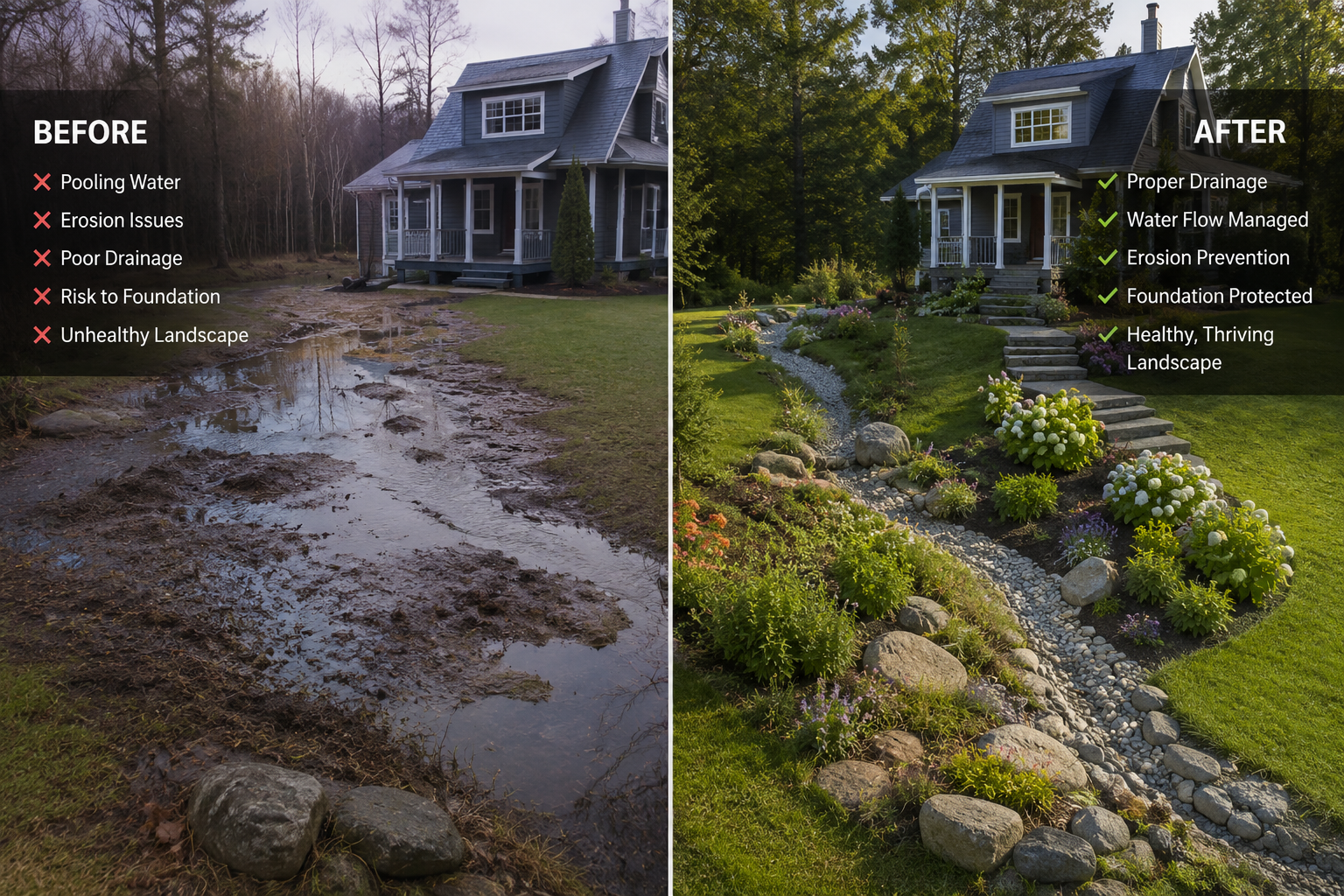
Transformative landscape drainage makeover

Your policy covers a burst pipe in your kitchen. It doesn't cover what happens when the Winooski swells, when spring melt converges with April rain, or when a nor'easter dumps eight inches in 24 hours. We've all watched neighbors pump out basements or lose first floors to water that came from above—not from within.

Standard homeowners insurance won't touch weather-related flooding. In Central Vermont, where many of us live near rivers, streams, and low-lying areas, this is less theoretical and more inevitable. You'll need a separate flood insurance policy—either through the National Flood Insurance Program or a private carrier. If your property is in a federally designated Special Flood Hazard Area, your lender will require it. But even if you're not required, the math is simple: the cost of a flood policy is a rounding error compared to the cost of a flooded home.

2. Damage from Neglect: The Slow Bleed

This one hits different in Vermont. Many of us own older homes—beautiful, character-filled Victorians and farmhouses that demand constant attention. The policy covers a tree that falls on your roof in a storm. It won't cover the roof that's been deteriorating for five years and finally leaks.

Here's the uncomfortable truth: procrastination is expensive. That pipe slowly leaking behind the basement wall? That attic moisture nobody addressed? That foundation issue you've been meaning to get looked at? Insurance treats these as self-inflicted wounds, and rightfully so. This is where the culinary training applies to real estate: preparation prevents problems. Maintenance isn't optional—it's the difference between owning a home and hemorrhaging money into one.

3. High-Value Items: Your Collections

Golden hour in a lush garden

You own that stunning landscape painting from a Vermont artist. The antique furniture passed down through generations. The vintage ski collection. The jewelry. Your policy's personal property coverage likely has a ceiling on what it will pay for individual items—and it's probably far below what you'd need to actually replace them.

A fire doesn't discriminate between priceless and replaceable. But your insurance policy does. If you own multiple valuable items, you need a scheduled personal property endorsement (or "rider"). It's straightforward: you list each item, get it appraised, and the insurer covers it at that value. It costs more, but it's the only way to protect what actually matters.

The Vermont Conversation

Here's what I've learned managing real estate across Washington, Lamoille, and Chittenden Counties: the best insurance policy is the conversation you have before you need it. Talk to your agent. Ask the hard questions. Be honest about what you own and where you live. Because in Vermont, where we pride ourselves on resilience and self-sufficiency, the irony is that we often wait too long to ask for help.

Don't be that neighbor.

Ready to Protect What Matters?

Whether you're buying, selling, or simply want to understand your property's true value and risk profile, let's talk. New England Landmark Realty knows Central Vermont's homes, its risks, and its rewards.

Call (802) 253-4711 Buyer's Guide

If You Want to Learn More

Start with these New England Landmark Realty resources:


May 30, 2026

Vermont Landscaping: The Brutal Math of Good Intentions

By New England Landmark Realty LTD

There's a particular optimism that strikes homeowners in spring. The snow melts. The earth softens. Suddenly, the yard feels full of possibility. You envision a landscape that whispers rather than shouts—something that fits Vermont's aesthetic without requiring you to become a horticulturist by June. Then reality arrives with the same force as mud season.

The problem isn't ambition. It's the gap between what looks good on Instagram and what actually survives a Vermont winter while staying manageable. That gap has killed more landscaping dreams than poor drainage and overwatering combined.

The Plant Problem: Choosing Beauty Over Biology

Here's the uncomfortable truth: the plants that look most appealing at the garden center often have no business in Central Vermont. They're seductive liars—beautiful in July, dead by February, expensive either way.

One of the most frequent mistakes homeowners make is selecting plants that don't fit the local climate. That ornamental cherry? Stunning for six weeks, then vulnerable to our late spring freezes and summer humidity. The dwarf boxwood from the fancy nursery? It'll sulk in our winters, demanding extra mulch, extra care, extra faith. They may look inviting at first, but they require extra water, constant vigilance, and eventual replacement when conditions turn against them.

Plants that naturally thrive in Vermont—native maples, serviceberry, hydrangeas built for cold climates, ornamental grasses that actually earn their place—are easier to maintain and more reliable over time. They're not as Instagram-friendly. That's their greatest strength.

Lush Vermont native garden with golden hour light filtering through serviceberry trees and hydrangeas

The math is simple: choose plants suited to your zone, and maintenance drops dramatically. Ignore local conditions, and you're paying a premium in time, money, and frustration for the next decade.

The Spacing Trap: Impatience as Expensive Habit

Every landscaper has seen this: a homeowner wants instant gratification. They plant densely, imagining a full, finished look on day one. What they get instead is a matted, overcrowded mess by year three.

Overplanting in the beginning is seductive because it promises immediate visual payoff. But as everything grows in—and in Vermont's growing season, things grow aggressively—you're stuck either watching your plants suffocate each other or spending weekends removing specimens you paid good money to install. It's landscaping's cruelest irony: success creates the problem.

Giving plants enough space from the start allows them to mature properly and reduces the need for constant trimming or removal later. A sparse-looking garden in year one feels like failure. A thriving, well-spaced garden in year five proves patience was the smarter investment. Nobody wants to hear that, but everyone regrets ignoring it.

The Maintenance Reckoning: Time as Your Most Limited Resource

This is where good intentions collide with reality. Some landscaping features look simple but demand relentless attention. Formal lawns require weekly mowing, edging, and fertilizing. Certain shrubs need annual pruning. Decorative stone pathways shift with frost heave and require constant maintenance. Water features need cleaning. Perennial beds need deadheading and division.

Most homeowners underestimate long-term maintenance because they don't think in those terms. They think in summers, not decades. The question isn't "How will this look when it's new?" It's "How will I feel about this task on a rainy Tuesday in August, seven years from now?"

Thinking realistically about how much time you want to spend on upkeep—and being honest about that number—can help guide better decisions. A low-maintenance yard isn't lazy design. It's honest design. It's acknowledging that your life includes more than lawn care, and your landscaping should reflect that.

The Drainage Disaster: Invisible Consequences

Water movement is not always top of mind when designing a yard, but it plays a major role in how the space functions. Poor drainage is the silent killer of Vermont landscaping. Standing water in spring leads to root rot. Erosion washes away topsoil and exposes foundation issues. Ice dams form in unexpected places. Plants that should thrive suddenly wilt because their feet are perpetually wet.

Vermont yard showing transformative landscape drainage makeover with proper grading and water management

Most homeowners skip proper drainage planning because they can't see the problem until it manifests. By then, you're digging up mature plants, installing French drains, and wondering why you didn't think about water flow in year one. Planning for how water flows through your yard—particularly in Vermont, where we get snow melt, spring rains, and occasional deluges—prevents these costly cascades.

The Aesthetic Chaos: When More Becomes Less

Too many homeowners treat their yard like a design catalogue. A little cottage style here. Some contemporary minimalism there. A dash of ornamental Japanese aesthetic. It sounds sophisticated until you're standing in a space that feels like aesthetic whiplash—disconnected, chaotic, and exhausting to maintain.

Mixing too many styles at once leads to a yard that's harder to maintain and less cohesive. You need different materials, different plant palettes, different maintenance protocols. Every design choice adds complexity. Simplicity, by contrast, is elegant and manageable. A cohesive design—whether it's all native plantings, or a clean contemporary aesthetic, or a traditional New England cottage garden—allows you to maintain the space with intention rather than exhaustion.

The Use Case Problem: Beauty Without Function

A yard that looks good but doesn't match how it's actually used becomes a source of daily frustration. Large planting beds that make movement awkward. Decorative features that don't serve any purpose except to be maintained. Paths that lead nowhere. Layouts that force you to negotiate your own space rather than move through it naturally.

Designing with function in mind—thinking about how you actually use the space, where people naturally walk, what serves your lifestyle rather than a designer's vision—ensures the space works as well as it looks.

The Vermont Approach: Intention Over Impulse

Landscaping decisions don't need to be complicated to be effective. But they do need to be honest. Choose plants that thrive in your zone. Space them properly. Accept that maintenance requires time and plan accordingly. Think about water flow before you have a problem. Keep your design simple and cohesive. Build the yard around how you actually live, not how you imagine you'll live.

By avoiding a few common mistakes and planning with the long term in mind—which in Vermont means thinking in terms of frost heaves, mud season, and the realities of year-round weather—you can create an outdoor space that feels intentional, manageable, and genuinely enjoyable year after year.

The best Vermont landscapes aren't the ones that look perfect in spring. They're the ones you still love tending in October.

Ready to Invest in Your Vermont Property?

A beautiful landscape increases your home's value and your quality of life. Whether you're planning improvements before selling or designing for long-term enjoyment, we're here to help you make smart decisions about your property.

Schedule Your Property Consultation
Posted in Home Selling Tips
May 29, 2026

The Vermont Down Payment Reality: Why Your Neighbor's Equity Isn't Your Starting Point

By New England Landmark Realty LTD

Vermont home in spring with forest surroundings

There's a particular cruelty baked into real estate's arithmetic. Repeat buyers arrive at the table with ammunition—equity from the last property, a down payment that doesn't require dividing their life savings into quarters. First-time buyers? We start at zero, which in Vermont's market means saving for years while watching prices drift north like smoke from a woodstove.

The math is unforgiving. The national median sits around $415,000. Ten percent down? That's $41,500. In Central Vermont, where we're seeing move-up prices in the $385,000 to $550,000 range depending on whether you want views or proximity to Stowe, the equation doesn't change—it just feels more personal. A LendingTree study from March 2026 confirms what we see in our office: first-time buyers are averaging 13.8% down ($55,471), while repeat buyers waltz in with 22.8% ($119,270). That gap isn't just a number. It's the difference between sleeping well and sleeping lightly.

Here's the uncomfortable truth: 30.5% of first-time buyers are putting down less than 10%. They're not taking the optimal path. They're taking the only path available to them.

The 20% Threshold: Where the Game Actually Changes

Comparison of mortgage stress versus financial clarity

This is where theory meets Vermont practicality. If you can reach 20%, three things happen simultaneously:

First, you evade private mortgage insurance—that invisible tax on being less than wealthy. PMI runs $90 to $210 monthly on a $300,000 mortgage. Over 30 years, that's a second property tax on your aspirations. At 20% down, it vanishes.

Second, your interest rate drops. Not by a quarter-point. By actual, measurable basis points that compound into real savings. Your lender sees you as someone with skin in the game, not someone betting with house money.

Third, you build equity from day one, not day 3,650. Equity is the gravitational force of real estate—the gap between what you owe and what your property is worth. A $415,000 home with $300,000 owed means $115,000 in equity. That equity becomes leverage for your life. It's collateral for education, emergencies, or the next property up the chain.

The Honest Path Forward

Twenty percent is the ideal. It's also increasingly fantasy for the average buyer. But here's what's achievable: 10-15% is within reach for disciplined savers, and every percentage point matters. It's the difference between a sustainable mortgage and a weight around your neck.

In Central Vermont, where community matters and roots run deep, the right property at a sustainable price point beats the aspirational property at a price that haunts you. Save aggressively. Buy thoughtfully. Build equity methodically.

The long game beats the down payment every time.

Ready to Build Your Vermont Future?

Whether you're saving for that first 10% or strategizing how to reach 20%, the right guidance changes everything. Central Vermont's market moves fast. Your down payment strategy shouldn't.

Schedule Your Down Payment Consultation

The Vermont Down Payment Reality: Why Your Neighbor's Equity Isn't Your Starting Point

Vermont home in spring with forest surroundings

There's a particular cruelty baked into real estate's arithmetic. Repeat buyers arrive at the table with ammunition—equity from the last property, a down payment that doesn't require dividing their life savings into quarters. First-time buyers? We start at zero, which in Vermont's market means saving for years while watching prices drift north like smoke from a woodstove.

The math is unforgiving. The national median sits around $415,000. Ten percent down? That's $41,500. In Central Vermont, where we're seeing move-up prices in the $385,000 to $550,000 range depending on whether you want views or proximity to Stowe, the equation doesn't change—it just feels more personal. A LendingTree study from March 2026 confirms what we see in our office: first-time buyers are averaging 13.8% down ($55,471), while repeat buyers waltz in with 22.8% ($119,270). That gap isn't just a number. It's the difference between sleeping well and sleeping lightly.

Here's the uncomfortable truth: 30.5% of first-time buyers are putting down less than 10%. They're not taking the optimal path. They're taking the only path available to them.

The 20% Threshold: Where the Game Actually Changes

Comparison of mortgage stress versus financial clarity

This is where theory meets Vermont practicality. If you can reach 20%, three things happen simultaneously:

First, you evade private mortgage insurance—that invisible tax on being less than wealthy. PMI runs $90 to $210 monthly on a $300,000 mortgage. Over 30 years, that's a second property tax on your aspirations. At 20% down, it vanishes.

Second, your interest rate drops. Not by a quarter-point. By actual, measurable basis points that compound into real savings. Your lender sees you as someone with skin in the game, not someone betting with house money.

Third, you build equity from day one, not day 3,650. Equity is the gravitational force of real estate—the gap between what you owe and what your property is worth. A $415,000 home with $300,000 owed means $115,000 in equity. That equity becomes leverage for your life. It's collateral for education, emergencies, or the next property up the chain.

The Honest Path Forward

Twenty percent is the ideal. It's also increasingly fantasy for the average buyer. But here's what's achievable: 10-15% is within reach for disciplined savers, and every percentage point matters. It's the difference between a sustainable mortgage and a weight around your neck.

In Central Vermont, where community matters and roots run deep, the right property at a sustainable price point beats the aspirational property at a price that haunts you. Save aggressively. Buy thoughtfully. Build equity methodically.

The long game beats the down payment every time.

Ready to Build Your Vermont Future?

Whether you're saving for that first 10% or strategizing how to reach 20%, the right guidance changes everything. Central Vermont's market moves fast. Your down payment strategy shouldn't.

Schedule Your Down Payment Consultation

New England Landmark Realty | Central Vermont's Premier Advisors

Posted in Home Buying Tips