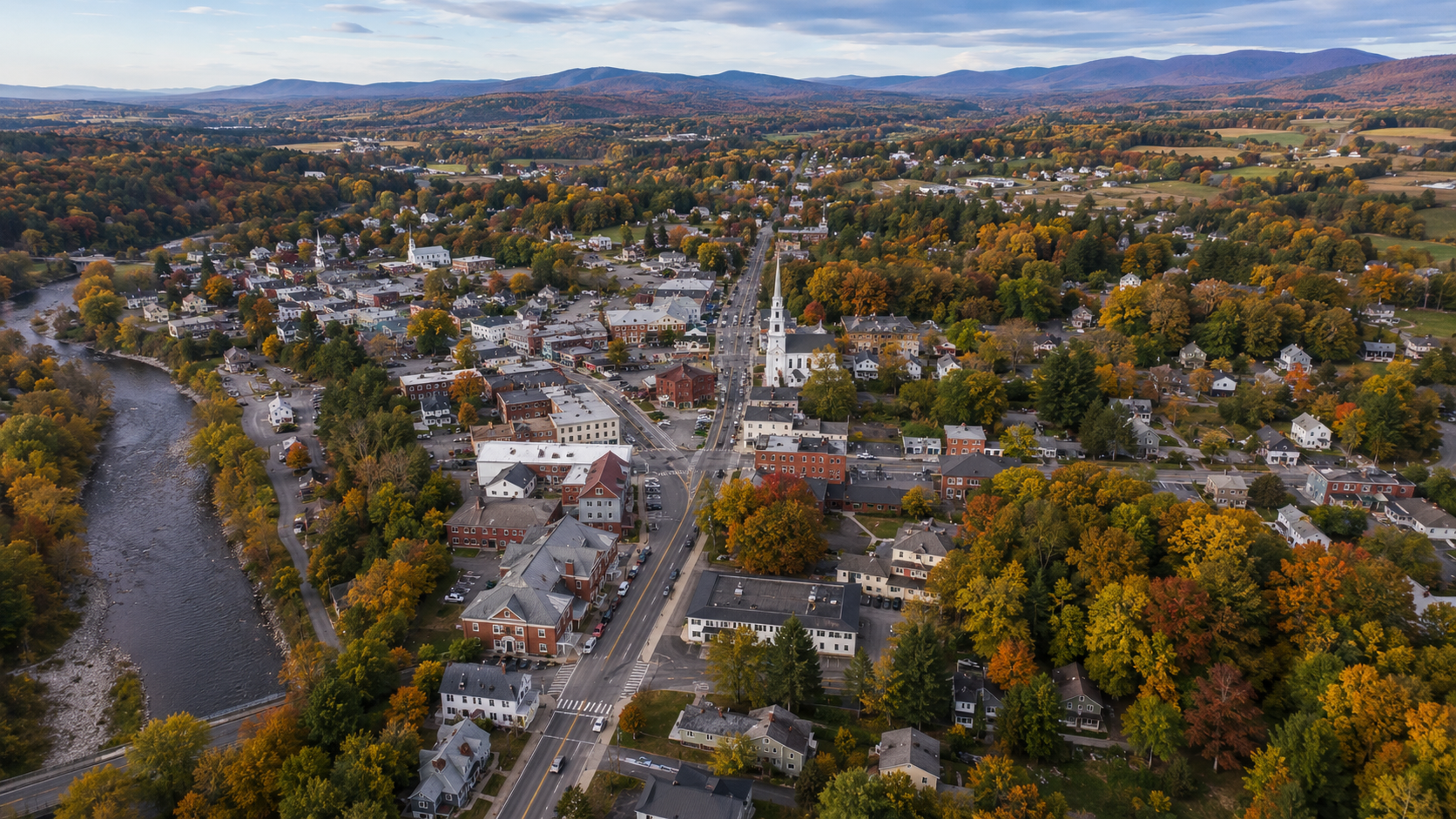
New England Landmark Realty covers the Vermont real estate market 

from the inside — market data, buyer strategy, seller timing, land 

use regulation, and the policy decisions shaping what homes cost and 

who can afford them.


Tony Walton has been working Vermont real estate since 1978. 

The analysis here reflects that depth.


Browse by topic below, or use the search to find what you need.

May 29, 2026

The Vermont Down Payment Reality: Why Your Neighbor's Equity Isn't Your Starting Point

By New England Landmark Realty LTD

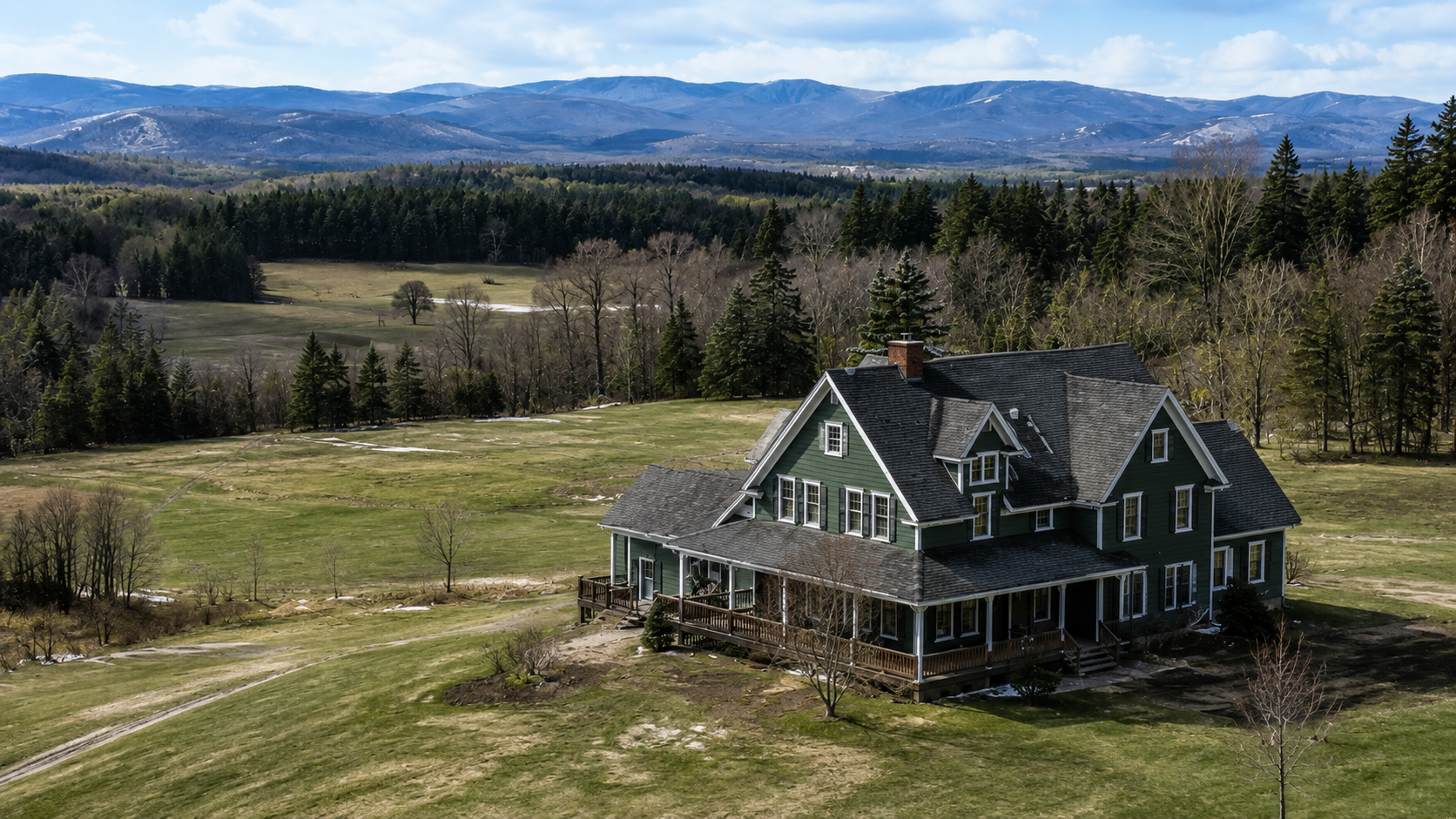
Vermont home in spring with forest surroundings

There's a particular cruelty baked into real estate's arithmetic. Repeat buyers arrive at the table with ammunition—equity from the last property, a down payment that doesn't require dividing their life savings into quarters. First-time buyers? We start at zero, which in Vermont's market means saving for years while watching prices drift north like smoke from a woodstove.

The math is unforgiving. The national median sits around $415,000. Ten percent down? That's $41,500. In Central Vermont, where we're seeing move-up prices in the $385,000 to $550,000 range depending on whether you want views or proximity to Stowe, the equation doesn't change—it just feels more personal. A LendingTree study from March 2026 confirms what we see in our office: first-time buyers are averaging 13.8% down ($55,471), while repeat buyers waltz in with 22.8% ($119,270). That gap isn't just a number. It's the difference between sleeping well and sleeping lightly.

Here's the uncomfortable truth: 30.5% of first-time buyers are putting down less than 10%. They're not taking the optimal path. They're taking the only path available to them.

The 20% Threshold: Where the Game Actually Changes

Comparison of mortgage stress versus financial clarity

This is where theory meets Vermont practicality. If you can reach 20%, three things happen simultaneously:

First, you evade private mortgage insurance—that invisible tax on being less than wealthy. PMI runs $90 to $210 monthly on a $300,000 mortgage. Over 30 years, that's a second property tax on your aspirations. At 20% down, it vanishes.

Second, your interest rate drops. Not by a quarter-point. By actual, measurable basis points that compound into real savings. Your lender sees you as someone with skin in the game, not someone betting with house money.

Third, you build equity from day one, not day 3,650. Equity is the gravitational force of real estate—the gap between what you owe and what your property is worth. A $415,000 home with $300,000 owed means $115,000 in equity. That equity becomes leverage for your life. It's collateral for education, emergencies, or the next property up the chain.

The Honest Path Forward

Twenty percent is the ideal. It's also increasingly fantasy for the average buyer. But here's what's achievable: 10-15% is within reach for disciplined savers, and every percentage point matters. It's the difference between a sustainable mortgage and a weight around your neck.

In Central Vermont, where community matters and roots run deep, the right property at a sustainable price point beats the aspirational property at a price that haunts you. Save aggressively. Buy thoughtfully. Build equity methodically.

The long game beats the down payment every time.

Ready to Build Your Vermont Future?

Whether you're saving for that first 10% or strategizing how to reach 20%, the right guidance changes everything. Central Vermont's market moves fast. Your down payment strategy shouldn't.

Schedule Your Down Payment Consultation

The Vermont Down Payment Reality: Why Your Neighbor's Equity Isn't Your Starting Point
Vermont home in spring with forest surroundings

There's a particular cruelty baked into real estate's arithmetic. Repeat buyers arrive at the table with ammunition—equity from the last property, a down payment that doesn't require dividing their life savings into quarters. First-time buyers? We start at zero, which in Vermont's market means saving for years while watching prices drift north like smoke from a woodstove.

The math is unforgiving. The national median sits around $415,000. Ten percent down? That's $41,500. In Central Vermont, where we're seeing move-up prices in the $385,000 to $550,000 range depending on whether you want views or proximity to Stowe, the equation doesn't change—it just feels more personal. A LendingTree study from March 2026 confirms what we see in our office: first-time buyers are averaging 13.8% down ($55,471), while repeat buyers waltz in with 22.8% ($119,270). That gap isn't just a number. It's the difference between sleeping well and sleeping lightly.

Here's the uncomfortable truth: 30.5% of first-time buyers are putting down less than 10%. They're not taking the optimal path. They're taking the only path available to them.

The 20% Threshold: Where the Game Actually Changes

Comparison of mortgage stress versus financial clarity

This is where theory meets Vermont practicality. If you can reach 20%, three things happen simultaneously:

First, you evade private mortgage insurance—that invisible tax on being less than wealthy. PMI runs $90 to $210 monthly on a $300,000 mortgage. Over 30 years, that's a second property tax on your aspirations. At 20% down, it vanishes.

Second, your interest rate drops. Not by a quarter-point. By actual, measurable basis points that compound into real savings. Your lender sees you as someone with skin in the game, not someone betting with house money.

Third, you build equity from day one, not day 3,650. Equity is the gravitational force of real estate—the gap between what you owe and what your property is worth. A $415,000 home with $300,000 owed means $115,000 in equity. That equity becomes leverage for your life. It's collateral for education, emergencies, or the next property up the chain.

The Honest Path Forward

Twenty percent is the ideal. It's also increasingly fantasy for the average buyer. But here's what's achievable: 10-15% is within reach for disciplined savers, and every percentage point matters. It's the difference between a sustainable mortgage and a weight around your neck.

In Central Vermont, where community matters and roots run deep, the right property at a sustainable price point beats the aspirational property at a price that haunts you. Save aggressively. Buy thoughtfully. Build equity methodically.

The long game beats the down payment every time.

Ready to Build Your Vermont Future?

Whether you're saving for that first 10% or strategizing how to reach 20%, the right guidance changes everything. Central Vermont's market moves fast. Your down payment strategy shouldn't.

Schedule Your Down Payment Consultation

New England Landmark Realty | Central Vermont's Premier Advisors

Posted in Home Buying Tips
May 27, 2026

Vermont Doesn’t Have Demand Destruction. It Has Mobility Destruction.

NELR Edge | Vermont Real Estate Perspective


Tony Walton

And for buyers waiting for “next year,” the last six years have delivered the same insult in different packaging: higher prices, higher payments, or both.

Jump to Key Takeaways

This piece is for Vermont buyers, sellers, and homeowners trying to make better decisions in a market that feels tight, expensive, and strangely frozen. It helps readers separate weak demand from trapped movement so they can act with clearer timing, pricing discipline, and expectations.

Vermont’s housing market is not broken because people stopped wanting Vermont. Quite the opposite. Too many people want in, too few homes exist, and almost nobody already inside the velvet rope wants to give up their spot. That’s not demand destruction. That’s mobility destruction.

National economists like to describe housing in antiseptic terms: affordability, rates, supply, consumer sentiment. Fine. In Vermont, the better phrase is simpler: the market is clogged. Renters can’t become buyers. Older owners can’t downsize without torching their balance sheet. Employers can’t recruit because workers can’t find a place to live. Builders still can’t produce enough housing fast enough to change the math. Vermont doesn’t have a housing cycle. It has a housing traffic jam.

Key Takeaways

If You Only Remember 3 Things

  • Vermont’s core housing problem is frozen movement, not disappearing demand.
  • Buyers who keep waiting for a cleaner, cheaper year have usually paid for the delay one way or another.
  • Sellers still benefit from scarcity, but pricing and presentation now matter more than they did in the frenzy years.

Quick Facts

  • Vermont still needs a significant increase in year-round housing to approach a healthier market balance.
  • The path from renter to owner has narrowed sharply, especially for working households trying to save while rents stay elevated.
  • Movement has slowed at every stage of the ladder: first-time buyers, downsizers, employers, and new arrivals all feel it.

And unlike traffic, this one doesn’t clear after rush hour.

The state needs tens of thousands of additional homes over the next several years just to approach something resembling a healthy market. Vacancy remains painfully low. In some parts of Vermont, finding housing feels less like shopping and more like competing in a reality show where the prize is a 1978 cape with a damp basement and “good bones.” The result is a market where ordinary life events — getting married, having a kid, taking a new job, getting divorced, retiring — become real estate crises.

That’s what makes Vermont different from the national story. In much of the country, higher rates slowed demand. In Vermont, higher rates mostly slowed movement. People still want homes. They still want these towns, these school districts, this version of life. But wanting and transacting are no longer close cousins. They’re distant relatives who only see each other at funerals.

The hardest truth for buyers is also the least fashionable one: waiting has not been a winning strategy. Since 2019, buyers who decided to “wait until next year” have usually been rewarded with the financial equivalent of a kick to the ribs. If you waited in 2019, you likely paid more in 2020. If you waited in 2020, you almost certainly paid more in 2021. If you waited in 2021, you walked into higher prices and then got clotheslined by higher rates. If you waited in 2025 hoping 2026 would finally be your year, congratulations — you are now shopping in a market where prices are still stubborn, financing is still expensive, and supply is still too thin.

This is not an argument for panic. Panic is for crypto traders and cable news producers. It is an argument for realism. In a structurally undersupplied market, delay is not neutral. It has a cost. Sometimes that cost shows up in sticker price. Sometimes it shows up in monthly payment. Sometimes it shows up in spending another year renting while the down payment target runs away from you like a Labrador off-leash in Stowe.

And Vermont has been especially cruel on that front. The path from renter to owner has narrowed so dramatically it barely qualifies as a path anymore. For a lot of working households, homeownership here has shifted from “hard” to “theoretically possible in the same way becoming an astronaut is theoretically possible.” That is not just a housing problem. It is a social stability problem, a workforce problem, and eventually a political problem.

Sellers, meanwhile, should resist the fantasy that scarcity means they can list anything at any number and wait for the applause. Vermont is still supply-constrained, yes. But buyers in 2026 are not the same buyers from the caffeine-and-carnage years of 2021 and 2022. They are more skeptical, more payment-sensitive, more informed, and less willing to pay a premium for your nostalgia. A market with limited inventory is not the same thing as a market with unlimited patience. Buyers will still pay for quality, location, land, and scarcity. They are less enthusiastic about paying extra for your unfinished mudroom manifesto and “potential.”

That’s the real shift. Vermont remains desirable, but desire now travels with a calculator. Buyers still want in; they’re just no longer willing to cosplay as venture capitalists to get there. They want value, concessions, clarity, and a reason to stretch. If they don’t see one, they hesitate. If enough buyers hesitate, transactions slow. And when transactions slow in a supply-starved state, the market starts to feel dead even while prices keep floating above common sense.

That contradiction is exactly why “demand destruction” is the wrong phrase. Demand hasn’t disappeared. It has been throttled. Choked by too little supply, too much financial friction, too much aging stock, too little turnover, and a policy framework that spent years protecting Vermont from growth with all the unintended elegance of a moat around a bakery. Wonderful if you’re already inside. Frustrating if you’re hungry.

The part we should say out loud — especially here in Vermont — is that this isn’t just about buyers being impatient or sellers being greedy. The system itself is producing the paralysis. Older homeowners often stay put because moving smaller would cost as much or more than staying larger. Renters can’t save because rent consumes what should have become down payment money. Young families can’t find entry-level homes because too few exist. Employers can’t fill jobs because workers can’t find places to live within reasonable distance. Everyone behaves rationally, and the combined result is absurd.

That’s mobility destruction: a market where nobody’s decision is crazy, but the final outcome is.

The encouraging news, if you want some, is that Vermont at least seems to have recognized the obvious: you cannot solve a housing shortage with nostalgia. You need more homes. Not more speeches about homes. More homes. More village housing. More infill. More conversions. More ADUs. More places for teachers, nurses, carpenters, servers, young families, and downsizing retirees to land without having to win a knife fight behind a general store.

But until supply arrives in meaningful volume, buyers should stop confusing patience with prudence. The last six years have not been kind to that bet. In Vermont housing, waiting has often felt responsible right up until the moment it became expensive.

So here’s the straight shot: Vermont doesn’t have demand destruction. It has mobility destruction. The market isn’t collapsing. It’s constipated. Buyers who keep waiting for a cheaper tomorrow should understand that “next year” has been a very expensive country to live in. Sellers should understand that scarcity is still an advantage, but no longer an excuse. And policymakers should understand that housing is not adjacent to economic development in Vermont.

It is economic development.

If we want this state to remain a place where people can build a life instead of just admire one from Zillow, we need to stop treating housing like a side issue. Because the future of Vermont will be decided, in no small part, by who can still afford to stay, who can still afford to come, and who gets tired of waiting.

Sources

Talk strategy before you talk yourself into waiting another year.

If you’re buying, selling, downsizing, or trying to understand where Vermont’s market is actually headed, Tony Walton and New England Landmark Realty can help you cut through the noise and make a cleaner decision.

New England Landmark Realty

Toll-Free (866) 324-2427
Tony’s Cell (802) 233-4107
May 22, 2026

Vermont Still Wants More Housing. It Just Can’t Agree on Where the Pain Goes.

New England Landmark Realty | Vermont Land Use & Real Estate


The state’s center-growth strategy is alive, but Tier 3 has become a political fight over land, control, and who pays for reform.

By Tony Walton | May 1, 2026

Jump to Key Takeaways

Most Vermonters still aren’t paying attention to Act 181. That’s understandable. “Location-based jurisdiction” sounds like something invented by a consultant who bills by the syllable. But beneath the jargon is a simple truth: Vermont is still trying to decide where people should live, where housing should go, and how much friction the state should put between landowners and a building permit.

Last fall, the story looked straightforward. Vermont was moving toward a two-part future: make it easier to build in places with sidewalks, sewer, water, and services — and make it harder to build in sensitive rural landscapes through a new Tier 3 regime. That was the theory. It was clean. Elegant, even. Very Vermont: growth in the village, restraint in the hills.

Key Takeaways

Two-Sentence Summary

For Vermont buyers, sellers, landowners, and local decision-makers, this piece helps translate Act 181 from policy fog into market meaning. It clarifies what changed by May 1, 2026 so you can make smarter decisions about timing, property value, and where future growth is most likely to land.

If You Only Remember 3 Things

  • Tier 3 is no longer a clean inevitability; by late April 2026, it had shifted into legislative uncertainty and suspended rulemaking.
  • Vermont’s push to steer housing toward compact, serviced places is already active through interim Act 250 exemptions.
  • Local zoning still decides whether state reform produces actual housing or just another stack of policy paper.

Quick Facts

  • Interim housing exemptions are already shaping where some projects can move faster.
  • Tier 1B and Tier 1A implementation remains a staged rollout, not an overnight switch.
  • The road rule and broader rural review framework are politically less settled than they looked in 2025.

But policy, like spring mud, has a way of swallowing clean boots.

As of this May 1, 2026 update, the most important news is this: Tier 3 is no longer rolling forward as expected. The official Act 250 site now says the Land Use Review Board has suspended further work on Tier 3 because the Legislature has indicated it plans to repeal that portion of Act 181. The same page notes that the Senate version of S.325 would have pushed the Tier 3 effective date to June 30, 2028, but the House Environment Committee signaled on April 14 that it intended to revise the bill and repeal Tier 3 outright. That is not a tweak. That is a political U-turn.

So let’s say the quiet part out loud: the grand bargain behind Act 181 is no longer intact. Vermont still wants more housing in and around its compact centers. But the part of the law aimed at imposing a broad new layer of state review over critical natural resource areas is now under active legislative assault. The “grow inward” half is alive. The “lock down more rural land” half is suddenly on trial.

That doesn’t mean nothing is happening. Quite the opposite. The state is already moving real projects through interim housing exemptions that are very much in force right now. Those exemptions let certain housing developments bypass Act 250 review in designated downtowns, village centers, growth centers, and related smart-growth areas while the long-term system is still being built. Unlimited units are allowed for some priority housing and downtown projects through January 1, 2027. Some designated growth-area projects can go up to 75 units. Some village-center projects can go to 50. Commercial-to-residential conversions can qualify statewide through July 1, 2028. And some hotel or motel conversions to permanently affordable housing are permanently exempt. That is not philosophical drift. That is real policy with real market consequences.

In other words, the state is still putting its thumb on the scale. Not everywhere. Not all at once. But unmistakably. If your land sits where Vermont wants growth — places with infrastructure, jobs, walkability, and municipal support — the regulatory weather is better than it used to be. If your land sits in the romantic geography of rural Vermont, the picture is murkier than it looked six months ago: not because Tier 3 arrived, but because it may not arrive in anything like its original form.

That’s the real update for landowners: uncertainty has replaced inevitability. In late 2025, it was fair to think Vermont had chosen a durable path toward tighter rural scrutiny. In spring 2026, it looks more like a policy experiment that ran headfirst into the reality of politics, property rights, mapping disputes, and the always combustible question of who gets to tell a Vermonter what can happen on his or her land.

The other thing your neighbors probably still don’t realize is how incomplete the long-term map remains. Even on the pro-housing side, the much-discussed tiered framework is not dropping from the sky tomorrow like stone tablets from Montpelier. April 2026 testimony to the House says initial Tier 1B mapping is expected by the end of 2026, with additional Tier 1B areas likely later as municipalities opt in. Tier 1A, the category that can exempt all projects from Act 250, is expected to begin later still, with the first applications anticipated in late 2026 and more likely in 2027 and 2028 after regional plans are approved and local bylaws are brought into line. Translation: the architecture is real, but a lot of the walls are still studs.

Which brings us to the point almost nobody in government likes to emphasize: local zoning is still the choke point. You can streamline Act 250. You can draw elegant future land use maps. You can host public meetings full of words like resilience, vitality, equity, and compact settlement patterns. But if a town’s local process still means death by hearing, redesign, parking math, setbacks, neighbor panic, and bureaucratic trench warfare, then the state has not created housing. It has created a theory of housing.

That’s why the towns matter more than ever. The state can point the compass. It can sweeten the deal. It can reduce friction in designated areas. But municipalities still control whether new housing gets processed like a public necessity or treated like a home invasion. Until that changes, the biggest bottleneck in Vermont housing will not be a state map. It will be local appetite.

There’s also another wobble in the system: the so-called road rule. Act 181’s modernization framework included a new jurisdictional trigger based on road and driveway length in Tier 2 areas — a way to discourage scattered development patterns that fragment land. But that, too, is now unstable. The Board’s own materials show the road-construction piece tied up in the same broader legislative reconsideration surrounding S.325. So one of the state’s clearest anti-sprawl tools may be delayed, diluted, or dumped. Vermont is not abandoning the argument against sprawl. It is discovering that operationalizing that argument is harder than writing it into a PowerPoint.

So where does that leave us?

It leaves Vermont in a familiar place: ambitious in theory, conflicted in practice, and still trying to solve a housing crisis without offending either its landscape or its self-image. We want more homes, but not everywhere. We want thriving villages, but not too much change. We want to protect the countryside, but not if the maps get too close to somebody’s driveway. We want reform, but only the kind that doesn’t feel like reform.

For buyers, sellers, developers, and rural landowners, the message is simple: don’t use late-2025 assumptions to make mid-2026 decisions. The direction of travel still favors growth in serviced centers. That much is clear. But the state’s attempt to pair that with a broad, new Tier 3 overlay is no longer a done deal. If you own rural land, the threat is less immediate than it looked. If you own or control land in or near a growth area, the opportunity is more concrete than most people realize.

The bottom line is this: Vermont’s land-use revolution is still happening — just not in the neat, linear way its architects imagined. The market signal remains. The village-and-center strategy remains. The housing push remains. But the rural-regulation side of the equation has slipped from “inevitable” to “contested.” And in a state like Vermont, contested can last a very long time.

Where to Go Next

If this issue lands close to home, these are the next pages worth opening. They give buyers and sellers the practical layer that usually gets lost when policy talk starts sounding like a graduate seminar in land-use theology.

Need a straight answer?

Talk to Tony Walton about how Act 181 may affect your move, your land, or your timing.

If you’re buying, selling, or weighing the future of rural land in Vermont, policy noise is expensive. A grounded read on the rules — and where they may actually be headed — can save time, money, and a lot of false confidence.

Website: www.nelandmark.com

Contact New England Landmark Realty

May 21, 2026

Cool Appliances vs. Smart Kitchens: What Actually Changes How You Cook


(and What Just Looks Good)

Walk into any kitchen showroom in Vermont and you'll see the theater. Gleaming induction cooktops. Range hoods that look like art installations. Appliances with more buttons than a 747 cockpit. Walk into a hundred homes for sale in Central Vermont and you'll see something different: kitchens where half the gear never gets used, where the range hood fights with the stove, where buyers stand there wondering if they're about to inherit someone else's expensive hobby.

Here's the truth a chef learns in year two and a broker learns in year five: the kitchen that photographs best is rarely the kitchen that cooks best. What moves the needle isn't the appliance that looks good on Instagram—it’s the appliance that changes how you actually work, every single day. Induction cooktops, properly sized range hoods, and real storage don't glamorize a kitchen. They liberate it.

Key Takeaways

If You Only Remember 3 Things

  • Induction cooktops cook faster and cleaner than gas, but only if your cookware cooperates and your electrician isn't overwhelmed. Vermont contractors are booked; factor 4–6 weeks for install and budget $3K–$6K.
  • Range hood sizing is a formula, not a guess. A hood that's too small pulls grease into your drywall; one that's too big creates negative pressure and costs more to run. Get it wrong and you've spent $2K on a $400 problem.
  • Drawer storage beats open shelving in Vermont's humidity. Your cast iron and dry goods deserve closed storage; open shelves look great for two months, then collect dust and moisture. Real kitchens have real pantries.

Why This Matters

Getting appliance choice wrong costs money three ways: renovation dollars wasted on gear you'll use twice, buyer disappointment when the kitchen doesn't cook the way they imagined, and years of frustration using a kitchen designed for looks instead of labor. Vermont kitchens are working kitchens.

You're either a buyer standing in someone's $120K kitchen renovation wondering why the stove feels cramped, or a homeowner who dropped forty grand on appliances and now can't sell the house because your dream kitchen isn't anyone else's. Both are preventable. The appliances that matter aren't the ones that feel luxurious—they're the ones that disappear into the rhythm of your day because they work.

A bad cooktop wastes heat and time. A bad range hood either fails silently (grease settles into your walls) or fails loudly (constant fan noise that drives you insane). Bad storage makes you hate your kitchen before breakfast. These aren't aesthetic choices. They're functional choices that determine whether you want to cook at home or order takeout for a decade.

The Induction Question

Induction cooktops heat faster, use less energy, and give you precision gas stoves can't match. But they require magnetic cookware, demand serious electrical work, and depend on Vermont contractors who are already booked through summer. Budget $3K–$6K installed and expect a four- to six-week wait.

Here's what induction does: It heats a pot in two minutes instead of five. It lets you simmer at 200 degrees without guessing. It cools instantly when you turn it off (no lingering heat). It doesn't fill your kitchen with combustion byproducts. If you cook seriously—stocks, braises, anything that benefits from precision—induction changes your life.

Here's what it doesn't do: It doesn't work with non-magnetic cookware. That means if you have a collection of copper-bottomed pans or aluminum, they're paperweights. You'll need to replace them. Test your existing gear with a magnet first; if the magnet doesn't stick, the pan won't work on induction. Factor an additional $500–$1,500 for cookware if you're starting from scratch.

The Vermont reality: Finding an electrician to run the 240-volt circuit you'll need is harder than finding a good marinara in March. Your kitchen may not have the capacity. Older homes especially. Call your electrician before you fall in love with an induction cooktop. That conversation costs nothing and could save you from buying a $4K appliance you can't install.

The trade-off to know: Gas stoves recover heat faster if you're juggling multiple pans on high heat (which is rare at home, but worth mentioning). Induction is superior for home cooking in almost every other scenario. If you entertain constantly and you're moving large volumes of liquid, gas may still serve you better. Everyone else should test induction before dismissing it.

Side-by-side comparison of induction cooktop with precise heat distribution and traditional gas range with diffuse flame
Induction (left) concentrates heat into the pot with precision; gas (right) diffuses heat across a wider surface. Induction wins for speed and efficiency—if your cookware is compatible.

Range Hoods: The Unglamorous Truth

Range hood sizing is governed by a simple formula: cooktop BTU output ÷ 100 = minimum CFM (cubic feet per minute). Get this wrong and either grease settles into your drywall or your fan runs so loud you can't hear the person next to you. Most kitchens get this catastrophically wrong.

Your stovetop generates heat and steam. A range hood's job is to capture that and move it outside. Oversized hoods (which look impressive) pull air from the entire kitchen, creating negative pressure that can backdraft your gas stove or pull heated air out of your home (read: higher heating bills in Vermont). Undersized hoods don't capture grease, which means it settles on your cabinets, walls, and range. Then you spend $2,000 cleaning bills and cabinet refinishing on top of the $2,000 hood you bought that wasn't doing its job.

The formula: Multiply your cooktop's BTU output by 1.25 (if the hood will be vented to the outside through a wall) or by 1.5 (if it's vented through the attic or soffit, which is less efficient). Divide that by 100 to get your CFM requirement. A 48-inch commercial-style cooktop putting out 180,000 BTU needs roughly 2,250–2,700 CFM. Most residential hoods top out at 600–1,200 CFM. Reality check: Is your new hood actually sized for your cooktop, or are you buying a hood that looks like it belongs there?

Noise is the invisible tax on oversized hoods. A hood running at 1,200 CFM sounds like a small airplane. At 600 CFM (properly sized), it's nearly silent. This matters if you cook and talk at the same time (which is what cooking actually is). Vermont kitchens are often open to living spaces. A roaring hood will drive everyone out of the room.

The Vermont detail: If you're venting through the roof or soffit (common in older homes where exterior walls are thick), you're losing efficiency. Outside, humid, cold air will be pulled back into your attic if the damper isn't sealed properly. Hire someone who knows New England climate to size and install your hood, not someone guessing.

Kitchen interior showing oversized range hood that visually dominates the space above cooktop
An oversized hood might impress on the showroom floor, but it creates negative pressure, wastes energy, and drives everyone out of the kitchen when you turn it on. Function over form.

Storage That Works

Drawer storage beats open shelving in Vermont's climate and lifestyle. Open shelves are Instagram-perfect for two months; after that, they collect dust, humidity, and the evidence that you're actually cooking. Real kitchens have real pantries with doors.

Vermont's humidity is real. From April through October, your kitchen is basically a greenhouse. Open shelves mean your spices lose potency, your flour attracts moisture, and your cookbooks start to warp. Closed drawers and cabinet storage keep everything stable. If you're preserving vegetables (which you should be doing if you live here), you need pantry space—real pantry space with shelving, not open shelving where jars collect dust.

Deep drawers (12–18 inches) beat shallow cabinets for everyday cooking. You can find a spatula in a deep drawer organized by category. In a shallow cabinet, you're digging through chaos. Drawer dividers cost $40 and change your life. If you're renovating, ask your contractor about soft-close drawers with full-extension slides; they're worth the premium.

The Vermont reality: You're storing root vegetables, preserves, backup freezer goods, and equipment for seasonal cooking (canning jars, food mill, etc.). You need volume. Open shelving looks beautiful in a styled photo shoot. In practice, it's visual noise and a dust trap. Close that kitchen up.

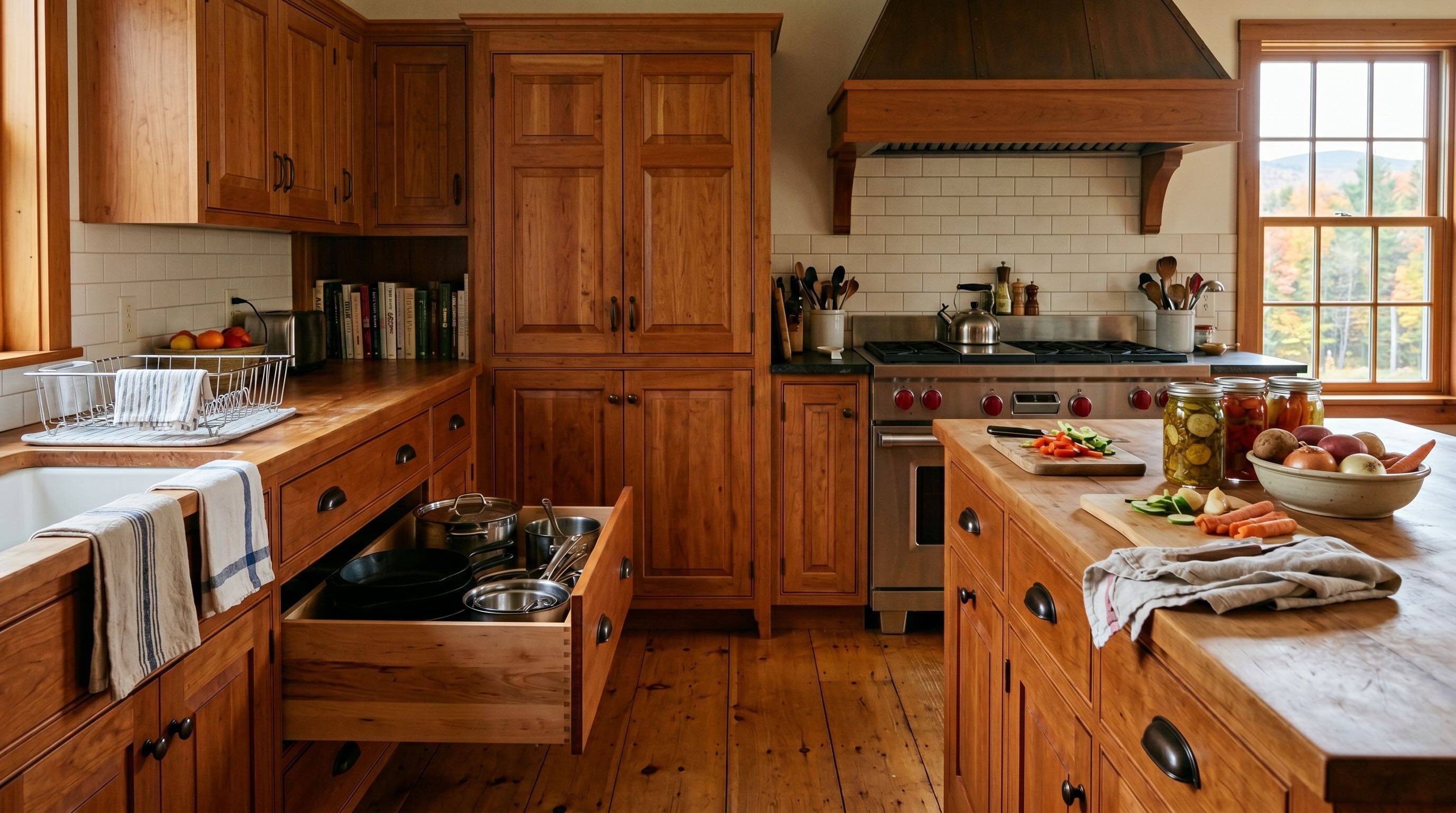
Vermont-style kitchen with closed cabinetry, deep drawers with soft-close hardware, and traditional pantry doors
Real Vermont kitchens have closed storage, deep drawers, and actual pantries. Not for looks—for living.

The Appliances That Actually Earn Their Cost

Three pieces of equipment transform daily cooking without requiring a second mortgage: continuous counter space (not an appliance, but critical), a dishwasher that actually cleans, and a refrigerator that doesn't frost over from humidity. Everything else is optional.

Counter space adjacent to your stove. This is non-negotiable. You need at least 24 inches of clear counter space next to your cooktop (ideally on both sides) where you can set down a hot pan, a cutting board, or a mixing bowl. A $20,000 cooktop is useless if you have nowhere to work. If you're evaluating a kitchen, this is your first real estate assessment.

A dishwasher that doesn't suck. A bad dishwasher costs you 15 minutes a day, every single day, rewashing dishes. That's roughly 91 hours per year pretending to wash dishes. Mid-range Bosch, Miele, and Thermador models ($1,200–$2,000) actually work. Budget brands ($400–$700) are expensive frustration machines. Buyers care about this. Renovators should too.

A fridge that seals properly. Vermont humidity destroys cheap refrigerator seals within three years. Your fridge has to work harder, consume more electricity, and frost over constantly. A quality fridge with a proper seal ($1,800–$2,500) will last a decade without drama. A cheap fridge ($700–$1,000) will drive you insane and die faster.

Everything else—smart appliances, multi-zone wine coolers, drawers that heat or cool separately—is nice. But these three earn their cost in daily function and years of reliable service.

Bottom Line: The Checklist

Before you buy or renovate, ask five questions about your kitchen: Does it have continuous counter space near the stove? Is the range hood properly sized? Is storage closed or open? Can the electrical service handle what you want? Does the workflow make sense from prep to stove to service?

For buyers evaluating a kitchen during a home tour:

  • Measure counter space next to the stove. If it's less than 24 inches, you're starting a renovation with a disadvantage.
  • Look at the range hood. Is it proportional to the cooktop? If it's massive, ask why. If it's tiny, that's a red flag.
  • Check storage. Are cabinets closed or is everything on open shelves? In Vermont, closed wins.
  • Test the dishwasher (if you can). Does it look like quality gear or budget compromise?
  • Stand at the stove. Imagine yourself cooking dinner for six people. Does the workflow feel natural or cramped?

For homeowners planning a renovation:

  • Call your electrician before you choose your cooktop. Know your electrical capacity.
  • Size your range hood using the formula above. Don't guess. Don't let your contractor guess.
  • Invest in closed storage and deep drawers. Open shelving will haunt you.
  • Buy the dishwasher that actually works, not the one that costs the least.
  • Plan your kitchen around how you actually cook, not how a magazine says kitchens should look.

Evaluating a Kitchen? Let's Talk.

Whether you're standing in a kitchen during a home tour or reckoning with your own space, the appliances matter less than the workflow. I've walked through hundreds of Central Vermont kitchens—as a chef and as a broker. I know what cooks, what costs too much, and what will make you happy at home.

Tony Walton
Principal Broker, New England Landmark Realty

Contact:
(802) 233-4107 (Cell) | (802) 253-4711 (Office) | (866) 324-2427 (Toll-Free)
nelandmark.com

Vermont Home Buying Guide | Selling Your Vermont Home

Where to Go Next

  1. Planning a kitchen renovation? Start with our Seller's Guide to understand what kitchen investments add value in Central Vermont's market.
  2. Shopping for a home? Use our Buyer's Guide to evaluate kitchens like a professional—workflow, storage, and function first.
  3. Need specific advice on your kitchen? Call Tony at (802) 233-4107. Kitchen walkthroughs are free, and the insight is priceless.
  4. Want more Counter Intelligence? Check back for weekly columns on kitchen design, Vermont lifestyle, and real estate reality.
May 18, 2026

Why People Sit Quietly Before Leaving the House

There is a moment before leaving the house when you sit down for no official reason.

You are fully dressed. Your keys exist. Your shoes are cooperative. The door is nearby and legally operational.

And yet you sit.

As a younger person, I believed this behavior indicated fatigue, confusion, or an unresolved chair-related incident. I assumed older adults sat before departures the way computers install updates: slowly, silently, and with consequences no one fully explains.

Now I do it myself.

Not dramatically.

Just a small, administrative sit.

At first I told myself it was efficiency. Perhaps I was reviewing the day ahead. Perhaps I was conducting a small internal systems check. Perhaps I was waiting to see if I still lived there.

But I quickly realized I was doing none of these things.

According to a study I conducted of myself over several mornings, the pre-departure sit contains no thoughts whatsoever. It is not planning. It is not resting. It is not regret. It is a quiet buffering period between indoors person and outside person.

Inside, I am competent and hydrated.

Outside, there are crosswalk negotiations.

Sometimes I sit for only a few seconds. Sometimes long enough to develop a small but meaningful relationship with the chair. Once, I adjusted my posture twice, which suggested commitment.

During the sit, I occasionally look at objects I have already lived with for years.

The lamp.

The hallway.

A coat I am not bringing, which watches me leave with the calm patience of something that expects to outlast my plans.

No one explains this stage of adulthood.

People warn you about taxes. People mention back pain. No one says, "Eventually you will pause before leaving the house as if waiting for permission from a committee that is mostly imaginary."

And yet the pause is important.

It is the last moment when your day still belongs to you and not to emails, sidewalks, weather, or someone saying "just circling back."

So I sit.

Not because I am tired.

Not because I am worried.

But because somewhere between picking up my keys and opening the door, I have apparently become the kind of person who likes to say goodbye to a room without alarming it.

Ready to Find Your Vermont Home?

Whether you're seeking that quiet moment before a new chapter or ready to explore Central Vermont's hidden corners, New England Landmark Realty is here to guide you.

Where to Go Next

May 17, 2026

Harris Gets Hired

New England Landmark Realty | Harris Vexley

Harris Gets Hired

(It Just Takes Two Weeks of Wi-Fi)

By Harris Vexley | May 2026 | Central Vermont

I decided retirement was becoming professionally unproductive around the third week of January. Not depressing exactly. More administrative. I had become extremely efficient at accomplishing nothing, which sounds relaxing until you realize you are essentially a regional manager of staring out windows.

So I called Tom at his insurance agency. He’d been asking for years if I wanted part-time work.

“I could use the help,” he said. “And you know everyone in three counties.”

This was true. I still remember people’s names, which now qualifies as a legacy skill, like shoe repair or repairing a clock with tiny tools while looking disappointed in Europe.

Monday morning I arrived at 8:47 with my thermos and what I believed was a healthy willingness to participate in society again.

Tom handed me a laminated card with a QR code on it.

“What’s this?”

“Your onboarding portal.”

I own a flip phone. It folds shut with emotional finality. When it rings, it sounds like someone requesting reasonable information from another human being.

Tom brought over Jessica from HR. She was twenty-four and somehow typing on her phone while speaking to me, a neurological achievement that would have gotten her accused of witchcraft in 1983.

“No problem,” she said. “We’ll do it on the office computer.”

The office computer appeared to have survived at least one flood and possibly the Bush administration. Jessica opened something called an LMS and explained I needed a password with sixteen characters, one uppercase letter, one lowercase letter, one number between three and seven, and one special character except ! or @.

“Why not ! or @?” I asked.

“Security.”

“Against whom?”

“Hackers.”

I have apparently spent my entire life invisible to hackers. This was oddly hurtful.

Jessica suggested we use a password manager.

“So another password remembers my password.”

“Exactly.”

“And I won’t know either of them.”

“Right.”

This struck me as less of a system and more of a hostage situation.

By 9:47 AM, I had successfully created a password I would never type again, stored inside a program I could not open, attached to an account I was not authorized to access yet.

This, I learned, was called progress.

By Thursday, I had completed fourteen training modules with titles like Data Security Awareness and Company Communication Ecosystems, which turned out to mean “the phones are inside the computer now.”

I asked Jessica if there was a regular phone somewhere in the building.

“Why would we need that?” she asked sincerely.

I didn’t know how to explain rotary phones, emergency calls, or civilization.

By the second week, I still had not done any actual work. I had been “provisioned,” “re-provisioned,” and briefly “deactivated due to unusual activity,” which turned out to mean I had attempted to log in correctly too many times.

An automated email informed me my password would expire in thirty days despite the fact that it had never once successfully lived.

I have purchased homes, buried parents, raised children, learned to make coq au vin, and once assembled a dock during a thunderstorm. None of those experiences required as many verification codes as opening Outlook.

One afternoon Marcus from accounting sat beside me in the break room. He was twenty-six and carried the permanent expression of someone waiting for software to load.

“How’s onboarding?” he asked.

“I’m not fully convinced I exist yet.”

He nodded sympathetically. “Yeah. The systems are rough.”

“Why?”

He shrugged. “That’s just how work is now.”

He said this the way people discuss pollen.

By week three I was finally allowed into enough portals to imitate employment. Tom handed me a client file.

“Review his coverage,” he said.

Now this part I understood. I called the client. Asked questions. Wrote notes on a legal pad like an Amish detective.

Then I attempted to enter the information into the CRM.

The system rejected me because I had not filled out “Primary Contact Secondary Department Designation.”

The client was a plumber.

Jessica leaned over my shoulder.

“Put N/A.”

Rejected.

“Try NONE.”

Accepted.

The machine had opinions now. We were negotiating with it.

“You’re getting it,” Jessica said encouragingly, like I had just completed a difficult maze for elderly mice.

But somewhere around week six, I noticed something strange.

Everyone under thirty spent enormous amounts of time moving information between systems that were allegedly designed to move information.

Marcus would spend forty minutes searching databases for an answer that Frank in claims could have provided while chewing a sandwich.

Jessica once sent three emails and a Teams message to someone sitting fourteen feet away.

Kyle from client services spent nearly an hour locating a vendor phone number that was written on a sticky note attached directly to Tom’s monitor in what I can only describe as plain English.

They were smart. Very smart. Faster than me in every technical way.

But nobody had taught them the ancient and forbidden art of simply asking another person.

Then the printer jammed.

Now printers are important because they are the last machines willing to admit they are unhappy. Computers freeze politely. Printers have public breakdowns. They make suffering everyone’s problem.

I walked over. Opened the tray. Removed the paper. Closed the tray.

Thirty seconds.

Jessica stared at me.

“How did you know what to do?”

“It was stuck.”

“Yes, but… you touched it.”

I realized then that I still possessed several marketable skills from the twentieth century.

I knew how to try the obvious thing first.

Marcus started asking me questions about clients because I actually remembered them. Not their file numbers. Their lives. Which son took over the business. Which wife handled the billing. Which contractor always lied about timelines by exactly three weeks for reasons known only to himself and God.

That information exists nowhere digitally because human memory has not yet been successfully turned into a subscription service.

One afternoon Jessica spent nearly an hour trying to generate a report.

“What if you just call her?” I suggested.

“Who?”

“The woman who uses the report.”

Jessica blinked slowly, like a person hearing about indoor plumbing for the first time.

“Oh.”

She called. Solved it in four minutes.

For the rest of the afternoon she behaved like someone who had accidentally discovered fire.

Around week seven, Tom stopped by my desk.

“You’ve adapted well,” he said.

“I still think half of this is ridiculous.”

“It absolutely is.”

“But these kids are good.”

“They are.”

“They just learned how to function inside systems that don’t.”

Tom nodded. “That’s most modern work. Navigating broken processes professionally.”

This felt less like an economy and more like an elaborate obstacle course designed by exhausted consultants.

Still, something changed after that.

Jessica started walking over to people instead of filing tickets for conversations.

Marcus began calling me before opening four separate databases.

Kyle discovered that “asking Tom” was somehow faster than “Enterprise Vendor Retrieval Suite.”

Nobody abandoned the systems. That would be impossible. The systems are immortal now. Long after humanity disappears, somewhere beneath the earth, a portal will still require a password reset.

But people remembered they were allowed to help each other directly.

The best part?

My password finally worked sometime during week four.

I’ve still never used it.

Where to Go Next

Whether you're buying, selling, relocating, or simply trying to find someone who still answers the phone, New England Landmark Realty helps people navigate Central Vermont the human way.

Making your own move?

Talk to New England Landmark Realty about your Vermont transition.

Whether you're relocating to Central Vermont, returning to work in the region, or just exploring what's possible, we're here to help you navigate the real stuff beneath the systems.

Website: www.nelandmark.com

Contact New England Landmark Realty

May 16, 2026

Gas Prices Are Back. Here’s Why Vermont Housing Math Just Changed Again.

The Numbers Guy | Vermont Real Estate Data

May 15, 2026

Inflation jumped back to 3.8% in April, driven largely by energy and shelter costs, and that changes the affordability math for Vermont buyers more than many people realize.

Jump to Key Takeaways
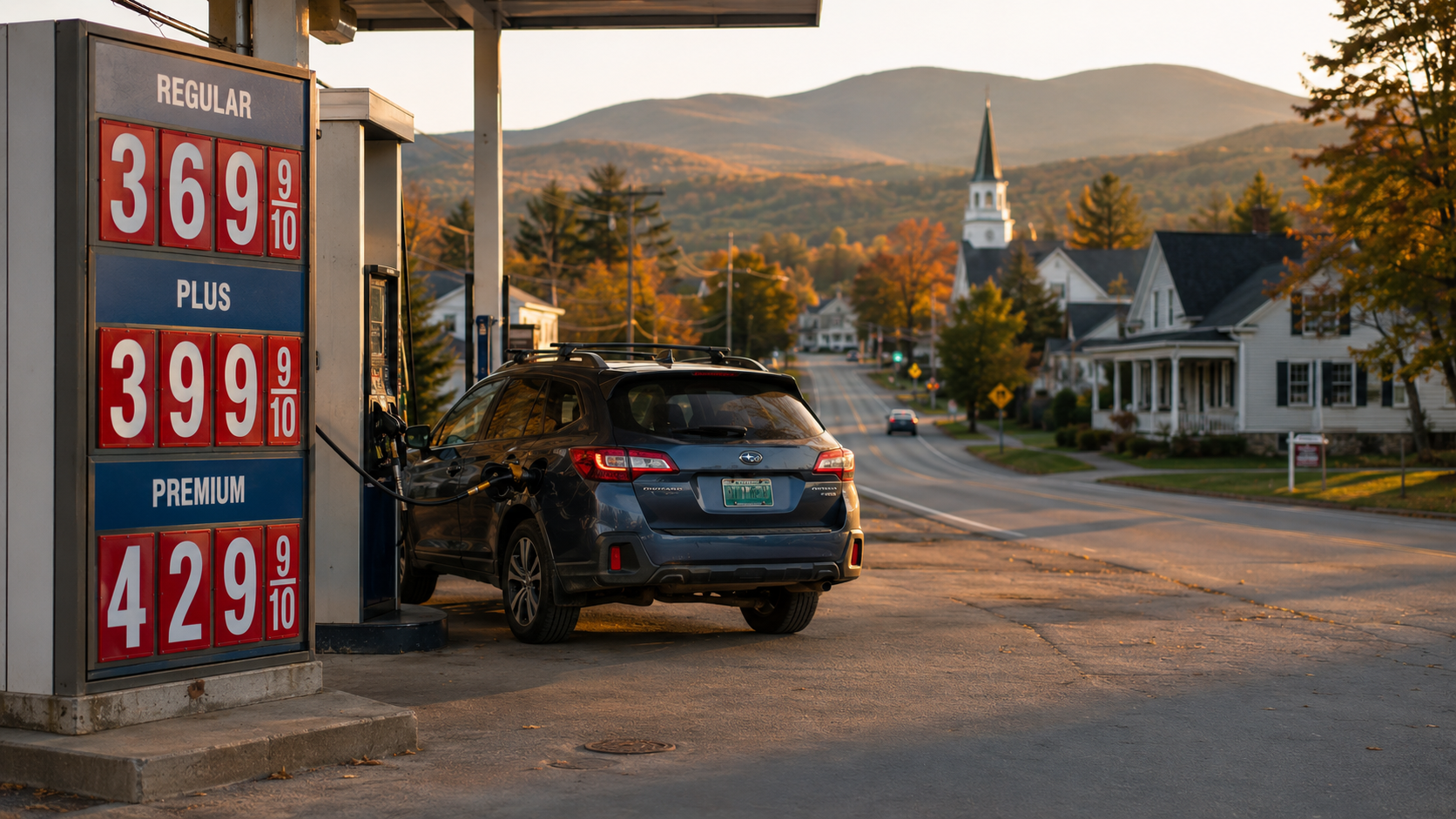
Vermont roadside gas station at golden hour with homes and mountains in the background

In Vermont, housing affordability is not just the mortgage. It is the mortgage, the tank, the heat, and the drive.

Inflation jumped back to 3.8% in April, driven largely by energy and shelter costs, and that changes the affordability math for Vermont buyers more than many people realize. In a rural state where driving, heating, and commuting are part of daily life, buyers are starting to think less about sticker price alone and more about total monthly operating cost.

Key Takeaways

If You Only Do 3 Things

  • If you’re buying, calculate fuel, commute, and heating costs alongside the mortgage payment before deciding what’s affordable.
  • If you’re selling, highlight efficiency upgrades, proximity to town, and operating-cost advantages because buyers are paying attention again.
  • If you own an older Vermont home, small energy improvements may now produce outsized buyer appeal relative to their cost.

Quick Facts

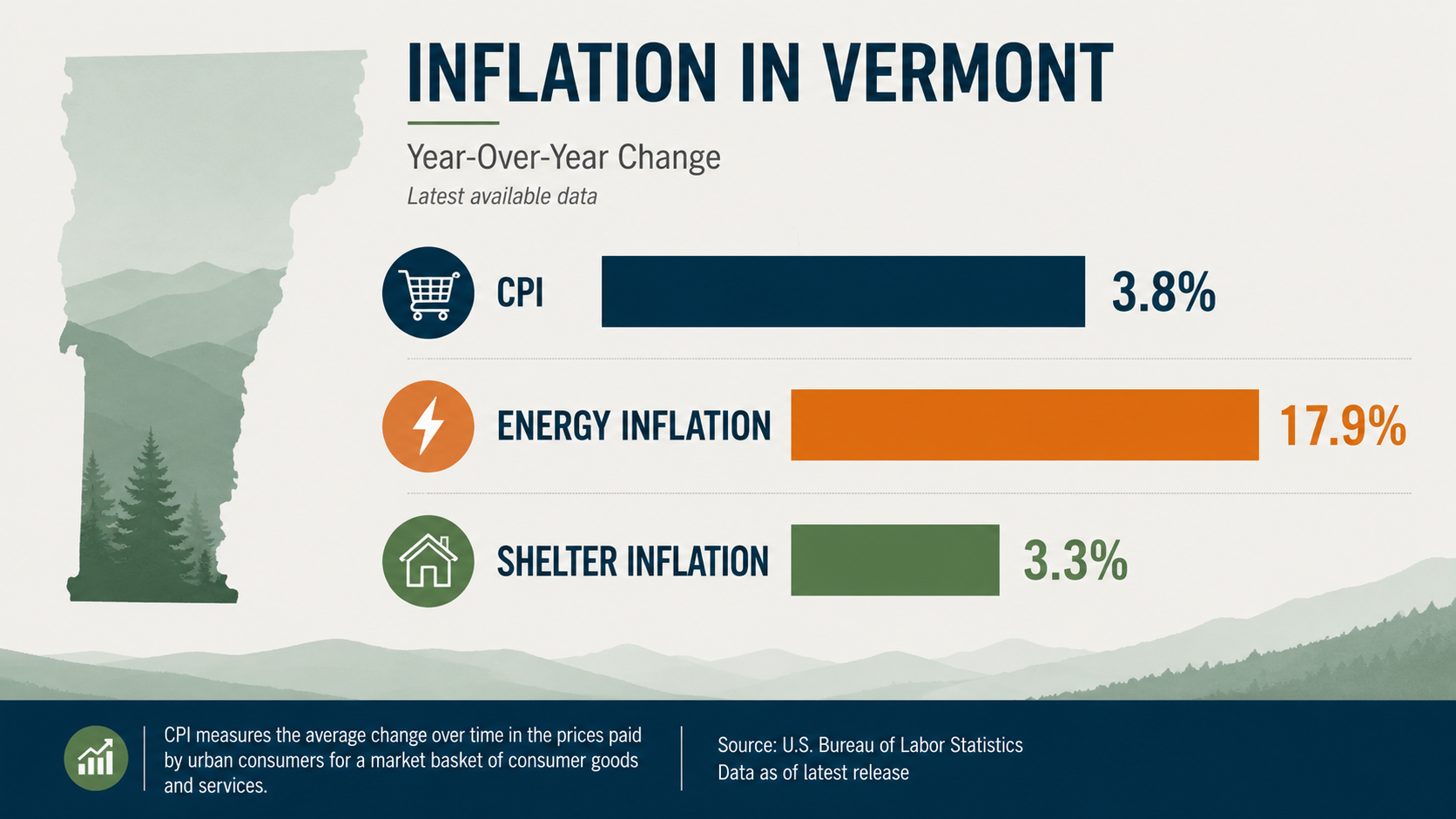
  • April CPI rose 0.6% month over month and 3.8% year over year.
  • Energy rose 17.9% year over year, with gasoline up 28.4%.
  • Shelter rose 3.3% year over year and 0.6% for the month.

What Changed?

Direct Answer: April inflation rose 3.8% year over year, with energy up 17.9% and shelter up 3.3%. For Vermont buyers, that means affordability is no longer just about purchase price or mortgage rate. The next smart move is to calculate the full cost of living in the home.

Let’s run the numbers.

The national inflation story this month is not complicated. Energy did a lot of the work. Shelter kept moving. And both matter in Vermont.

Translation: a buyer can qualify for the mortgage and still feel squeezed by the daily economics of the house.

The Data

Direct Answer: The three numbers that matter are 3.8% overall inflation, 17.9% energy inflation, and 3.3% shelter inflation. In Vermont, energy costs hit differently because many households depend on driving, heating oil, propane, and longer commutes. Buyers should compare homes by monthly operating cost, not price alone.

Editorial chart showing CPI at 3.8 percent, energy inflation at 17.9 percent, and shelter inflation at 3.3 percent

Three numbers. One practical question: what does the house really cost to live in?

CPI rose 0.6% in April and 3.8% from a year earlier, according to the U.S. Bureau of Labor Statistics. Energy rose 17.9% year over year. Shelter rose 3.3%.

Math doesn’t care whether the cost shows up in the mortgage statement, the fuel bill, or the gas pump. It still comes out of the same household budget.

So What Does That Mean for Vermont?

Direct Answer: Vermont buyers are likely to put more value on efficiency, location, and lower monthly carrying costs. A home closer to town, easier to heat, or less expensive to maintain may compete better even if the purchase price is higher. Sellers should make those advantages obvious in their marketing.

This is where Vermont gets specific.

A rural home with more land can still be a great decision. But if it comes with a longer commute, older windows, oil heat, and higher maintenance, the monthly math changes fast.

That does not mean buyers stop wanting Vermont character. They just start pricing it more carefully.

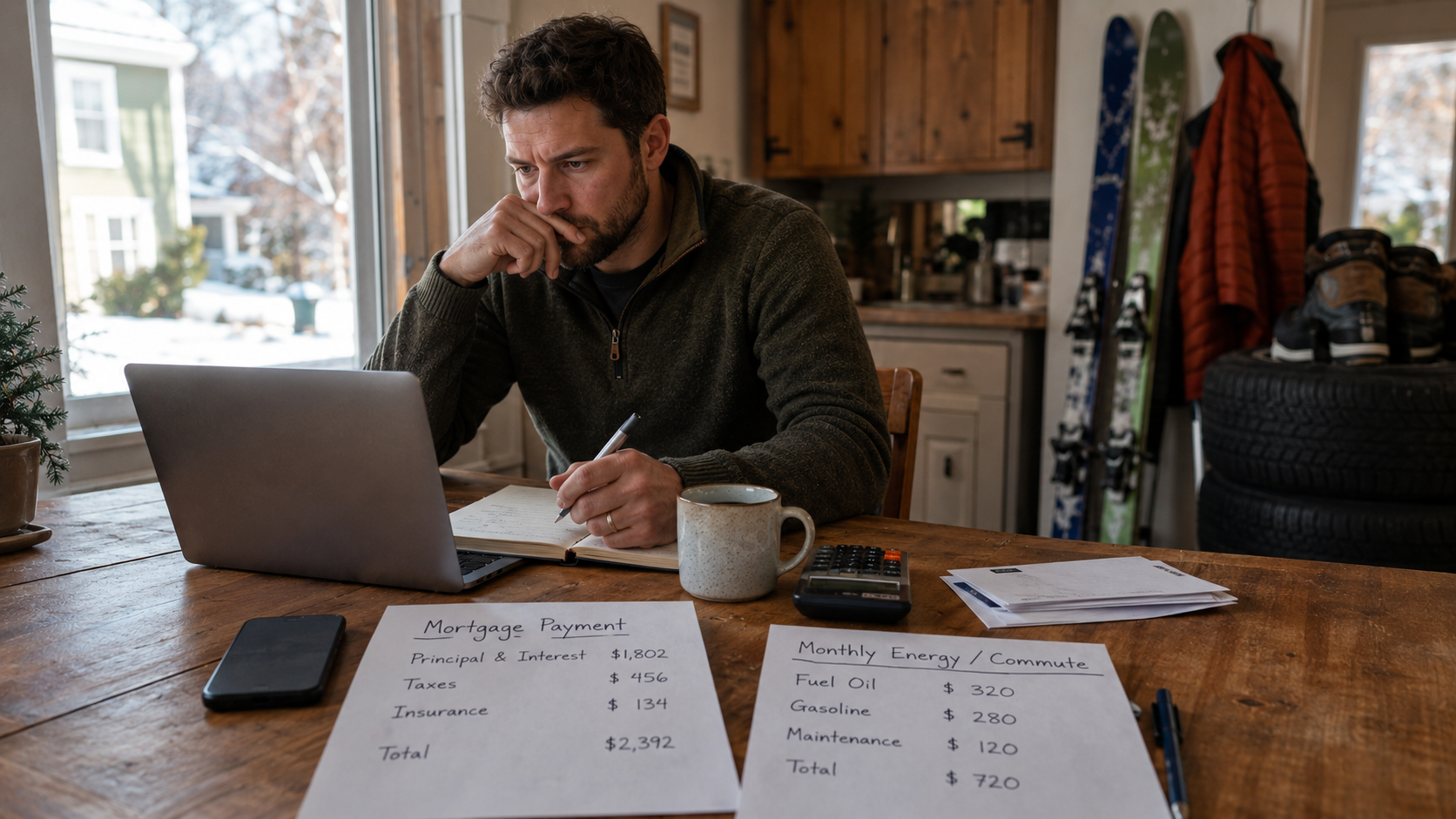
Vermont homebuyer at a kitchen table reviewing mortgage, heating, gasoline, and commute costs

The smartest buyers are not just asking, “Can I buy it?” They are asking, “Can I comfortably live with it?”

Bottom Line

Direct Answer: Inflation does not make Vermont real estate simple, but it does make the decision clearer. Buyers should focus on total monthly cost, and sellers should frame their homes around efficiency, convenience, and livability. The opportunity is in understanding the tradeoff before the market fully prices it in.

Here’s the opportunity.

If you are buying, this is a moment to be more precise, not more fearful. A slightly more expensive home with lower operating costs may be the better long-term number.

If you are selling, this is a moment to translate your home’s practical advantages. New windows, insulation, heat pumps, village proximity, lower utility bills, and an easier commute are not side notes. They are part of the value proposition.

Aerial view of a Vermont village center surrounded by rural roads and homes

In a higher-cost environment, proximity has value. So does efficiency. So does simplicity.

What To Do Next

Direct Answer: Buyers should ask for utility history, commute estimates, and improvement details before writing an offer. Sellers should prepare those answers before listing. In Vermont, the homes that explain their monthly math clearly may have an edge.

Here’s the play if you’re buying: build a real monthly budget before you fall in love with the house.

Here’s the play if you’re selling: do not just market bedrooms, baths, and acreage. Market the economics of living there.

That is the expensive mistake to avoid — treating the sale price as the whole number.

Sources

Talk through the full cost before you make the next move.

If you’re buying, selling, or trying to understand how inflation changes the Vermont housing decision, Tony Walton and New England Landmark Realty can help you look past the headline price and get to the real number.

New England Landmark Realty

Toll-Free (866) 324-2427
Tony’s Cell (802) 233-4107
May 15, 2026

The Vermont Housing Market in 2026: A Thaw, Not a Fire Sale

Tony Walton's Full Article (Unedited)

The Vermont Housing Market in 2026: A Thaw, Not a Fire Sale

The market is calming down. The shortage is not.

Quick Answer

No. Vermont's housing market is calming down, not crashing. March 2026 prices hit $438,400, listings rose 16.4%, and Vermont still needs 24,000–36,000 more homes — easing conditions do not equal a statewide reset.

The Vermont housing market isn't crashing. It's calming down. Those are not the same thing, and confusing them has become one of the state's more reliable hobbies. Nationally, 2026 looks like a year of modest relief: mortgage rates are forecast to average 6.3%, home prices are expected to rise 2.2%, and for-sale inventory is projected to improve by 8.9%. In most places, it would mean a softer, more negotiable market. In Vermont, it means something narrower: a little more room, a little less frenzy, and the same old supply problem still sitting in the middle of the table.

The latest numbers support that view. In March 2026, the median sale price in Vermont reached $438,400, up 9.1% from a year earlier. Homes for sale rose 16.4% to 2,871. New listings were up 8.1%, and months of supply climbed to five. In other words, buyers finally have a little oxygen. They may even get to ask a question, call their lender, and sleep on a decision without losing the house to someone paying cash before breakfast. That's progress. It's just not a miracle.

Before anyone starts whispering about a grand correction, it's worth remembering the central fact of this market: Vermont is still structurally short on housing. The state's housing needs assessment estimates Vermont needs another 24,000 to 36,000 homes between 2025 and 2029 to support household growth, normalize vacancy rates, replace lost housing stock, and reduce homelessness. That is not a small gap waiting politely to be closed. That is the kind of deficit that turns "better inventory" into "still not enough."

That's why affordability remains the real story. A balanced market is not the same as an accessible one. One gives buyers options. The other gives them entry. Vermont is inching toward the first while still denying the second to too many people. VHFA found that the share of Vermont renters with enough income to buy a median-priced home fell from 32% in 2021 to 6% in 2023. Half of Vermont renters are cost-burdened, and one in four spend more than half their income on housing. Those are not just housing statistics. They are pressure points for families, employers, schools, and anyone who would like Vermont to remain a place people can live in rather than merely admire.

Key Takeaways

Two-Sentence Summary

Vermont buyers, sellers, and relocation-minded readers need a market read that separates softer conditions from wishful thinking. Tony Walton frames the 2026 Vermont housing market around price, supply, and leverage so readers can judge timing without mistaking more inventory for real affordability.

If You Only Remember 3 Things

  • More listings have improved negotiating room, but higher inventory has not solved Vermont's structural housing shortage.
  • Vermont buyers can act with more discipline in 2026, but strong homes in strong locations still move quickly.
  • Vermont sellers can still win, but pricing, condition, and presentation matter more now because buyers have choices again.

Quick Facts

  • Vermont's median sale price reached $438,400 in March 2026, up 9.1% year over year.
  • Vermont homes for sale rose 16.4% to 2,871; new listings rose 8.1%.
  • Vermont needs 24,000–36,000 additional homes between 2025 and 2029.

Data from sources listed below.

To be fair, this is not an unhealthy market. It is simply a market with less theater and better manners than it had a few years ago. In March, 17.6% of Vermont homes still sold above list price, and the statewide sale-to-list ratio was 97.1%. Vermont still has demand. Good homes in good locations still get attention. The market has become more civilized. It has not become sleepy.

For sellers, that means this is still a strong market, but not one that rewards fantasy pricing or lazy preparation. Buyers now have more choices, which means condition matters, presentation matters, and pricing matters. The house has to earn the offer. For buyers, the shift is meaningful not because homes are suddenly cheap — they are not — but because the emotional tempo has improved. Buying a house should feel weighty. It should not feel like speed dating with a mortgage pre-approval.

For the broader state, the lesson is harder and less flattering. Vermont's housing problem is not mainly a mortgage-rate problem or a mood problem. It is, at root, a supply problem. And supply problems do not respond to sentiment. They respond to homes being built. Until that happens at scale, every improvement will be partial, every sigh of relief temporary, and every rebound likely to run back into the same wall.

So what should we call the Vermont housing market in 2026? Not a crash. Not a frenzy. A thaw, maybe. Buyers have more room. Sellers have less leverage than they did at the peak. The tone is better. The math is still brutal. And the dream of living in Vermont remains more expensive than many working households can comfortably afford. That doesn't call for panic. It calls for clarity.

Talk Through Your Next Move

New England Landmark Realty helps buyers and sellers in Waterbury, Vermont and across Central Vermont pressure-test timing, price, and strategy before they make a move. Tony Walton and the New England Landmark Realty team can help you read the market clearly and act with a plan that fits the math.

Call or Text

Posted in Community Insights
May 15, 2026

Vermont Buyers Finally Have More Room — But Prices Aren't Falling


Vermont home prices are still climbing, and buyers still have more negotiating room than they've had in years. Both things are true at the same time.

Inventory across Vermont rose 11.7% year-over-year. Homes are now sitting a median of 91 days. Sellers are averaging 96.3 cents on the dollar instead of routinely getting above asking price. Yet statewide median prices still climbed to roughly $412,200.

If you're buying, the market finally has some breathing room. If you're selling, pricing discipline suddenly matters again. Either way, this is the first spring market since before the pandemic that actually feels negotiable.

What the Numbers Actually Say

The headline number is inventory. Vermont active listings rose 11.7% year-over-year, the largest meaningful inventory gain the state has seen in several years.

That matters because Vermont spent much of the post-pandemic cycle operating in an artificially frozen market. Buyers weren't competing against a healthy supply of homes. They were competing over scarcity itself.

Today, the market looks different — but not dramatically different. Vermont still has only about 2.9 months of supply. A balanced market typically needs 4–6 months. So while conditions have improved for buyers, this is not a buyer's market.

It's a disciplined seller's market with better manners.

Median days on market have stretched to roughly 91 days. Sellers are averaging about 96.3% of asking price. And the percentage of homes selling above list price has fallen to 13.7%, down from nearly 20% one year ago.

That's a real shift in negotiating leverage.

At the same time, prices continue moving higher. Vermont's statewide median home price now sits near $412,200, while Chittenden County has crossed the $500,000 threshold in many segments.

The deeper story sits underneath all of it. Since 2001, Vermont median home prices have risen roughly 148%, while median household income has risen only about 72%. That gap explains almost everything happening in this market right now.

This is not a market waiting for a dramatic correction. It's a market reflecting a long-term supply deficit that Vermont still hasn't solved.

Why Prices Are Still Rising When Inventory Is Also Rising

Most people hear "inventory is rising" and assume prices should be falling.

In a normal housing cycle, maybe. Vermont isn't operating in a normal housing cycle.

The first reason is simple: inventory is rising from an extremely low base. An 11.7% increase sounds large until you remember how starved the market became after 2020.

More homes than last year still means fewer homes than a functioning market actually needs.

Second, Vermont homeowners are unusually equity-rich. More than 87% of mortgaged Vermont homeowners are considered equity rich — among the highest rates in the country. That matters because financially stressed sellers cut prices aggressively. Equity-rich sellers don't have to.

Most Vermont owners can wait.

Third, the structural shortage remains enormous. Various housing studies now estimate Vermont remains short roughly 24,000 housing units statewide. Rising inventory relieves pressure around the edges. It doesn't erase the shortage.

And finally, Vermont attracts a different buyer profile than many markets.

A significant portion of demand still comes from remote workers, retirees, second-home buyers, and equity migrants from Boston and New York. These are buyers actively choosing Vermont. They're often less rate-sensitive than traditional first-time buyers stretching to qualify.

That's why inventory can rise while prices still climb modestly at the same time.

The market isn't overheating anymore. But it also isn't collapsing under its own weight.

What This Means If You're Buying Now

For buyers, the negotiating window is real.

A year or two ago, many Vermont buyers felt like they were bidding against panic itself. Today, homes are sitting longer, sellers are absorbing carrying costs, and negotiations have become more normal again.

96.3 cents on the dollar is meaningful. So is the decline in above-list sales from nearly 20% down to 13.7%.

That doesn't mean every seller is negotiable. Well-priced homes in strong locations still move quickly. But buyers finally have the ability to ask harder questions, compare more options, and avoid making instant emotional decisions.

The honest caution is this: Vermont still isn't cheap, and prices are still rising.

Waiting for a dramatic crash may prove frustrating because the underlying supply shortage remains intact. Vermont simply has not built enough housing to create sustained downward pricing pressure.

What I would tell buyers right now is straightforward.

If your financing is solid and you already know your target towns, this is probably the best negotiating environment you've seen in several years. Engage now while inventory is improving and before peak spring competition compresses the window again.

If you're still uncertain about budget, geography, commute realities, or renovation tolerance, use this period to get precise instead of rushing.

What This Means If You're Selling Now

For sellers, the market still works in your favor — just not automatically.

The biggest mistake I'm seeing right now is sellers pricing from memory instead of current conditions.

A market averaging 96.3% of asking price is not rewarding aspirational pricing the way 2021 and 2022 did. Sellers who start too high are often sitting for 91 days and reducing later anyway.

That's not pessimism. That's math.

Where sellers still hold strong leverage is in move-in-ready homes located in supply-constrained towns. Entry-level and first-time buyer price points remain competitive because inventory there is still extremely thin.

Where leverage has softened is more obvious now too.

Overpriced second-home inventory. Rural properties with outdated infrastructure. Homes lacking broadband, septic upgrades, or major deferred maintenance. Buyers have enough options again to become selective.

Condition matters more now. Presentation matters more now. Pricing strategy matters a lot more now.

The One Question Worth Asking

So where does this go over the next 6–12 months?

My read is fairly simple.

Inventory will probably continue rising modestly. But absent a major economic shock, Vermont is unlikely to reach true balance anytime soon.

Prices likely continue climbing too — just slowly. Probably somewhere in the low single digits rather than the explosive gains of the pandemic years.

And the negotiating window buyers are seeing right now? That's real. But it's also seasonal and temporary. As more buyers re-enter the market through late spring and summer, some of that flexibility compresses again.

Mortgage rates matter around the margins. Vermont's structural housing shortage matters at the core.

If a client were sitting across my desk today, I'd probably tell them the same thing whether they were buying or selling:

This finally feels like a functioning market again. Not easy. Not cheap. But functional. And compared to where Vermont has been the last several years, that's a meaningful shift.

Let's Run Your Numbers

Every Vermont market behaves differently right now. Waterbury isn't Stowe. Montpelier isn't Burlington. Some neighborhoods still move instantly. Others finally have negotiating room.

If you're buying, we'll help you understand where leverage actually exists — and where it doesn't.

Buyers:
Read the Vermont Home Buyer's Guide

If you're selling, we'll show you how your property fits into today's market instead of last year's market.

Sellers:
Read the Vermont Home Selling Guide

Tony Walton
New England Landmark Realty
Cell: (802) 233-4107
Office: (802) 253-4711
Website: nelandmark.com

Frequently Asked Questions

Is now a good time to buy a house in Vermont?

For many buyers, yes. Inventory is rising, bidding wars have cooled somewhat, and homes are sitting longer than they were during the peak frenzy years. Buyers now have more negotiating room and more inventory to evaluate. But Vermont still has a structural housing shortage, so buyers waiting for dramatic price declines may be waiting a very long time.

Will Vermont home prices drop in 2026?

A broad statewide drop appears unlikely based on current supply levels. Vermont still has only about 2.9 months of housing supply, well below balanced conditions. The state also has one of the country's highest rates of equity-rich homeowners, limiting distressed selling pressure. Prices may rise more slowly, but the structural supply deficit still supports values.

How long are homes sitting on the market in Vermont?

Median days on market are now around 91 days statewide. That's significantly longer than the hyper-competitive pandemic years and gives buyers more room to negotiate and evaluate options carefully. However, desirable homes in strong locations can still move quickly.

Is Vermont a buyer's market or seller's market?

Vermont remains a seller-aligned market overall, but conditions have become more favorable for buyers than they were over the past several years. Inventory has improved, above-list bidding has cooled, and sellers are negotiating more frequently. Still, supply remains below balanced market levels.

What is the median home price in Vermont in 2026?

The statewide Vermont median home price is approximately $412,200 as of early 2026 according to Redfin data. Chittenden County has crossed the $500,000 threshold in many segments, while Central Vermont remains somewhat more affordable depending on town and property condition.

Sources: Redfin, Federal Reserve Economic Data (FRED), Vermont Housing Finance Agency (VHFA), National Association of Realtors (NAR), Census housing and income trend data, New England Landmark Realty market observations.

Posted in Numbers Guy
May 15, 2026

Fix It or Price It? The Seller's Math That Actually Works

Two-Sentence Summary:

Some repairs must happen before you list—the ones that kill appraisals, fail inspections, or signal neglect to every buyer who walks through the door. Others can be strategically priced into your asking price and disclosed instead, which often returns more money to your pocket than the renovation would have cost.

💡 If You Only Remember 3 Things
  • Safety and appraisal-critical repairs are non-negotiable; everything else is a decision, not a mandate.
  • A known flaw honestly disclosed often costs less in buyer hesitation than the repair itself would have cost—and you keep the difference.
  • The real question isn't "Will this hurt my sale?" but "Will this repair return more than its cost in buyer confidence, or should I price around it instead?"

Fix It or Price It? The Seller's Math That Actually Works

A seller standing in a kitchen with visible wear, considering repair decisions

You're standing in your bathroom. The tile is original—1987, avocado, the whole ensemble. The mirror is spotted. The fixtures work, but they look tired. And now you're selling.

Your instinct: rip it out, spend $8,000 to $12,000, list it gleaming, sleep better.

Your second instinct: panic that you can't afford that, panic that buyers will see the wear and walk.

Your third instinct is the one most sellers never reach: actually do the math.

Why This Decision Matters

The difference between a renovation you can't afford and a strategic price adjustment you can live with is the difference between selling with money left over and selling exhausted. Most sellers spend on the wrong repairs—the ones that feel urgent but don't move the needle on price. The ones that do move the needle—roof, foundation, mechanical systems—get deferred because they're expensive and invisible. Then the appraisal comes back, and suddenly you're negotiating anyway.

The sellers who sleep best aren't the ones with perfect homes. They're the ones who know which repairs are non-negotiable, which ones are pure leverage, and which ones can be absorbed into price without costing them thousands in buyer doubt.

The Three Categories of Repair

Category One: Appraisal-Critical Repairs

These are the ones you cannot negotiate. The roof that's shot. The foundation with active cracks. The electrical panel that's a fire hazard. The HVAC system that's failed. The septic system backing up.

Before-and-after comparison showing repair impact on home value

Your appraiser will find these. Your inspector will flag these. Your lender will refuse to finance without these fixed. Do not gamble here. Fix them. Price the home with the repair cost already factored into your net. Move on.

The question is never "Should I fix this?" It's "Should I fix it before closing, or will the buyer?"—and that depends on your market. In Vermont, in May, with multiple offers coming in? You might price around it and let the buyer absorb it as part of their negotiation. In a slower market, fix it first and move the listing.

Category Two: Buyer Psychology Repairs

These are the ones that don't kill the appraisal but kill the feeling. A kitchen from 1987 that works but screams neglect. A primary bathroom with original harvest gold fixtures. A bedroom with water stains on the ceiling from a leak that was fixed five years ago but never painted over.

These repairs cost between $3,000 and $8,000, usually. And here's the thing: they often return less in sale price than their cost.

But—and this is crucial—they often prevent hesitation. A buyer walks in, sees the dated kitchen, and her mind goes to "$5,000 in updates I'll need to do." She bids lower to account for it. You could have updated that kitchen for $6,000, but now you've lost $8,000 in negotiating leverage because she's already mentally deducted it.

The math: Does the repair cost less than the price reduction it will trigger? If yes, do it. If no, price around it and disclose it clearly.

Category Three: Cosmetic Wear That Signals Nothing

Worn carpet. Dated paint. Original hardware. Scuffed baseboards. Tired landscaping.

These don't cost much to fix. Paint a room: $800. New carpet in three bedrooms: $2,500. Fresh landscaping: $1,000.

And yet—most of this can be absorbed into the asking price without moving the needle on buyer interest, if the home is otherwise clean, well-maintained, and honestly presented. A buyer who walks into a home with good bones, good systems, and good light will overlook tired carpet if the price reflects it.

Do not spend $4,000 on cosmetics you could price around for $3,000 less and let the buyer choose her own colors anyway.

The Home Turn: What Strategic Pricing Actually Means

Seller and agent discussing home condition and pricing strategy

There is a particular relief that comes from knowing exactly what needs to happen.

Not "we should probably update this," but "we will not touch this, and here's why." Not "I hope they don't notice," but "we're disclosing this clearly, pricing it honestly, and moving forward."

The best sellers aren't the ones living in perfect homes. They're the ones who've made hard decisions about which imperfections matter and which ones don't. They've looked at the wear, done the math, and decided: this gets fixed, this gets priced, and this gets painted and called done.

That clarity moves faster than perfection ever will.

The Bottom Line: Your Real Question

Seller and agent in thoughtful conversation about home assessment

Before you spend a dime, ask this: "Will this repair cost less than the price reduction I'll take if I don't do it?"

If yes—fix it.

If no—price around it, disclose it, and move on.

And if you're not sure which category your repair falls into, that's what your agent is for. Call (802) 253-4711 or (866) 324-2427. New England Landmark Realty helps sellers make this call every day—and the ones who get it right sleep better and net more money.

The home you're selling doesn't need to be perfect. It needs to be honestly represented. Everything else is negotiation.

Ready to Sell Smart?

Get clarity on what to fix, what to price around, and what moves the needle on buyer confidence. New England Landmark Realty helps Central Vermont sellers make the right repair decisions—and keep more money at closing.

Or reach Tony directly: (802) 233-4107

Where to Go Next

Preparing to list or still deciding? These guides help sellers in Central Vermont make informed decisions:

Posted in Home Selling Tips