New England Landmark Realty covers the Vermont real estate market 

from the inside — market data, buyer strategy, seller timing, land 

use regulation, and the policy decisions shaping what homes cost and 

who can afford them.


Tony Walton has been working Vermont real estate since 1978. 

The analysis here reflects that depth.


Browse by topic below, or use the search to find what you need.

May 13, 2026

Vermont's Zoning Rules Are Constraining Housing Supply — And Driving Prices Higher


Vermont needs at least 24,000 additional year-round homes by 2029, and the state is not building fast enough to make that happen.

That is the housing story behind the housing story. Prices are not rising simply because more people discovered Vermont, or because remote workers arrived after 2020, or because second-home buyers showed up with stronger cash positions.

Those things matter. But they are not the whole explanation.

The deeper problem is structural: Vermont has spent decades making it difficult to build the kind of housing the market now needs most — smaller homes, duplexes, apartments, accessory dwelling units, starter homes, and modest infill housing near existing roads, jobs, schools, and village centers.

The Numbers Behind the Lock

Vermont needs roughly 24,000 to 36,000 additional homes by 2029. The 2025–2029 Vermont Housing Needs Assessment estimates that Vermont needs tens of thousands of additional homes to bring the market closer to balance.

That number matters because Vermont's housing shortage is no longer an abstract policy problem. It now shows up in almost every buyer conversation, rental search, workforce discussion, and municipal planning debate.

  • Vermont needs at least 24,000 additional year-round homes by 2029 to move toward a healthier housing market.
  • Vermont's rental vacancy rate is roughly 3%, well below the 5% level often considered a healthier rental market.
  • Chittenden County's rental vacancy rate has been estimated near 1%, which means renters are competing in an unusually tight market.
  • Vermont home prices rose sharply after 2020, with many ordinary primary residences now trading well above pre-pandemic levels.
  • New construction remains too limited, especially in the smaller, more attainable housing types most first-time buyers and workers need.

Demand is part of the story. Vermont saw remote work migration, second-home demand, and continued interest from higher-cost Northeast markets.

But in a functioning housing market, rising prices eventually trigger additional supply. Builders build. Land gets subdivided. Smaller housing types appear. More units come online.

In Vermont, that response is slowed by local zoning, large minimum lot sizes, infrastructure limits, permitting costs, Act 250 uncertainty, and political resistance to density.

When a state consistently prevents enough housing from being built, rising prices stop being a market surprise and start becoming the predictable outcome of policy.

This is why housing affordability cannot be understood separately from land-use rules. If you are trying to understand the broader cost of living here, see our Vermont Cost of Living Guide. Housing is the largest line item, and zoning is one of the reasons that line keeps getting heavier.

How the Lock Works: Three Mechanisms

1. Single-Family Rules Limit What Can Be Built

Single-family zoning does not simply allow single-family homes. The more important effect is that it prevents other housing types from being built on land where they might otherwise make sense.

Duplexes, triplexes, small apartment buildings, cottage courts, and accessory dwelling units are often the missing middle between a detached house and a large apartment complex. Vermont needs more of that middle.

Act 47, passed in 2023, moved Vermont away from the strictest version of single-family-only zoning by requiring municipalities to allow duplexes where single-family homes are allowed and to allow additional density in areas served by water and sewer.

That was a meaningful reform. It was not a magic wand.

Local bylaws, infrastructure limits, lot standards, wastewater constraints, parking habits, neighborhood opposition, and project economics still determine whether housing can actually be built.

The practical problem: Nearly every Vermont community says it needs more housing. The conflict begins when a specific project is proposed on a specific road, near specific neighbors, with specific traffic, parking, school, wastewater, and character concerns attached.

2. Large Lot Requirements Make Starter Homes Harder to Build

Large-lot zoning sounds harmless until you run the math.

If a town requires two acres per home and raw land costs $25,000 per acre, the builder starts with roughly $50,000 in land cost before roads, septic, utilities, engineering, permitting, financing, labor, materials, or construction begin.

Now add Vermont construction costs, septic design, stormwater review, driveway work, utility extensions, interest carry, and the risk that the project takes longer than expected.

Very quickly, the economics stop supporting starter homes.

That is one reason new construction in Vermont so often skews higher-end. It is not simply a matter of builders choosing luxury over affordability. In many towns, the regulatory and land-cost structure pushes projects toward the price points that can absorb the cost of creating the lot in the first place.

Buyers looking at land should pay close attention to zoning, lot size, wastewater capacity, road frontage, and subdivision potential. Our Vermont Land Buying Guide and Vermont New Construction Guide go deeper into those practical issues.

3. Permitting Timelines and Act 250 Add Friction

Act 250 is often treated as the villain in Vermont housing debates. That is too simple.

The law serves real environmental and land-use purposes. Vermont would not look the way it does today without decades of intentional land-use regulation.

But friction still has a cost.

Long permitting timelines, engineering requirements, appeals, environmental review, and uncertainty make smaller projects harder to pencil out. Larger developers can spread risk across multiple projects. Local small-scale builders often cannot.

That creates a market distortion. The regulatory process may be well-intentioned, but the burden does not fall evenly.

Small builders, local landowners, first-time buyers, and renters often feel the cost most directly.

Who Benefits and Who Pays

Vermont's housing structure produces winners and losers. Pretending otherwise makes the conversation less honest.

Who Benefits

  • Existing homeowners benefit from asset appreciation when supply stays scarce.
  • Second-home owners benefit from protected scarcity and limited neighborhood change.
  • Affluent out-of-state buyers can compete in a market where local wages often cannot.
  • Municipal boards avoid immediate political conflict by slowing or limiting controversial growth.

Who Pays

  • First-time buyers compete for a shrinking pool of entry-level homes.
  • Renters face low vacancy rates and limited negotiating power.
  • Teachers, nurses, municipal employees, and tradespeople often struggle to live in the communities they serve.
  • Local employers face hiring problems when workers cannot find housing nearby.
  • Vermont towns risk long-term hollowing out when younger households cannot establish themselves locally.

This is especially visible in high-demand markets like Stowe, Waterbury, Montpelier, Burlington, Middlebury, and parts of the Mad River Valley. In these places, the housing shortage is not theoretical. It affects hiring, school enrollment, commuting patterns, and whether younger families can remain in town.

For buyers comparing Vermont towns, the zoning profile matters almost as much as the current listing inventory. A town with limited density, strict lot requirements, and little appetite for new housing is not just charming. It is supply-constrained by design.

That may support long-term property values. It may also make affordability worse. Both things can be true at the same time.

What Is Actually Changing

Vermont has started to make meaningful housing policy changes. The important word is started.

Act 47, also known as the HOME Act, made several important moves. It required municipalities to allow duplexes where single-family homes are allowed. It also required more flexibility for multiunit housing in areas served by municipal water and sewer.

Those changes matter because they begin to separate Vermont's future housing policy from the assumption that detached single-family homes should dominate nearly every residential landscape.

Burlington has also moved toward more flexible zoning. Earlier ADU reforms streamlined permitting, reduced parking barriers, and made it easier to create accessory dwelling units. Burlington's broader Neighborhood Code discussion also focused on allowing more housing types in existing neighborhoods rather than forcing nearly all growth outward.

That is the right direction.

But the pace is still slow compared with the size of the shortage.

Allowing duplexes on paper does not automatically produce duplexes in the ground. Builders still need feasible lots, infrastructure, financing, predictable approvals, and a market price that works.

That is the part many policy conversations miss. Zoning reform is necessary. It is not sufficient by itself.

For buyers and sellers, the market implication is straightforward: Vermont's housing shortage will not unwind quickly. Even with reform, the inventory gap is large enough that supply pressure is likely to remain a defining feature of the market for years.

What It Means If You're Buying in Vermont Now

If you are buying in Vermont now, you need to understand the market underneath the listing.

A house is not just a house. It sits inside a town zoning system, a wastewater framework, a road network, a tax structure, and a local political culture around growth.

That context affects value.

  • A home in a supply-constrained town may hold value well because new competition is difficult to create.
  • A property with subdivision potential may have long-term optionality that is not obvious from the listing photos.
  • A home near a village center may benefit from future infill, walkability, and infrastructure investment.
  • A parcel in a large-lot district may offer privacy but limit future housing flexibility.
  • A town actively reforming zoning may see more inventory over time than a town trying to preserve existing patterns.

That is why buyer strategy in Vermont should include more than price, condition, and interest rate. You should also understand the land-use environment around the property.

If you are relocating, start with our Moving to Vermont Relocation Guide. If you are early in the process, our Vermont Home Buying Guide and Vermont First-Time Homebuyer Guide will help you understand the broader buying landscape.

If you are tracking pricing and inventory, our Vermont Real Estate Market Trends page is a useful next stop.

Thinking About Buying in Vermont?

At New England Landmark Realty, we help buyers look beyond the listing sheet. Zoning, lot size, wastewater, town planning, tax structure, inventory pressure, and future supply all matter when you're making a Vermont real estate decision.

Explore our Vermont Home Buying Guide or contact Tony Walton directly at (802) 233-4107 to talk through Vermont markets, zoning patterns, and where inventory may evolve over the next several years.

Frequently Asked Questions

Why is housing so expensive in Vermont?

Housing is expensive in Vermont because demand has grown faster than supply. The state has low vacancy rates, limited new construction, high building costs, and local zoning rules that often make smaller or denser housing difficult to build. When supply cannot respond quickly to demand, buyers and renters compete for too few homes.

What are Vermont's zoning laws?

Vermont zoning laws are mostly local rules adopted by cities and towns. They control what can be built, where it can be built, how large lots must be, how many homes are allowed on a parcel, and what uses are permitted in different districts. State laws such as Act 47 and Act 250 also shape how housing development works.

Does Vermont allow duplexes?

Yes. Act 47 requires Vermont municipalities to allow duplexes where single-family homes are allowed. However, local implementation, lot standards, wastewater limits, infrastructure, and project economics still affect whether duplexes actually get built.

What is Act 250 in Vermont?

Act 250 is Vermont's statewide land-use and environmental review law. It reviews certain development projects for impacts related to environment, infrastructure, community character, and public services. Act 250 has helped protect Vermont's landscape, but it can also add time, cost, and uncertainty to some housing projects.

Is Vermont building enough housing?

No. Vermont housing needs assessments indicate the state needs tens of thousands of additional homes by 2029 to move toward a healthier market. Current production remains below the level needed to relieve pressure on buyers and renters.

Why is it hard to find affordable housing in Vermont?

Affordable housing is hard to find because Vermont has too little inventory, low rental vacancy, high construction costs, and zoning rules that limit the supply of smaller and more attainable homes. The shortage is especially difficult for renters, first-time buyers, essential workers, and younger households trying to stay in Vermont communities.

How do zoning rules affect Vermont home buyers?

Zoning affects what can be built near a property, whether a parcel can be subdivided, whether an accessory dwelling unit may be possible, and how much future housing supply a town is likely to allow. Buyers should understand a town's zoning posture before assuming that today's neighborhood pattern will stay the same — or that new inventory will appear quickly.

Sources and Further Reading

May 13, 2026

290 Wood Farm Road in Waterbury, Vermont


The Vermont House That Quietly Redefines Luxury Living

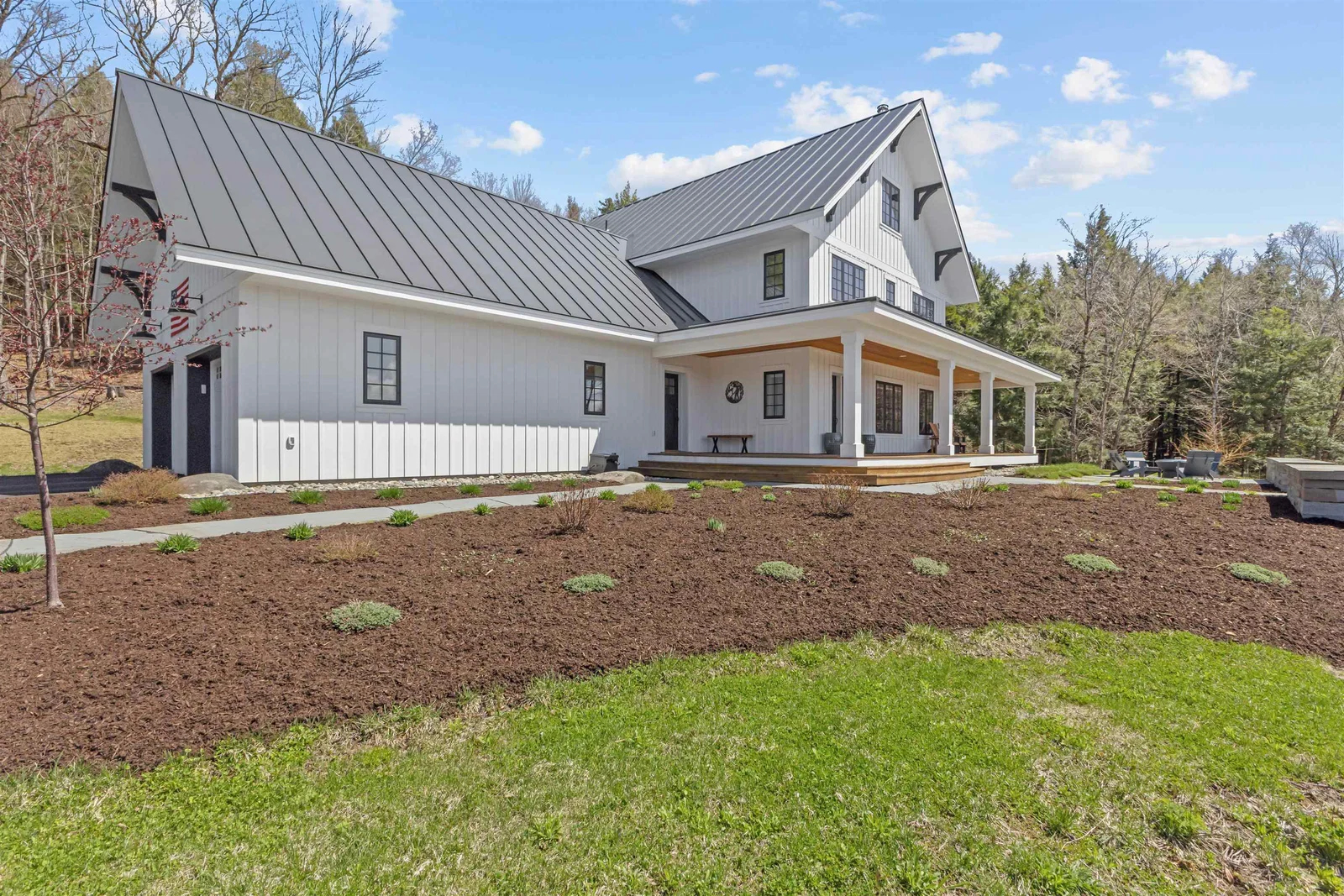
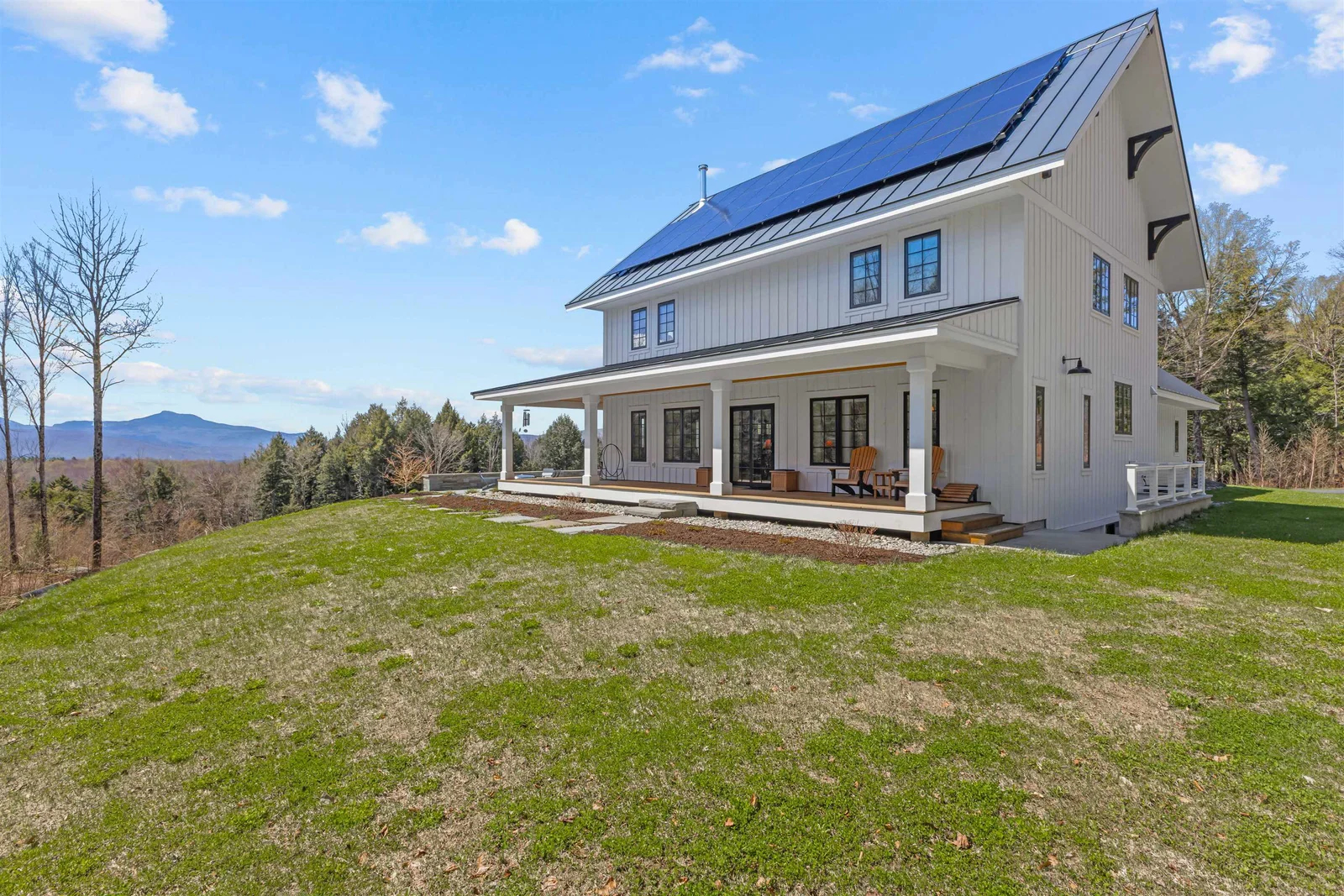
290 Wood Farm Road exterior with solar panels and mountain views

290 Wood Farm Road in Waterbury, Vermont pairs mountain privacy with unusually thoughtful design and long-term performance.

There are homes built to impress.

And then there are homes built by people who genuinely understand Vermont.

At first glance, the property at 290 Wood Farm Road feels cinematic — nearly 11 acres, layered mountain views, a private brook, and the kind of silence that people from major metropolitan areas spend years trying to buy back into their lives.

But the deeper story here isn’t just beauty.

It’s intelligence.

If You Only Remember 3 Things

  • This is luxury built around resilience, efficiency, and year-round Vermont living.
  • The Waterbury location offers privacy without giving up access to Stowe, Sugarbush, Burlington, Montpelier, and I-89.
  • The home’s systems, materials, and layout make it stand apart from properties that simply chase square footage or finishes.

This is not performative luxury. It’s Vermont luxury interpreted through the lens of resilience, efficiency, craftsmanship, and long-term livability. The home combines geothermal heating and cooling, owned solar, integrated battery storage, insulated concrete form construction, and a heavy-gauge standing seam roof into something increasingly rare: a house designed not merely to photograph well, but to function exceptionally well over decades.

Custom Vermont home exterior with standing seam roof and landscaped grounds

A custom Vermont home designed for beauty, privacy, and long-term durability.

This is not luxury as decoration. It is luxury as competence.

And that distinction matters.

Across much of the luxury market, buyers are beginning to look beyond square footage and countertops. They’re asking harder questions:

  • How does this home actually perform in February?
  • What happens during outages?
  • How much maintenance will this require five or ten years from now?
  • Does this property feel connected to Vermont — or merely placed inside it?

This home answers those questions quietly, without trying too hard.

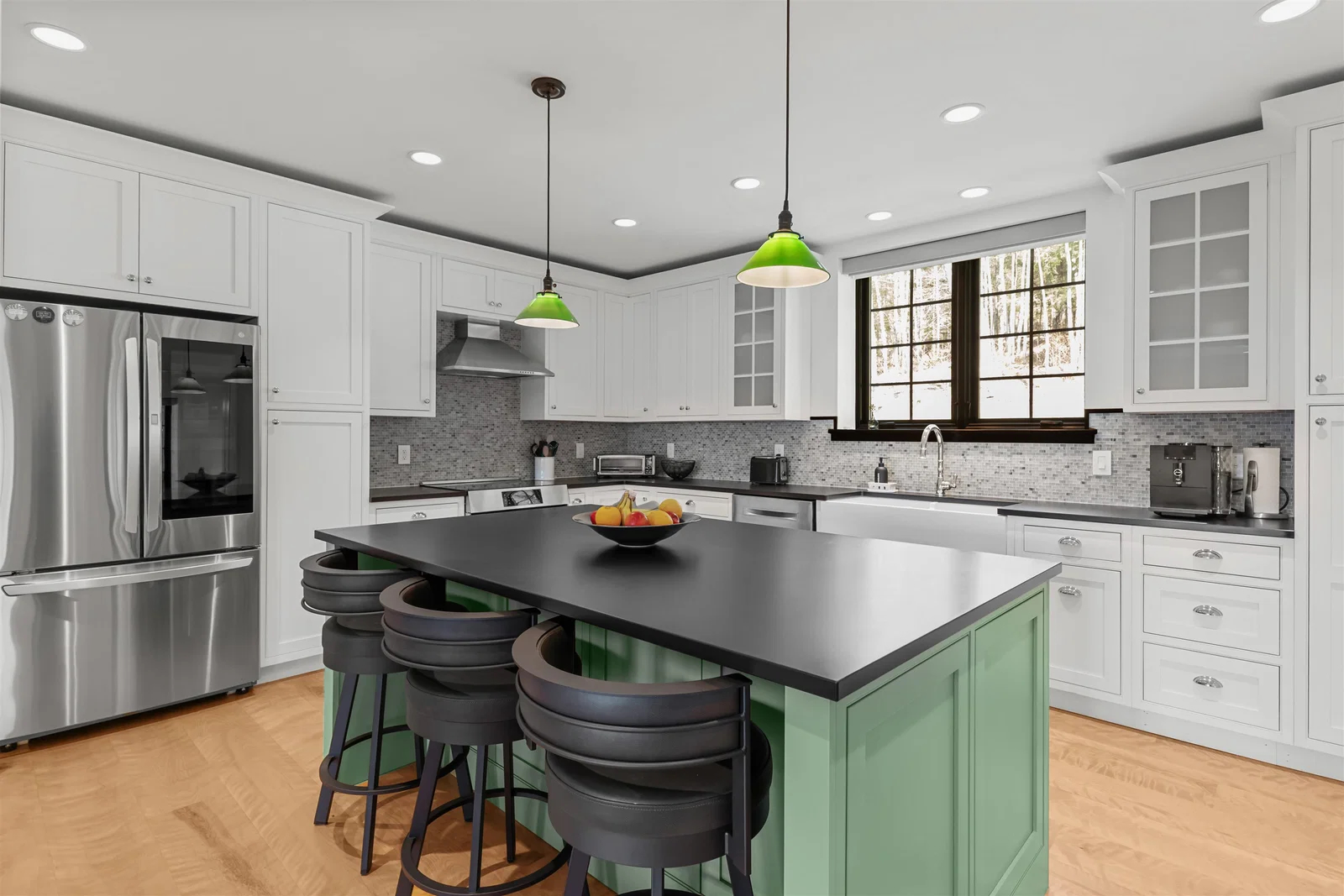
Modern Vermont luxury kitchen with oversized island and refined finishes

The kitchen balances clean modern function with warm Vermont character.

Inside, the architecture avoids the overbuilt heaviness that can plague mountain properties. Instead, the spaces feel thoughtful and grounded. Quarter sawn oak, curly birch, pine flooring, Italian slate countertops, radiant heat, a Jøtul wood stove, expansive glass, and warm natural light create an atmosphere that feels sophisticated without becoming sterile.

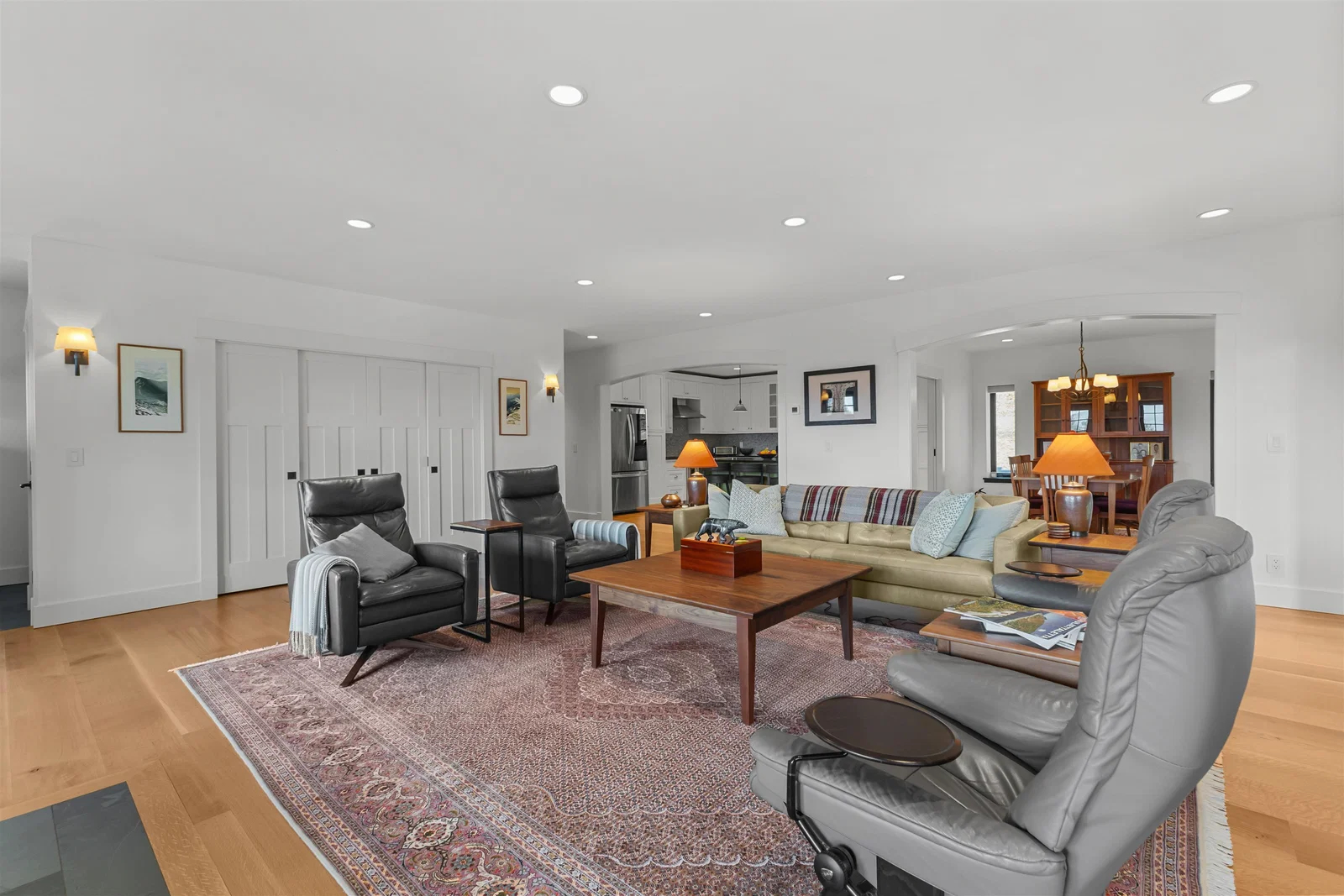
Sophisticated Vermont living room with open-concept design

Interior spaces feel refined, comfortable, and livable rather than overly staged.

And then there’s the location — which may be one of the property’s most understated strengths.

Waterbury occupies a uniquely strategic position within Central Vermont. Owners can access Stowe Mountain Resort, Sugarbush Resort, Montpelier, Burlington, and Interstate 89 without sacrificing privacy or the feeling of genuine separation from density and noise.

For many buyers relocating from larger markets, that balance is becoming increasingly valuable: proximity without exposure.

What’s particularly compelling is how the property embraces modern systems while still feeling emotionally Vermont. The brook. The woods. The changing light over the mountains. The terrace positioned to absorb the landscape rather than compete with it. There’s restraint here — and restraint is often what separates true luxury from expensive construction.

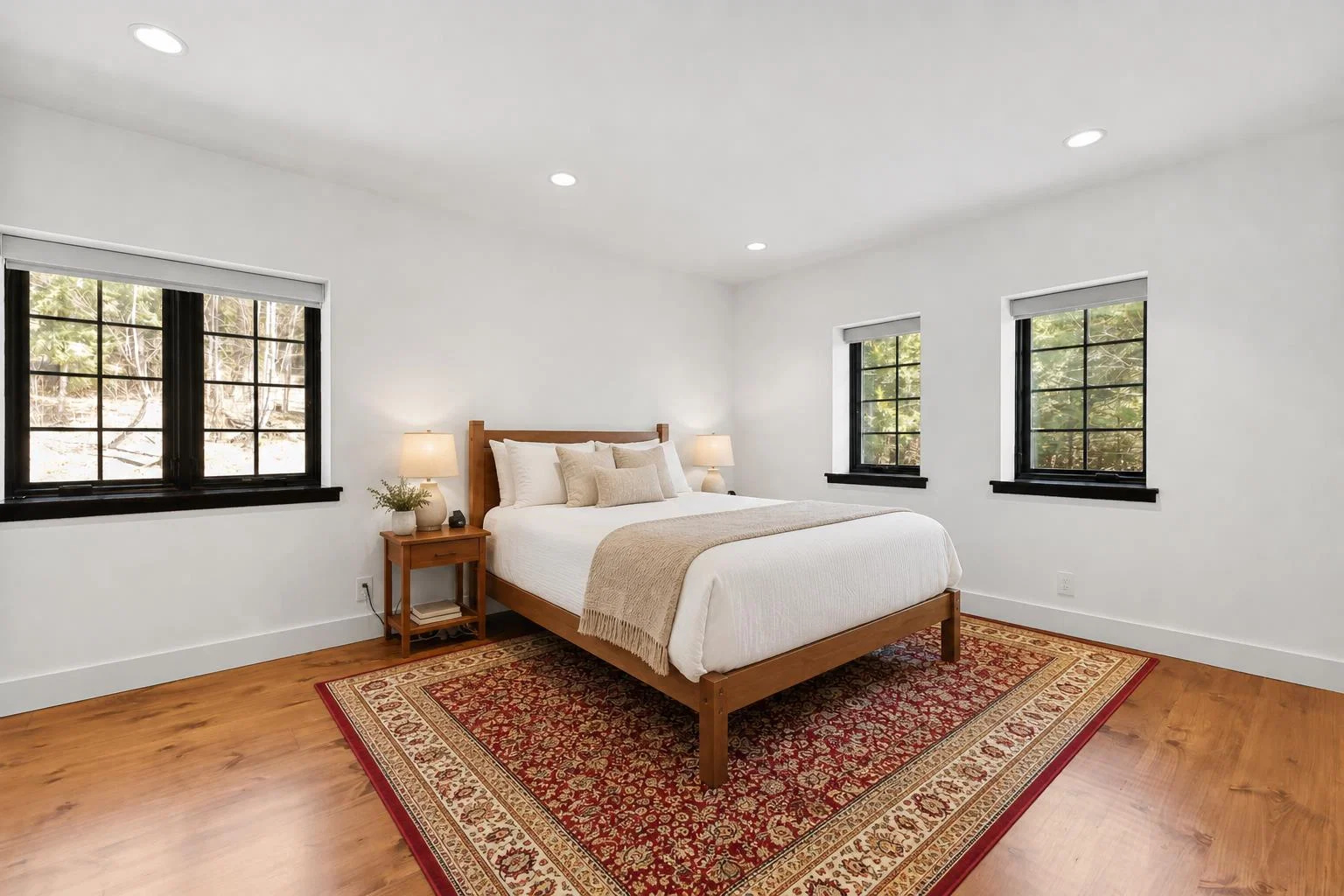
Luxury Vermont bedroom with warm wood floors and black-trim windows

Quiet, understated bedroom spaces continue the home’s calm architectural rhythm.

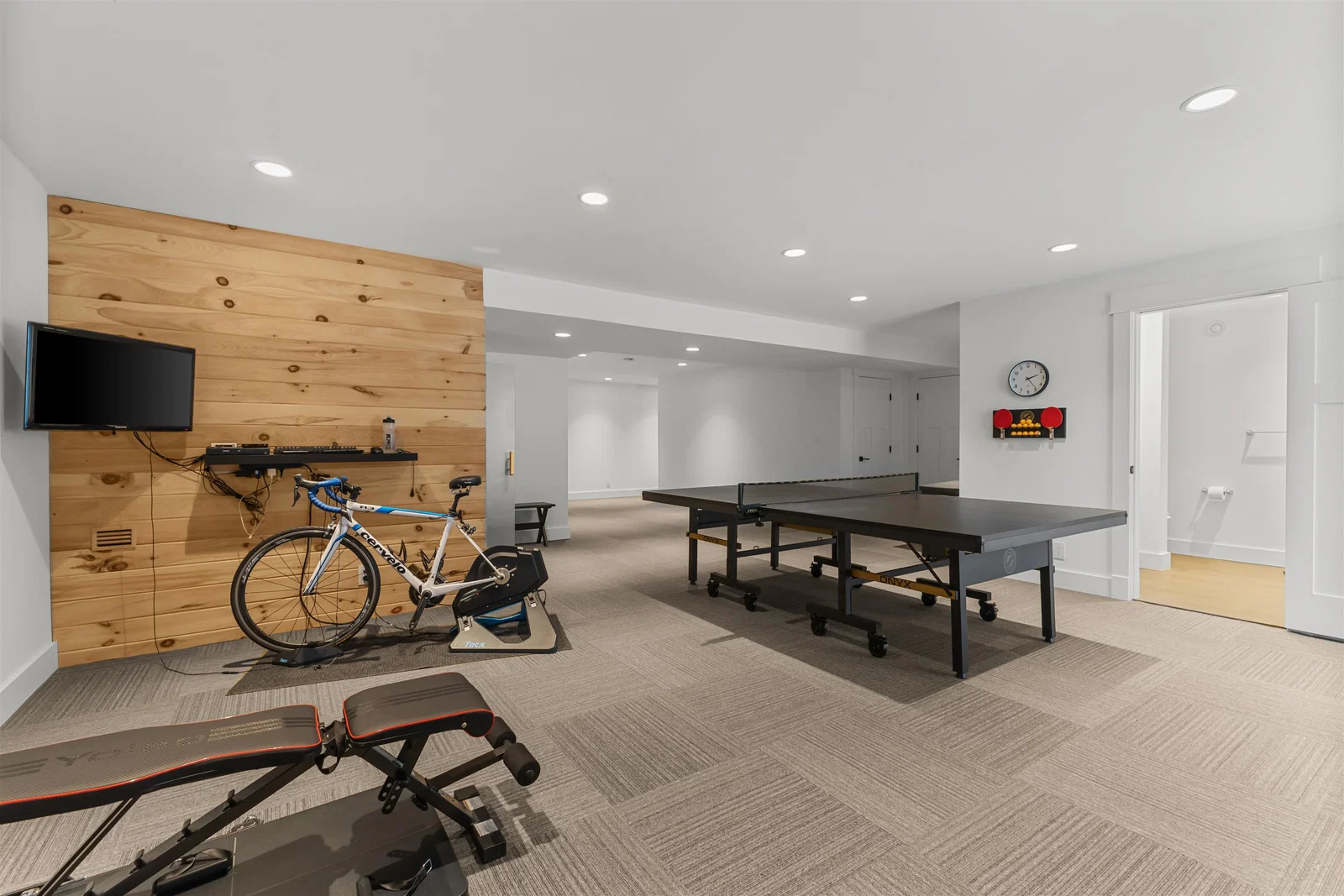
Finished lower level recreation and fitness space

The finished lower level adds flexible space for recreation, fitness, guests, or retreat.

A Different Kind of Vermont Buyer

Properties like this tend to attract a very particular type of buyer.

Not necessarily someone looking for maximalism.

Usually someone looking for permanence.

Someone who appreciates energy independence, sophisticated engineering, privacy, skiing, architecture, craftsmanship, and a calmer pace of life — but who still wants easy access to excellent dining, recreation, airports, and culture.

Increasingly, Vermont’s luxury market is attracting buyers who value operational intelligence as much as aesthetics. Homes that are efficient, resilient, and thoughtfully designed are beginning to stand apart from properties that simply chase square footage or trend-driven finishes.

This home sits firmly in that first category.

Why Representation Matters in Properties Like This

Luxury properties in Vermont are rarely just about the structure itself. They’re about context.

Road access. Winter exposure. Long-term operating costs. Local market nuance. Builder reputation. Recreation patterns. Infrastructure quality. Resale positioning. Seasonal usability.

That’s where experienced local representation becomes enormously valuable.

Trish Sawyer approaches the Central Vermont market with exactly that perspective — combining local knowledge, responsiveness, and a grounded understanding of how Vermont properties actually live day-to-day.

Her work in the region reflects a thoughtful approach to both lifestyle-driven and luxury-oriented buyers — particularly those seeking properties that balance Vermont authenticity with modern comfort and design.

Explore 290 Wood Farm Road

To learn more about this exceptional Waterbury property or arrange a private showing, contact Trish Sawyer at New England Landmark Realty.

Contact Trish Sawyer

View the full listing for 290 Wood Farm Road

Office: (802) 253-4711
Toll-Free: (866) 324-2427

Sources


Posted in Property Insights
May 12, 2026

Everyone's Watching Rates; Nobody's Watching Inventory

Two-Sentence Summary:

Mortgage rates fell to 6.30% this month, and everyone's celebrating. But the real leverage shift isn't the rate drop—it's the 11.7% jump in Vermont inventory that almost nobody's watching, and it changes everything for sellers deciding whether to move in May.

If You Only Do 3 Things
  • Stop obsessing over the rate drop. 7 basis points (6.83% to 6.30%) is table-stakes. Inventory is the actual play.
  • Recognize your window is closing, not opening. Rising inventory means your seller's advantage erodes as more homes compete for buyer attention.
  • If you're sitting on the fence about listing, the math says May is your month. Not because rates are perfect, but because supply is still manageable before summer crush.

Everyone's Watching Rates; Nobody's Watching Inventory

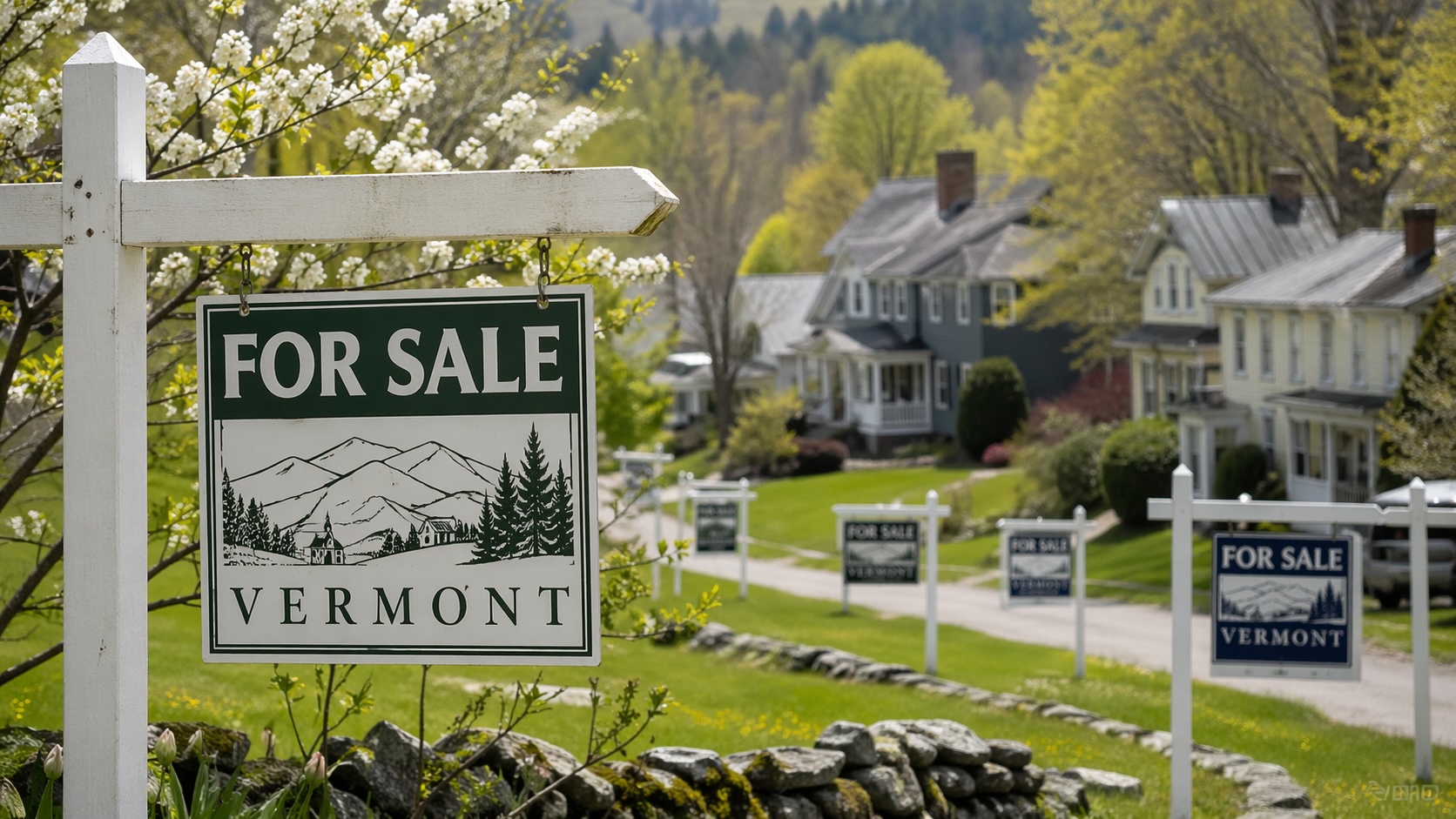
Vermont real estate for-sale sign in spring landscape with multiple homes visible in background
The market is crowded now. Most sellers don't realize it yet.

The headline hit your inbox last week: Freddie Mac mortgage rates dropped to 6.30%. Cable news ran the story. Your neighbor texted. Everyone started refreshing refinance calculators like it was a lottery number.

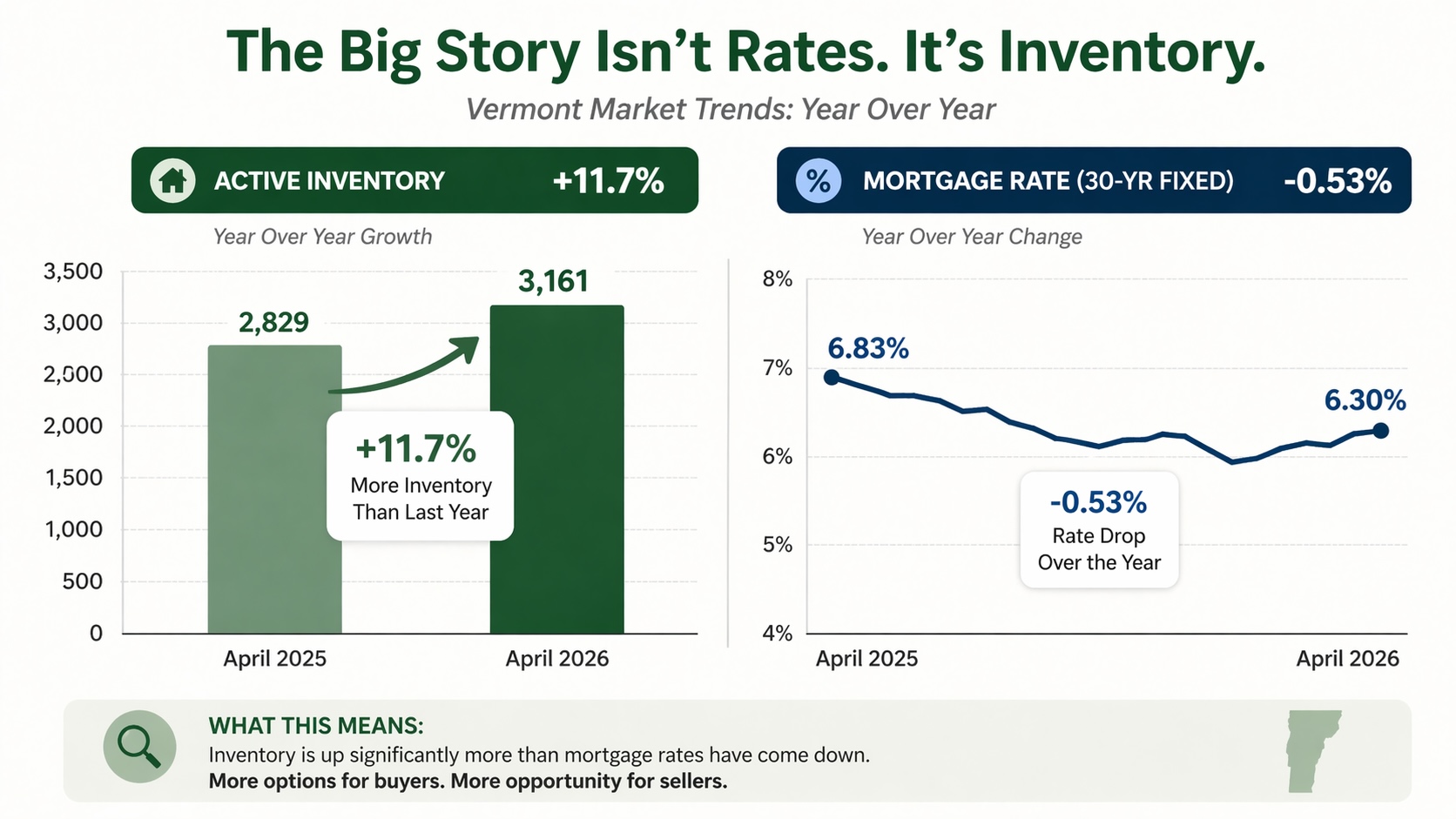
Here's what nobody mentioned: Vermont inventory jumped 11.7% year-over-year. That's not a headline. That's a market shift. And it changes everything for anyone thinking about selling in May.

Let's run the numbers.

What Actually Changed: The Rate Drop vs. The Inventory Surge

Direct answer: Mortgage rates fell 53 basis points year-over-year (6.83% in April 2025 to 6.30% in April 2026). But Vermont inventory rose 11.7% in the same period. Translation: Yes, rates matter. But rising inventory matters more for sellers because it erodes negotiating power faster than a lower rate creates buyer demand.

Freddie Mac 30-Year Fixed Rate:
April 2025: 6.83%
April 2026: 6.30%
Change: -53 basis points

The rate drop is real. A buyer financing $300,000 at 6.30% instead of 6.83% saves roughly $150 per month on principal and interest. That matters. But it's not transformative.

Vermont Housing Inventory (YoY):
April 2025: Baseline
April 2026: +11.7%
National context: +8.1% (March 2026)

Vermont is outpacing the national trend. More homes. More choice for buyers. Less leverage for sellers.

The Data: Why Inventory Matters More Than You Think

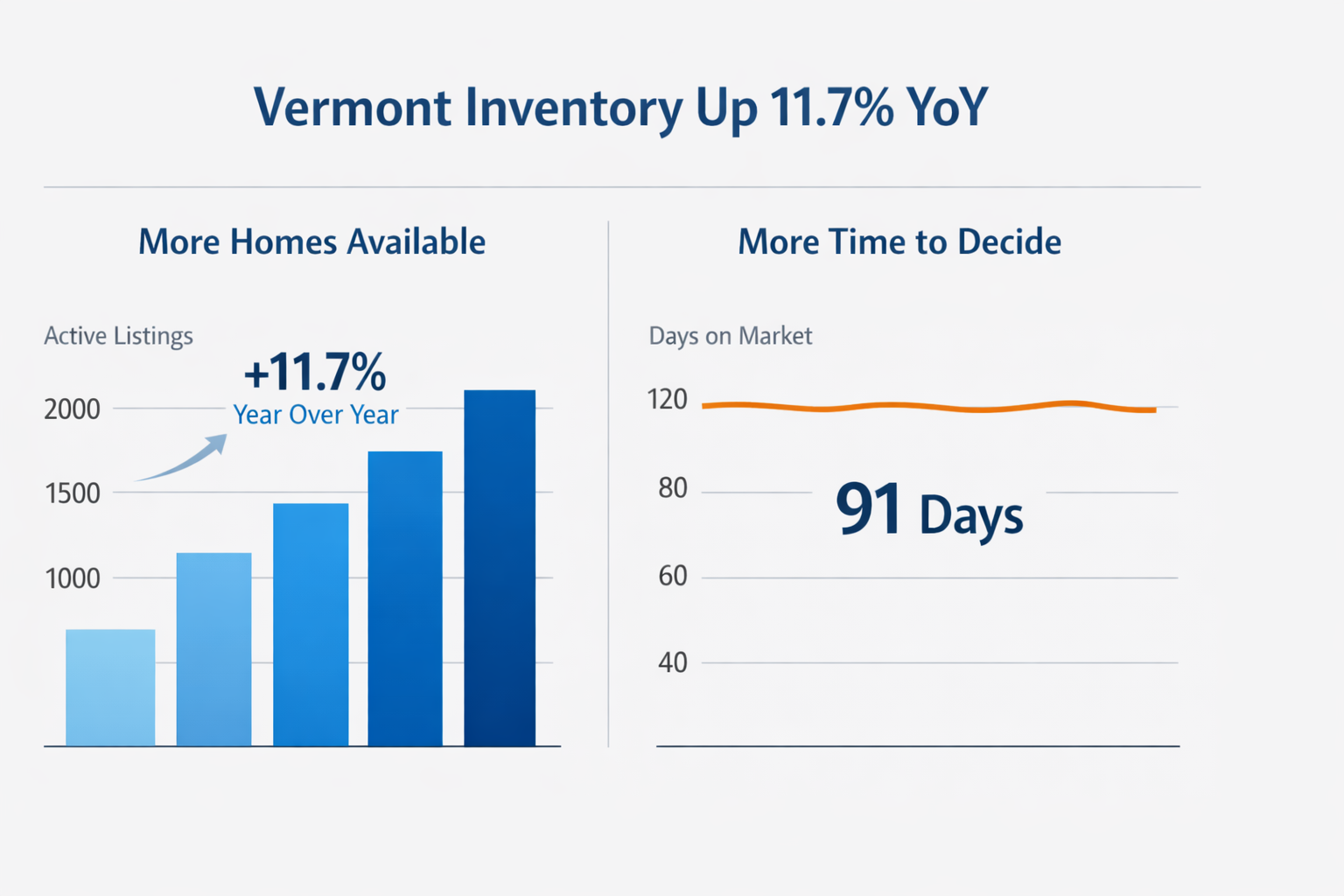
Direct answer: In a buyer's market, every additional home listing reduces your negotiating position. Vermont's 11.7% inventory surge means you're competing against 12% more homes. A 7 basis-point rate drop doesn't offset that. The math: More homes + Same buyer demand = Lower prices and longer selling timelines.

Graph showing Vermont inventory growth of 11.7% YoY against mortgage rate drop to 6.30%
The story nobody's talking about: Inventory (left) is outpacing the narrative around rates (right).

Here's the Vermont context: Statewide median home price sits around $382,000–$394,000. That's only 1.0–1.9% year-over-year appreciation. Translation: Prices aren't rising. They're holding steady at best.

When inventory rises and prices stall, the seller's window closes quietly. No drama. No alert. Just a slow erosion of your position.

Meanwhile, the media keeps talking about rates like that's the story. It's not.

So What Does That Mean for Vermont Sellers?

Direct answer: Your advantage is now, not later. As inventory climbs through spring and summer, your negotiating power declines. Buyers will have more options. You'll have more competition. The longer you wait, the more you'll need to discount or compromise to move the home.

Sellers contemplating the spring market decision at a window
This is the decision point. May is still manageable. June gets harder.

May is strategic. Not because rates are historically low (they're not). But because inventory is climbing, and you're still ahead of the summer crush.

Here's the real play: If you're sitting on the fence, the math favors moving now. Your home gets shown more. Buyers pay closer attention. You have leverage because supply hasn't reached saturation yet.

By July, when every seller who thought "I'll wait until summer" lists their home, the dynamic flips. You'll be one sign among many.

The Bottom Line: Math Doesn't Care About Headlines

Direct answer: Mortgage rates falling is good news for buyers. But as a seller, you should be more concerned about the rising inventory that's happening simultaneously. Your window for a strong negotiating position is May through early June. After that, the advantage disperses.

The rate drop is a 3-month story. The inventory surge is a 6-month story. One happened on the news. The other happened quietly in the MLS.

If you're a seller weighing the decision to list, here's the honest translation: You don't need rates to be perfect. You need supply to be imperfect. Right now, it still is. Wait another 8 weeks, and it won't be.

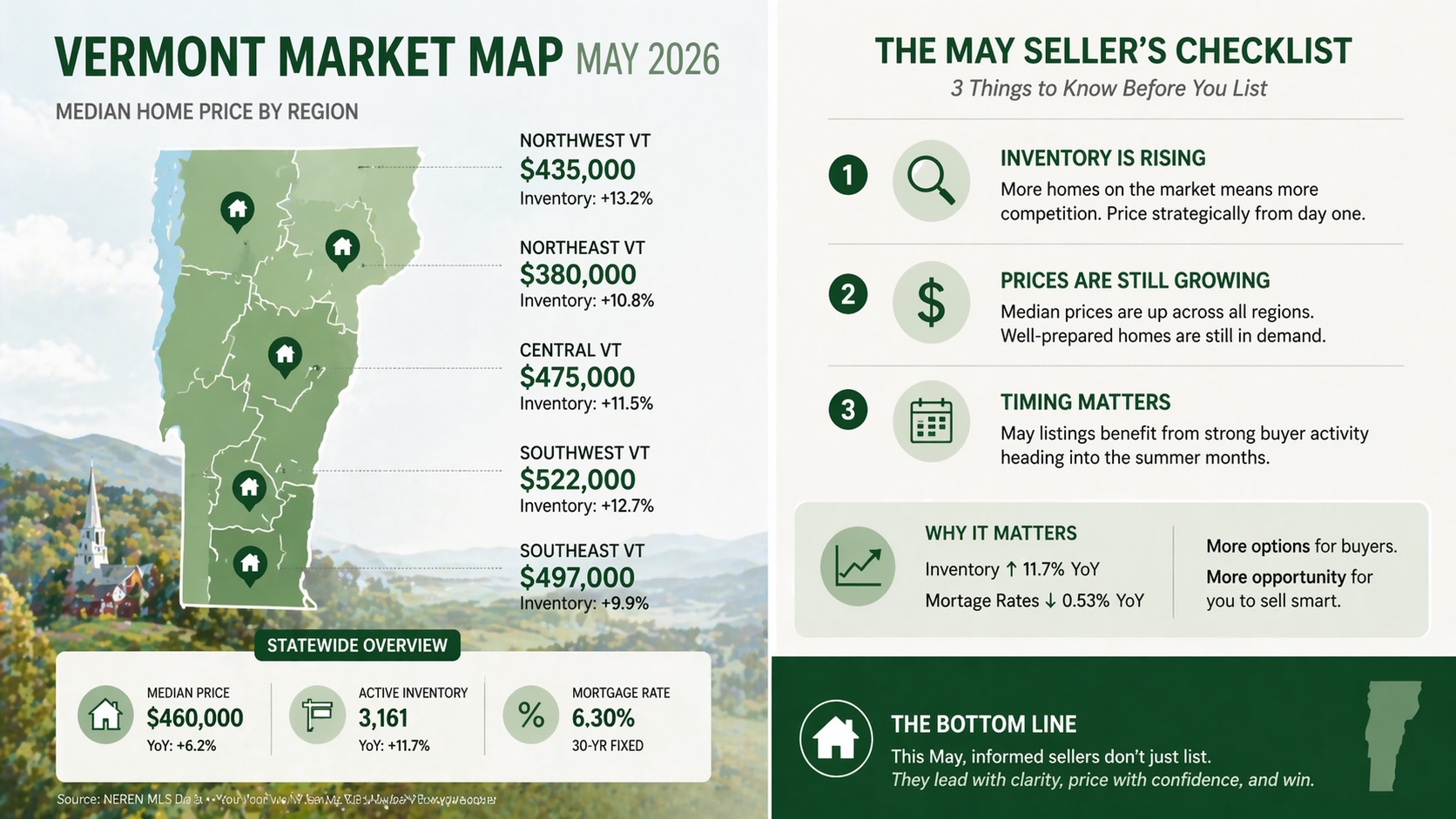
Vermont real estate market map showing regional data and seller checklist for May
May seller checklist: Price strategically, list now, leverage the window before summer inventory peaks.

What to Do Next

Direct answer: If you're thinking about selling, call New England Landmark Realty. We can run your specific numbers, show you your market position, and help you decide if May is your month. The data doesn't lie. But it does require translation.

Stop refreshing Freddie Mac. Start thinking about inventory. That's where the real decision lives.

Ready to Make the Move?

The numbers say May is your window. New England Landmark Realty helps sellers understand their actual market position and make decisions based on data, not headlines.

Or reach Tony directly: (802) 233-4107

Where to Go Next

Ready to understand your position? These guides help Vermont sellers make data-driven decisions:

Sources:

May 12, 2026

The Vermont Tax Debate Is Really a Growth Debate

New England Landmark Realty

The Vermont Tax Debate Is Really a Growth Debate

Jump to Key Takeaways

It is too easy — and too convenient — to blame education for Vermont’s property-tax pain. That argument is politically useful, but analytically thin. The deeper problem is that Vermont keeps trying to finance an ambitious, high-service state on a tax base that is not expanding fast enough. When you don’t build enough housing, don’t add enough workforce, and make growth harder than it should be, the cost doesn’t vanish. It gets spread across too few households and businesses.

The market data makes the point more clearly than the rhetoric. In March, Vermont’s median sales price reached $425,000. Active inventory rose to 1,741 homes, up 17.2% from a year earlier, yet properties still moved in an average of just 9 days. Demand is not the issue. People want to live here, buy here, and invest here. The problem is that Vermont still behaves like a place surprised by its own desirability. Scarcity may preserve character, but it also drives price, pressure, and exclusion.

Key Takeaways

Two-Sentence Summary

For Vermont homeowners, buyers, sellers, and local business leaders, the real question is not whether costs are rising but whether the state is willing to expand the base that carries them. This piece helps connect property-tax pressure to housing supply, land-use friction, and the economic consequences of staying scarce by default.

If You Only Remember 3 Things

  • Vermont’s tax strain is tied to a thin and slow-growing base, not just a spending fight.
  • Housing demand remains strong, but supply and permitting still lag the state’s needs.
  • Act 181 matters because land-use predictability is now part of the affordability conversation.

Quick Facts

  • Vermont’s March median sales price reached $425,000, while homes moved in an average of 9 days.
  • The state has identified about 140 underused properties that could potentially support housing.
  • Multiple communities approved local option taxes as they looked for revenue beyond the property-tax bill.

That is what makes the current fight over Act 181 so revealing. The law was meant to modernize land-use review by pushing housing toward designated growth areas, creating interim housing exemptions through 2027, and building a new map-and-tier system through the Land Use Review Board and Regional Planning Commissions. In concept, it is sensible: make it easier to build in the right places and more protective in sensitive ones. In practice, the planning architecture is still incomplete. The maps are still being developed, the rules are still phasing in through 2026, and the rollout has been technical enough to lose much of the public in translation.

That uncertainty is now colliding with politics. Speaker Jill Krowinski has acknowledged that many Vermonters — especially in rural communities — have not felt heard in the process, particularly around the road rule and Tier 3 rulemaking. Lawmakers are now moving to pull back part of the law after backlash from landowners and towns. That does not mean Act 181 was misguided. It means Vermont is trying to execute a major planning reset in real time, with unfinished rules, incomplete maps, and a public that has less patience for process than Montpelier tends to assume.

Meanwhile, the House has advanced legislation that would raise education property-tax rates by an average of 7%, following more than 40% growth in average education property taxes over the past five years. That increase is real, and painful. But the smarter takeaway is not that Vermont should spend the next decade searching for villains inside school budgets. It is that the state cannot keep loading fiscal pressure onto a narrow base while remaining ambivalent about the housing and economic growth that would broaden it.

There are signs Vermont understands this, at least in theory. The state has identified about 140 underused properties that could potentially be sold or leased for housing, and multiple communities have approved local option taxes as they look for revenue beyond the property-tax bill. Those are not silver bullets. But they point in the right direction: more homes, more workers, more commercial activity, and a planning system that can distinguish between stewardship and self-sabotage. Vermont does have a tax problem. More fundamentally, it has a tax-base problem. Until the state gets serious about expanding supply and reducing friction, tax pain will remain less a bug than a feature of the model.

Talk Through What This Means for Your Move

Whether you are buying, selling, or simply trying to make sense of Vermont’s market and policy direction, New England Landmark Realty can help you read the landscape before you act.

Where to Go Next

If this piece resonates, these next steps keep the conversation practical.

May 11, 2026

Whose Business Are You Building in Vermont?


New England Landmark Realty | Vermont Real Estate Perspective

Whose Business Are You Building in Vermont?

A practical note to agents choosing a team, a brokerage, or their next chapter.

Jump to Key Takeaways

Tony Walton

Most agents think they’re choosing a split. They’re not. They’re choosing a future.

That’s especially true in Vermont, where the market is smaller, the circles are tighter, and your name tends to travel faster than your marketing budget. In a place like this, your reputation is not a side dish. It’s the entrée.

Key Takeaways

Two-Sentence Summary

For Vermont agents weighing a team, brokerage, or next move, this piece helps clarify how public credit shapes long-term career value. Read it before you trade short-term support for long-term invisibility.

If You Only Remember 3 Things

  • In Vermont, your name travels fast and your track record lasts longer than any split.
  • Public credit is career equity, not vanity.
  • If a team cannot clearly explain how your work stays visible, ask harder questions before you commit.

Quick Facts

  • Vermont requires the brokerage firm’s registered name to be the largest and most prominent identifier in real estate advertising.
  • Misleading advertising by a real estate licensee can be treated as unprofessional conduct in Vermont.
  • Some MLS systems already allow production credit to be split between a team and an individual agent.

Where to Go Next

So this isn’t an anti-team argument. Good teams are useful. Sometimes they’re the fastest way to learn the business, build confidence, and avoid expensive rookie mistakes. But not every team is a launchpad. Some are just very polite toll booths. They help you close deals, yes. But the real question is whether they help you build visible, portable career equity in your own name.

That’s the issue.

In Vermont, clarity isn’t optional

Vermont’s regulatory framework leans toward clarity, and that matters. This is a licensed business. The state expects order, transparency, and accountability.

Vermont law is not subtle about misleading advertising. It treats dishonest or misleading advertising by licensees as unprofessional conduct. And Vermont’s false advertising statute makes clear that advertising real estate with anything untrue, deceptive, or misleading is a legal problem, not a branding choice.

The administrative rules go further. In Vermont, every real estate ad must conspicuously display the brokerage firm’s registered name, and that name must be the largest and most prominent identifier — larger than the agent’s name, phone number, team name, and web address.

That is a very Vermont kind of rule: practical, no-frills, and rooted in one simple idea — the public should be able to tell who they are dealing with.

Why this matters for agents

If you’re an agent on a team, especially a newer one, the temptation is obvious: leads, systems, signs, training, momentum. All good things. But if the public record of the work keeps flowing to someone else, then you may be gaining income while losing authorship.

And in this business, authorship matters.

Public credit isn’t vanity. It’s career equity.

It is the proof that your name belongs in the room. Proof that you know how to win business, manage clients, handle pressure, and close. If that proof is invisible, then some part of your future is being warehoused in someone else’s brand.

One of the clearest arguments for giving agents visible credit is also the simplest: it creates transparency, helps people measure progress, builds healthy competition, and strengthens the whole team by showing each member as productive and capable. In other words, giving people credit for their work doesn’t weaken the team. It proves the team is real.

Agents know this instinctively. You see it every time the subject comes up in the field. One agent says they worked dozens of deals and hardly any showed up in their profile. Another realizes the closings are real, the effort is real, the paycheck is real — but the public record makes it look like someone else did the work. That’s not just frustrating. It’s expensive.

Because if the record doesn’t follow the work, the worker’s value gets discounted.

The good news: this is often a choice, not a technical problem

Here’s the important part: this usually isn’t some unavoidable flaw in the system.

MLS platforms already show that team and individual credit can be split. The industry has tools for that. Which means a lack of visible credit is often not a software problem. It’s a philosophy problem.

Or, more precisely, an incentives problem.

Some leaders want to build a bench of visible professionals. Others want to build a solar system where every planet has to orbit the sun on the bus bench. One model creates enterprise value. The other creates dependence.

That distinction matters even more in Vermont, where credibility compounds slowly and publicly. This is not a place where you vanish into the crowd. In a smaller market, your name is either gaining weight or losing it.

Three questions every Vermont agent should ask

Before you join a team — or before you stay on one — ask three things.

First: Who gets the public credit when a transaction closes?

Not just the commission. The credit.

Second: If I leave in two years, what proof of production follows me?

Because you may love the team now and still outgrow it later.

Third: Am I building a business in my own name, or helping build one I don’t control?

That’s not paranoia. That’s adulthood.

A lot of agents don’t ask these questions up front because the early stuff is seductive. Training. Lead flow. Support. Culture. Momentum. Fair enough. But a structure can feel generous in year one and still be quietly starving your independence by year three.

That’s why this matters.

You are not just choosing where to hang your license. You are choosing where your effort accumulates.

Bottom line

Vermont doesn’t need fewer teams. It needs better ones.

Teams that create lift, not fog. Teams that understand public credit is not just ego fuel — it’s career equity for independent contractors building a life in a small, competitive, trust-based market. Teams that know the goal is not to keep people small enough to stay, but strong enough to matter.

Because in Vermont real estate, the most important thing you build is not volume.

It’s credibility with your name attached to it.

And if your name disappears, some part of your future goes with it.

Talk with New England Landmark Realty

If you want a straight answer about team structure, brand equity, or how to build a real career in Vermont real estate, start here.

Office: (802) 253-4711

Toll-Free: (866) 324-2427

Tony’s Cell: (802) 233-4107

Website: https://www.nelandmark.com

Guides: Buyer Guide and Seller Guide

Endnotes

Posted in Agent Resources
April 27, 2026

Adding a Sunroom: Smart Expansion or Expensive Flattery?

House in Progress • New England Landmark Realty


A good sunroom does more than catch light. It carries gray afternoons, guest overflow, quiet mornings, and the hard months when a Vermont house needs one more place to exhale.

Vermont • House in Progress

Jump to Key Takeaways

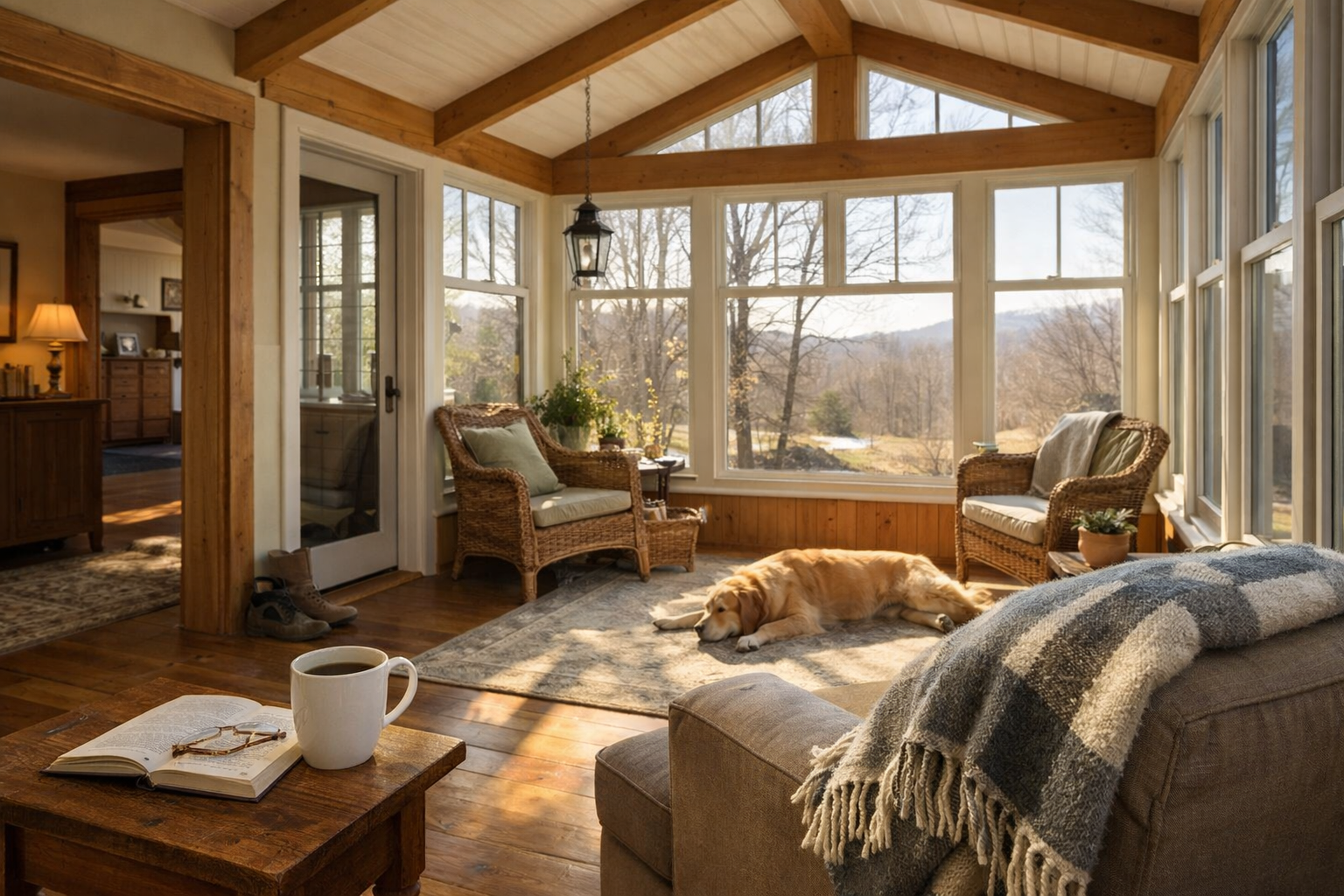
A four-season Vermont sunroom addition connected to the home with soft morning light.

Hero image: a four-season Vermont sunroom that feels attached to daily life, not staged for a brochure.

By late winter, every house reveals its weak spots.

One room gets crowded by 4 p.m. One chair gets dragged toward the only decent patch of daylight. Boots gather near a door that was never meant to handle real weather. The dog finds the sun before anyone else does, which is often the best design feedback in the house.

Key Takeaways: fast read before the full piece

Two-Sentence Summary

This piece is for homeowners weighing a sunroom addition and trying to separate daily usefulness from design temptation. In Vermont, the smartest sunrooms earn their keep in winter, on gray afternoons, and in the parts of home life that need relief.

If You Only Remember 3 Things

  • A sunroom should solve a function problem before it becomes a design project.
  • Four-season usefulness matters more than summer charm.
  • The best additions reduce friction in the house, not just increase admiration of it.

Quick Facts

  • In Vermont, a four-season room will almost always out-earn a seasonal one in daily usefulness.
  • Sunrooms work best when they connect to a room the household already uses hard.
  • Resale logic improves when the addition feels integrated, insulated, and clearly livable year-round.

That is usually when the sunroom enters the conversation.

Not because homeowners suddenly need more beauty. Because the house starts feeling emotionally underlit. A good sunroom can fix that. A bad one becomes a very expensive compliment.

Why this matters

A sunroom works when it improves the hardest hours in a house, not the easiest ones. That matters more in Vermont, where winter light runs short, mud season expands the perimeter of mess, and families spend long stretches negotiating with the indoors.

Most additions get justified with broad language: more space, better flow, added value. Fine. None of that helps if the room ends up too cold in January, too hot in July, and empty whenever real life shows up wearing wet boots.

A sunroom sits in a dangerous category of renovation: highly desirable, highly photogenic, and easy to oversell to yourself. Glass has charisma. So does the idea of morning coffee in a room full of light. But charisma is not function, and coffee only lasts twenty minutes.

The better question is more ruthless: what burden will this room carry?

Morning light counts. Overflow seating counts. A place to read, work, recover, host, or simply get out of the traffic pattern of the house counts. Vague optimism does not.

The real tension

Most people are not adding a sunroom because they need another room. Most are trying to correct a mood, a light deficit, or a layout problem they have grown tired of negotiating. The tension is simple: solve the real problem, or build a prettier version of the wrong answer.

A sunroom often arrives dressed as a luxury, but the best ones behave like infrastructure. They absorb family spillover. They create a second zone for adults who would like one conversation without competing with a television, a homework crisis, and someone asking where the charger went.

That is the upside.

The downside is familiar. A homeowner adds glass to the back of the house when the real problem lives somewhere else: a dark kitchen, poor circulation space (the room people need to move comfortably through a home), a bottleneck near the entry, or a family room that never had a reason to succeed. In that case, the sunroom becomes an annex for good intentions.

A sunroom that only works in July is a very expensive compliment.

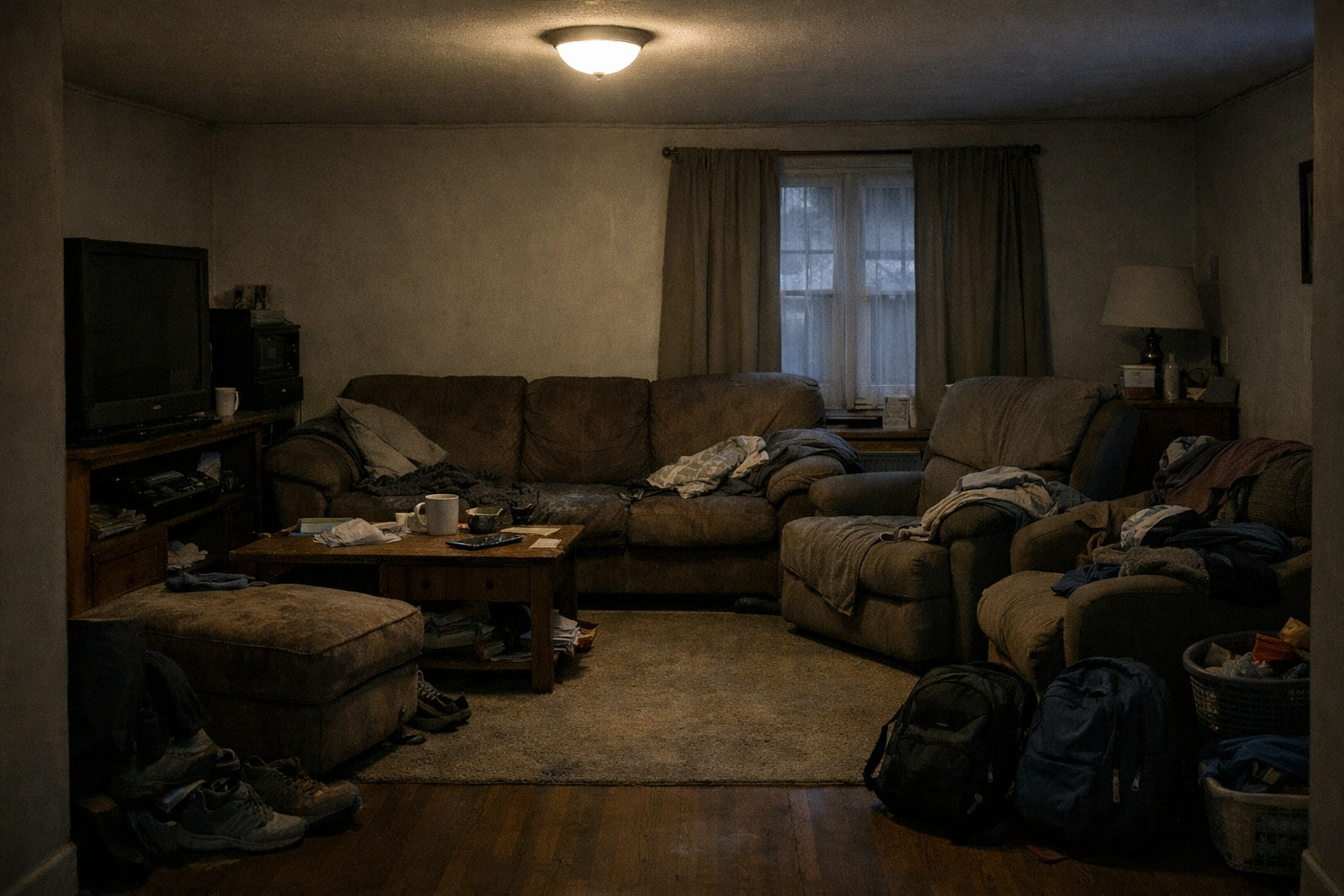
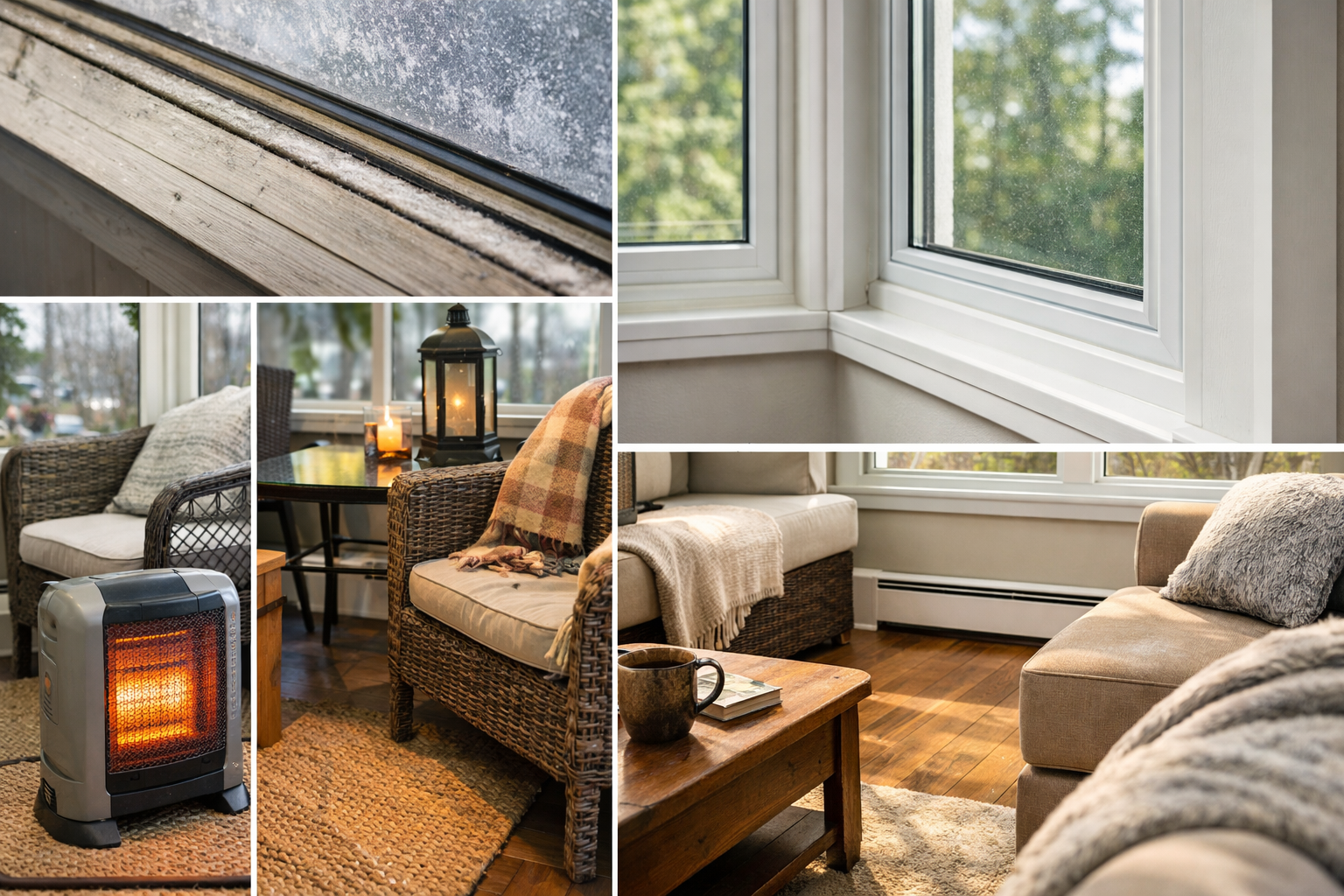
A dim, overworked family room in late winter light.

Friction point: the room that makes an addition look obvious before the diagnosis is finished.

What works

The best sunrooms do three things well: they connect cleanly to the rest of the house, they function in more than one season, and they support actual behavior instead of fantasy behavior. In New England, that means treating the room like living space, not like a screened porch with ambition.

Three moves tend to separate the smart additions from the decorative ones.

First, place the room where life already wants to drift. Off the kitchen works for obvious reasons. Off a strained family room can work even better. The room should catch existing energy, not demand that everyone invent a new routine to justify it.

Second, design for February, not June. Insulation, flooring, heating strategy, and furniture choices matter more than the romance of the windows. A room with radiant warmth underfoot and a chair someone actually wants to sit in will beat a prettier room every time.

Third, give the room more than one job. Reading room. coffee room. guest overflow. plant refuge. quiet call zone. homework spill space. The winning rooms are never single-purpose because real houses are never single-purpose.

Beauty still matters. Of course it does. But beauty that earns its keep looks different. It hides wear. It handles light well at 8 a.m. and 4 p.m. It survives a dog, a tray, a wet sleeve, and a long winter without turning precious.

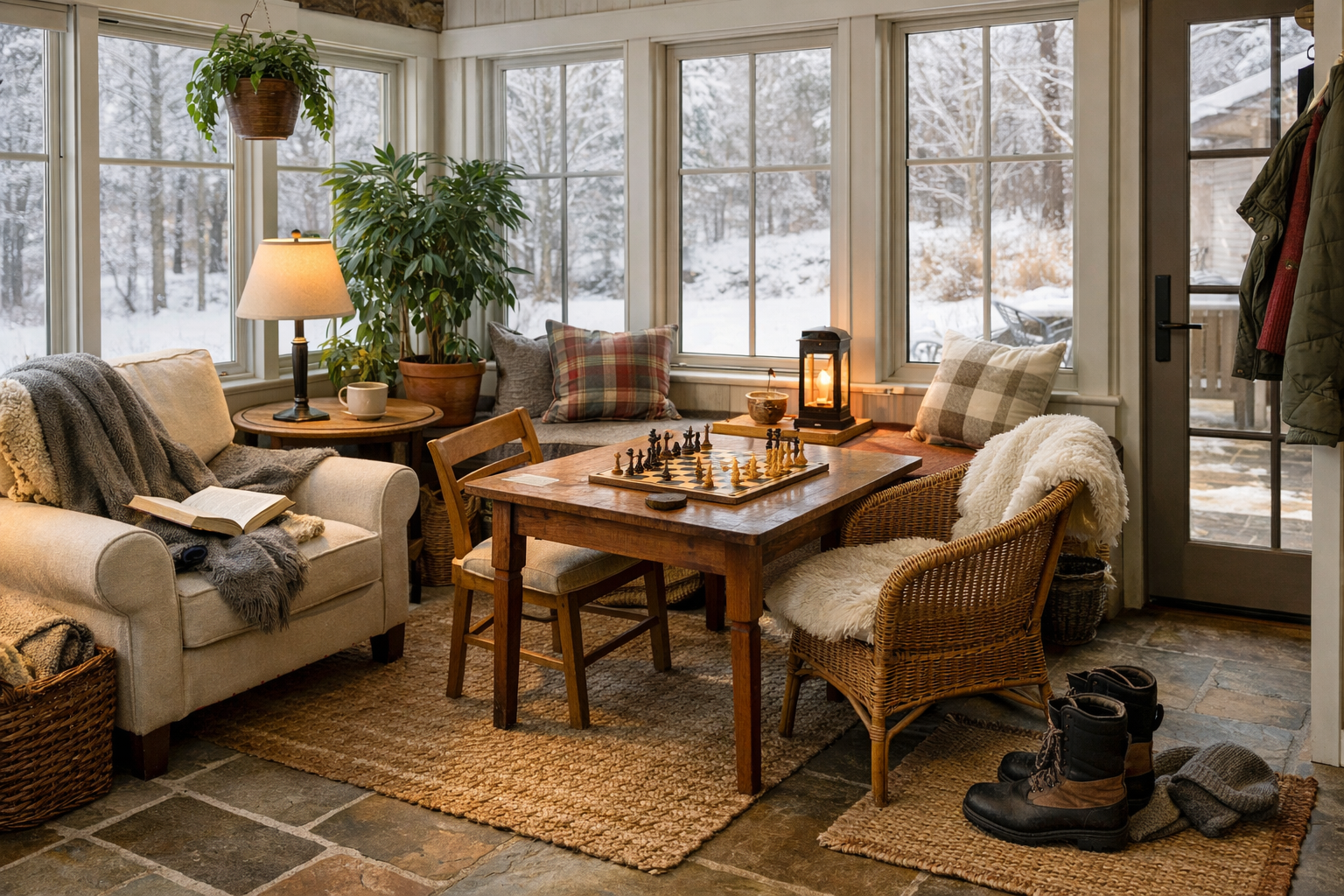
A well-designed sunroom in active use during cold weather.

What works: a sunroom that reads as real living space, not a seasonal prop.

The home turn

A good sunroom changes more than the square footage. It changes the emotional weather of the house. That matters because homes are judged less by their best moment than by how they behave when everyone is tired.

Nobody praises the right room in real time. Nobody stops and says, this addition has transformed our domestic rhythm. They just migrate there. Someone reads. Someone exhales. The dog takes the warm corner. A guest lingers after dinner instead of drifting toward the door.

That is the shift worth paying for.

Support often looks humble. Better light at the hour people feel most depleted. One more place to be alone without leaving the family. A softer landing spot between outside weather and inside life. The room carries more than furniture. It carries relief.

Bottom line

A sunroom makes sense when it reduces friction, improves four-season living, and gives the house a better place to hold real life. If it cannot do that in Vermont conditions, skip the flattery and fix the deeper problem first.

A split-composition comparison showing what separates a pretty sunroom from a usable one.

Decision detail: the difference between a charming room and a room that survives February.

Start with diagnosis, not drawings.

Ask three questions. Which hour in the house feels worst? Where does everyone go when they want light, quiet, or separation? Would this addition still make sense in mud season, stick season, and the dead center of winter?

That is the whole case.

The best rooms do not beg to be admired. They make the day go better.

Where to Go Next

Keep the next click useful. Start with the guide that matches the side of the transaction you’re on, or head back to New England Landmark Realty for current Vermont listings and market context.

Talk it through before you build it

Some additions increase value. Some just increase square footage. If you want a straight answer on how a project may land with Vermont buyers, reach out to Tony Walton and New England Landmark Realty.

Office: (802) 253-4711  |  Toll-Free: (866) 324-2427  |  Tony's Cell: (802) 233-4107

April 25, 2026

The Overhang Equation: How Much Roof You Need (and Why Architects Get It Wrong)

April 3, 2026 | Jump to Key Takeaways

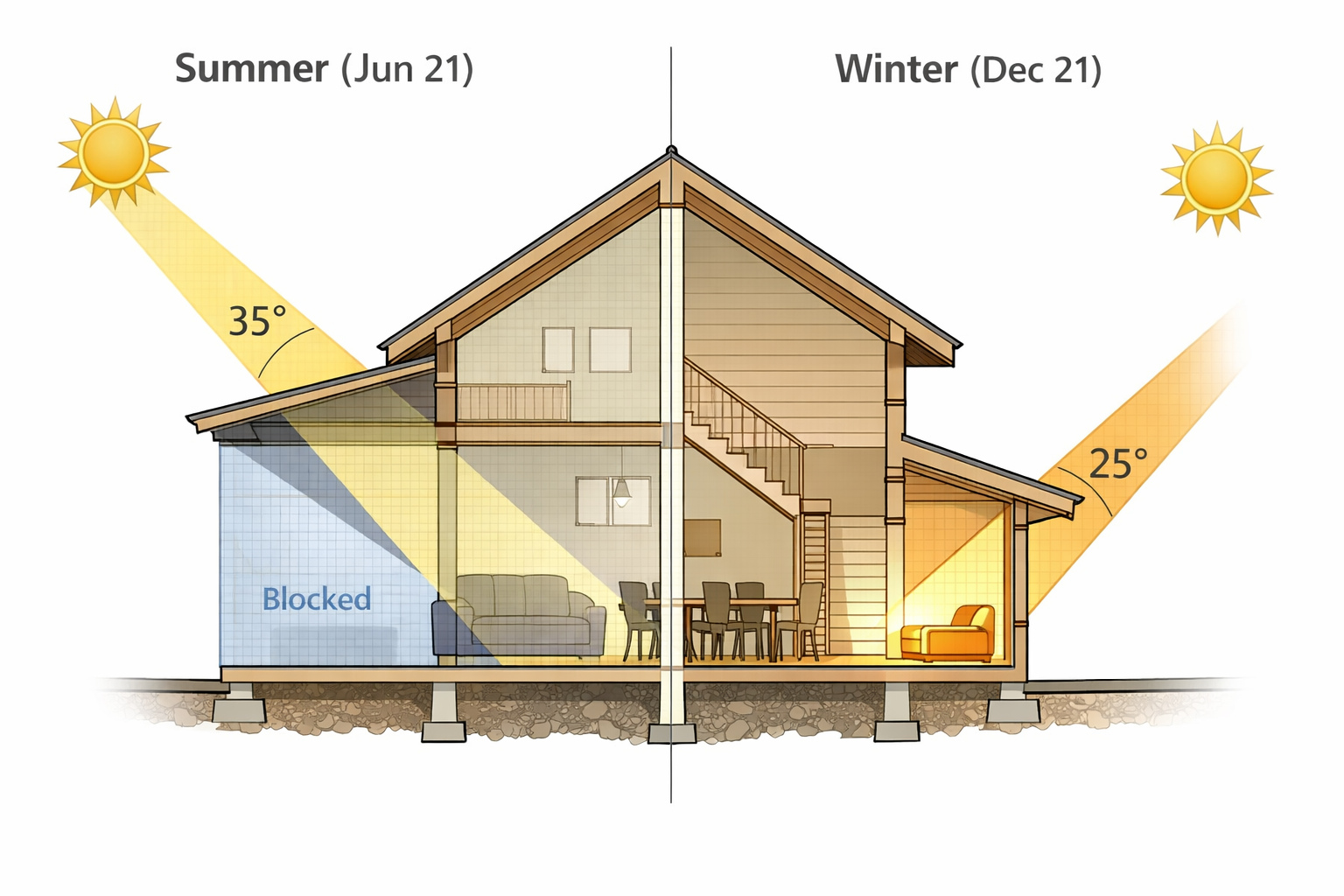
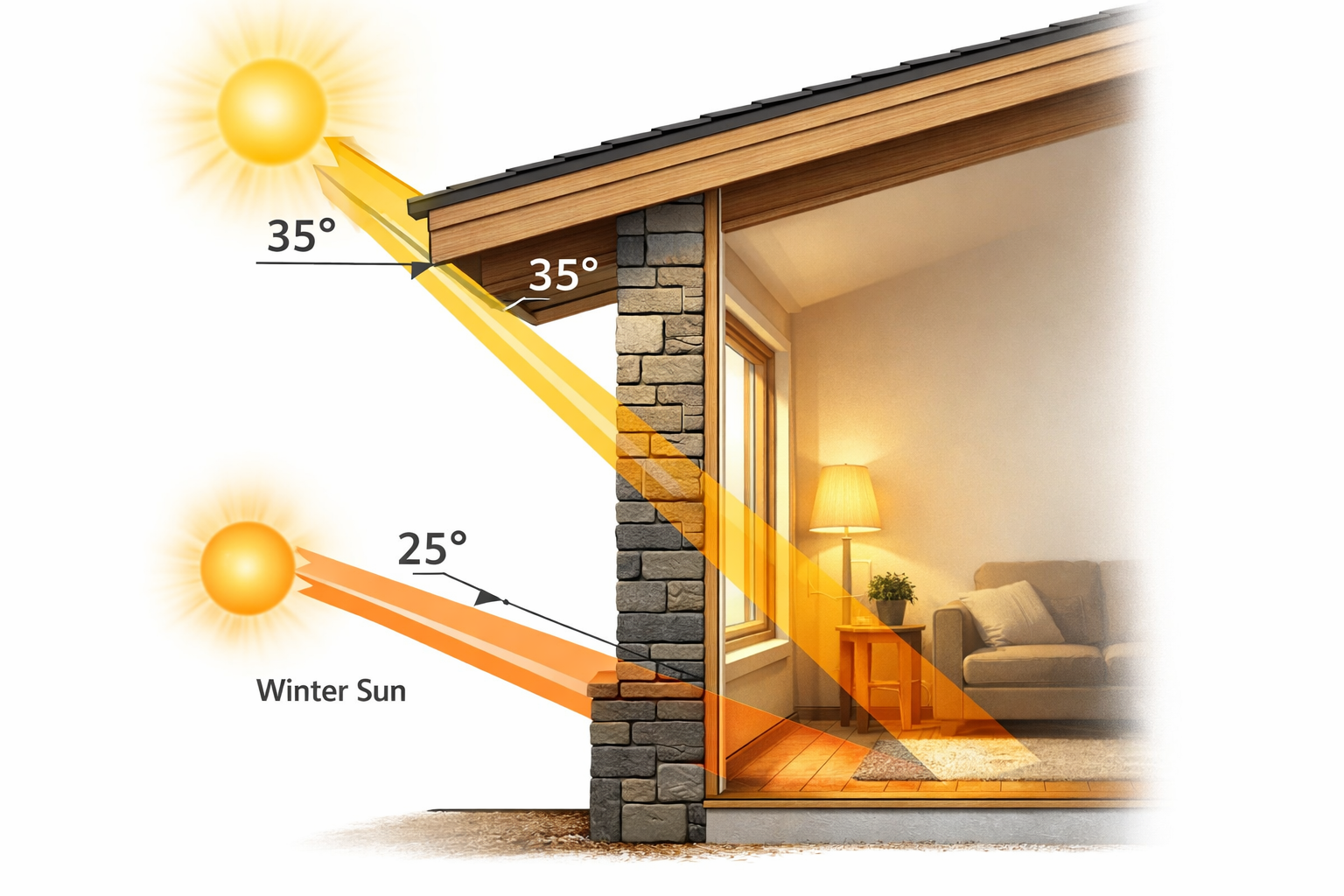
Cross-section showing summer sun blocked by overhang at 62 degrees and winter sun penetrating at 15 degrees—solar angle diagram for Vermont.

Summer sun (high angle, ~35°) is blocked by a properly sized overhang. Winter sun (low angle, ~25°) penetrates below, warming south-facing walls. This isn't aesthetics—it's physics that pays for itself.

Two-Sentence Summary: An overhang—the horizontal roof extension beyond your walls—is Vermont's oldest and cheapest climate technology, yet most architects size it wrong. Get the math right, and you block summer heat, prevent ice dams, and protect your siding for 30 years; get it wrong, and you're paying $15K–$40K in repairs before you turn 50.

If you only do 3 things:

  • Calculate your winter and summer sun angles for your specific latitude and slope orientation before the architect draws a line. (This takes 20 minutes and a solar calculator—non-negotiable.)
  • Size your overhang to block summer sun on south and west walls, but allow winter sun penetration. Use the formula: overhang depth = wall height ÷ tan(summer sun angle) − tan(winter sun angle). Ballpark for Central Vermont: 24–36 inches on south; 12–18 inches on north.
  • Have your architect stamp the overhang depth on the final plans and tie it to site orientation. Verbal "just do a good overhang" costs you when the framer eyeballs it in August.
Key Takeaways

Quick Facts

  • Payback window: A 30-inch overhang costs ~$3,000 more to frame but saves $800–$1,200/year in cooling and ice dam prevention. You're cash-positive in 3–5 years.
  • Solar angle precision: Summer sun at 62°, winter sun at 15° in Central Vermont. This 47° difference is the entire equation.
  • Resale impact: Homes with passive solar design (starting with overhang sizing) command 5–8% premiums over poorly oriented alternatives.

Why This Matters

Direct Answer: An overhang is not ornament. It's thermal engineering baked into the roof line. Vermont's freeze-thaw cycle, ice dam physics, and seasonal sun angles mean an undersized overhang is a 30-year tax on your energy bills, maintenance, and resale value. Get it right once, and it works forever.

Most homeowners and even some architects treat the overhang as a design afterthought—a question of "how much is too much?" or "do we need a porch?" That's backwards. In Vermont, an overhang is load-bearing climate technology. It blocks 60–80% of summer solar gain on south and west walls (saving you $1,200–$1,800 per year in air conditioning and cooling load). It prevents ice from backing up under your shingles (saving you $3,000–$8,000 per ice dam repair). It protects wood siding and trim from UV damage and rain saturation, extending their life by 10–15 years.

But—and this is critical—only if it's sized right. A 10-inch overhang on a south-facing wall in Central Vermont is almost useless. A 48-inch overhang blocks winter sun you actually need. The equation is latitude-specific, orientation-specific, and time-specific. Skip the math, and you're flying blind.

The Principle: Solar Angle Math

Direct Answer: The sun follows a predictable arc. On the summer solstice (June 21) in Central Vermont, it reaches ~62° above the horizon at solar noon. On the winter solstice (December 21), it reaches only ~15°. An overhang sized for this difference lets winter sun warm your walls while summer heat bounces off your roof. This is free thermal control.

Here's the mechanism: An overhang's job is to cast a shadow on the wall below during summer and allow sunlight through during winter. Because the sun's angle changes by ~47° between June and December, the same overhang that blocks noon sun in July allows noon sun through in January. This is not guesswork—it's trigonometry that's been working since Vermont settlers built the first barns.

The formula is straightforward: Overhang depth = wall height ÷ tan(summer sun angle) − tan(winter sun angle). For a 9-foot wall in Central Vermont (44°N latitude) with a south-facing exposure:

Overhang depth = 9 ft ÷ tan(62°) − tan(15°)
Overhang depth = 9 ft ÷ (1.88 − 0.27)
Overhang depth = 9 ft ÷ 1.61
Overhang depth ≈ 30 inches

Translation: A 30-inch overhang on a 9-foot wall will block the summer sun but let winter sun through. It works year-round without moving parts, maintenance, or electricity. Compare that to blinds, shutters, or active cooling systems—all of which cost money, break, and require decision-making.

Vermont Reality Check: Ice Dams and Freeze-Thaw Dynamics

Direct Answer: Vermont's freeze-thaw cycle creates a secondary overhang problem: ice dams. Warm attic air melts snow on the roof, water runs down and hits the cold eave, freezes, and backs up under shingles. An undersized overhang (less than 18 inches) means the ice dam forms at the wall line and water intrusion is guaranteed. A properly sized overhang pushes the ice dam out past the heated zone, keeping water out of your walls.
Undersized roof overhang with ice dam formation and water intrusion damage visible on siding below.

An undersized overhang (8–12 inches) allows melt water to refreeze at the wall line. Ice dams form, water backs up under shingles, and by March you're facing interior water damage, mold, and $8,000 in repairs. This is what happens when architects skip the math.

Here's why it matters: An ice dam isn't just an aesthetic nuisance. Water that penetrates your roof plane can sit in the cavity for weeks, soaking insulation, rotting framing, and seeding mold. By the time you see water staining on your living room ceiling in April, the real damage is already done—inside your walls, where you can't see it.

A proper overhang (20+ inches) pushes the eave line far enough out that melting snow drips clear of your walls. The ice still forms on the overhang itself, but the water falls safely past the foundation. It's the difference between $300 worth of roof rake in February and $15,000 in remediation in May.

What Works: Three Moves to Get It Right

Direct Answer: Size overhangs by cardinal direction, calculate for your latitude, and put the numbers on the plans. Most projects fail because architects wing it, framers improvise, and by the time you notice, it's too late. These three moves lock in the right answer before work begins.

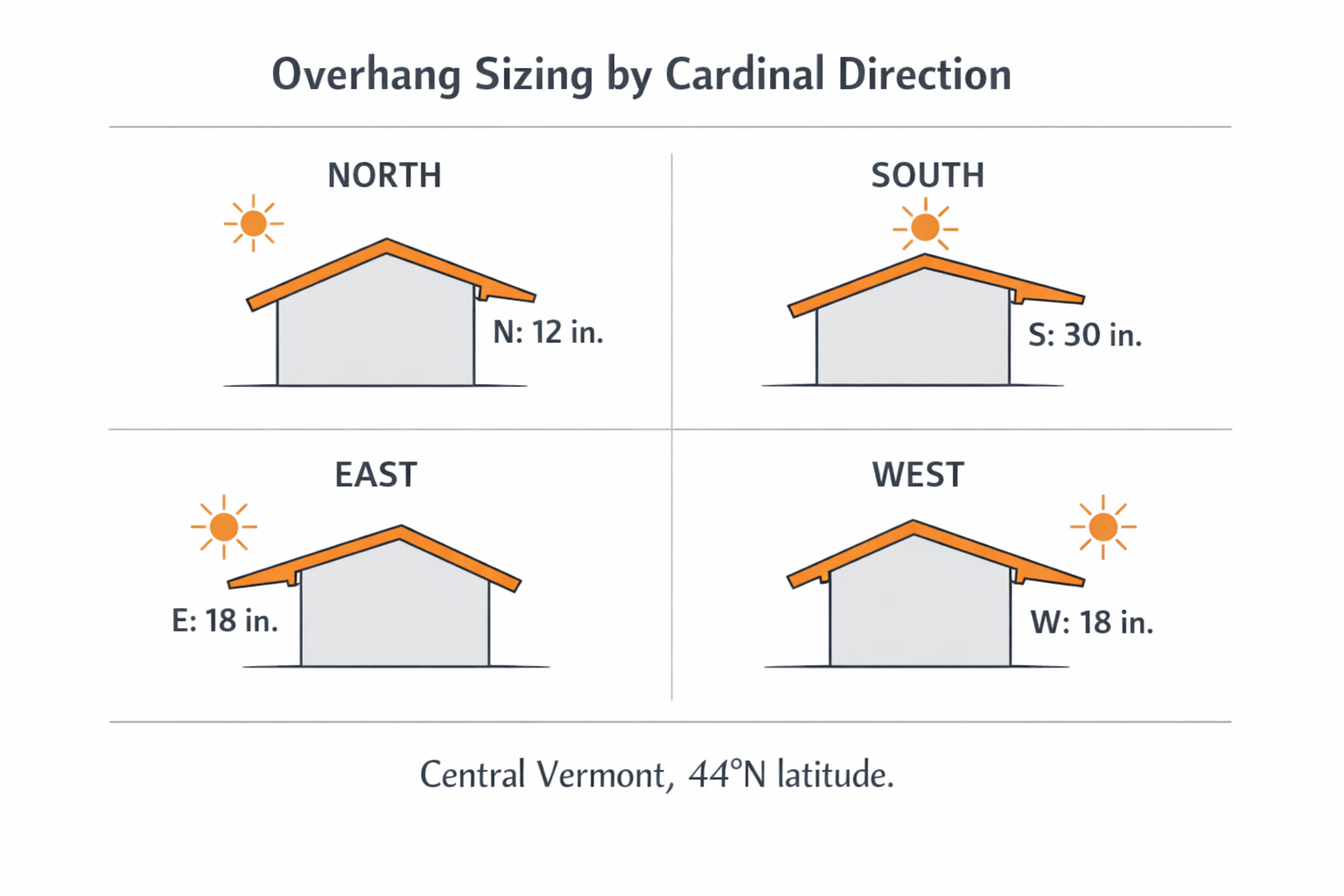
Move 1: Establish baseline overhang depths by orientation. For Central Vermont (44°N), these are ballpark targets. Adjust if your site is significantly higher elevation or heavily shaded:

  • South-facing walls: 24–36 inches (highest priority—this wall gets the most summer sun and winter heating benefit)
  • West-facing walls: 20–28 inches (afternoon sun in summer is intense; winter benefit is secondary)
  • East-facing walls: 12–18 inches (morning sun is weaker; winter benefit is real but limited)
  • North-facing walls: 8–12 inches (minimal sun; overhang is ice dam protection and rain shedding, not thermal)
Overhang sizing chart by cardinal direction for Central Vermont—north 8–12 inches, east 12–18 inches, west 20–28 inches, south 24–36 inches.

Overhang sizing by cardinal direction for Central Vermont. These are not suggestions—they're the output of solar-angle math. South gets the deepest overhang (free winter heat and summer cooling). North gets the shallowest (thermal benefit is minimal, but ice dam protection matters).

Move 2: Run a solar study for your specific site and building orientation. This takes an afternoon but saves years of regret. Use free tools like NOAA's Solar Calculator or paid services like Helioscope. Input your latitude, building orientation, wall height, and roof slope. You'll get a solar path diagram showing exactly where shadows fall on every day of the year. This is what should drive the architect's overhang decision—not Pinterest.

Move 3: Lock the overhang depth into the construction documents. Have your architect specify overhang depth by orientation on the roof and elevation plans. Include a note: "Overhang depths are sized for solar gain and ice dam prevention. Do not vary from plan." Put the same note in your specifications. When the framer shows up in August with a different idea, you have a paper trail.

What Works: The Right-Sized Overhang in Action

Direct Answer: A properly sized overhang on a south-facing wall will reduce your cooling load by 40–60% in July and August, allow free solar heating in December and January, and prevent ice dam damage year-round. Cost to implement: $2,000–$5,000 more than a minimal overhang. Annual savings: $800–$1,200. Payback: 3–5 years. Then it's just profit.
Properly sized 30-inch overhang on south-facing wall with summer sun blocked and winter sun penetrating thermal mass.

A right-sized overhang (30 inches on a 9-foot south wall) blocks summer sun completely and lets winter sun through to warm stone, masonry, or dark siding. This is passive solar design—the original green building strategy.

The math on overhang payback is simple. A 30-inch overhang costs approximately $3,000 more to frame and detail than a 12-inch overhang (extra lumber, flashing, soffit work). But a home with proper south-facing overhang will cool 40–60% more efficiently than one without it—because you're not fighting the sun, you're managing it. In Central Vermont, that's $800–$1,200 per year in air conditioning and fan costs alone. Add ice dam prevention ($3,000–$8,000 per incident, and you only need one incident to pay for the overhang), and the math becomes laughable.

Resale? A home designed for passive solar gain (which starts with overhang sizing) commands a 5–8% premium over poorly oriented alternatives. Energy-conscious buyers understand that an overhang is infrastructure, not decoration. They're willing to pay for durability.

Vermont Context: What Gets Built, What Fails

Direct Answer: Central Vermont has two archetypes: Old farmhouses with massive overhangs (3–4 feet) that have survived 150+ years of ice dams and UV exposure, and modern homes designed without regard to solar angle that fail within 10 years. There's a reason the old stuff still works.

Walk through any pre-1950 Vermont neighborhood and look at the house profiles. You'll see deep, purposeful overhangs. The farmers who built those homes didn't have solar calculators, but they had experience and climate intuition. A 3–4 foot overhang kept snow off the first-floor windows, protected the stone foundation, and let the house stay warm in winter without burning cordwood like crazy. These homes are still standing because the overhang equation was baked into the building culture.

Now look at new construction built in the last 20 years. A lot of it has 8–12 inch overhangs—sometimes less on the north side. Why? Architects trained in mild climates, trend-chasing aesthetics ("clean lines," "modern minimalism"), and cost-cutting by builders who don't live with the results. These homes age badly. Ice dams are endemic. Siding rots. Cooling bills are brutal. By year 15, they need $40K in remedial work.

The Central Vermont builders and architects who understand this are building differently. Woodstock, Waterbury, and Montpelier have examples of new homes with deep overhangs that already look like they belong to this place. They will age well because they're designed for Vermont, not for a magazine cover.

Bottom Line + Next Steps

Direct Answer: Before you hire an architect or sign off on plans, calculate your overhang depths. It's 20 minutes of math that locks in 30 years of performance. If your architect resists or dismisses the conversation, find one who understands that in Vermont, durability is the first design principle.

Here's what to do now:

  • If you're evaluating land: During a spring or fall visit, note the slope orientation (compass direction the land faces). Talk to your broker about seasonal sun exposure. This will inform building placement and orientation before you break ground.
  • If you're working with an architect: Ask for a solar study as part of the schematic design phase. Request overhang depths specified by orientation. Require those depths on the final construction documents. It's a small conversation that prevents a big problem.
  • If you're building: Before framing begins, walk the site with the general contractor and architect. Review the overhang specs. Mark the wall lines and eave lines with chalk. Get photos. Once framing is up, it's too late to change.
  • If you're retrofitting or remodeling: An addition is an opportunity. Size the new overhang right. If the existing home has undersized overhangs, consider adding them—it's a visible upgrade that buyers notice and understand.

Overhangs are Vermont's original green building technology. They're free to operate, simple to maintain, and more effective than any smart home gadget. Get the math right, and you're buying durability, comfort, and resale value for the same cost as getting it wrong.

Ready to talk site orientation and building placement?

If you're evaluating land or preparing to design a new home in Central Vermont, let's discuss how your site's sun exposure, slope, and orientation can drive smarter design decisions.

Contact Tony Walton to walk your property and understand its seasonal potential.

New England Landmark Realty
Main: (802) 253-4711 or (866) 324-2427
Tony's Cell: (802) 233-4107
Web: https://www.nelandmark.com

Buyer's Guide Seller's Guide

Where to Go Next

  • Vermont Home Buying Guide — Evaluate land and understand site analysis before you make an offer.
  • Selling Your Vermont Home — Energy efficiency and durability drive buyer perception. Understand what sells.
  • Blueprint: Site Analysis for Builders — How to read slope, drainage, sun, wind, and access before you design.
  • Blueprint: Ice Dam Prevention (Beyond the Overhang) — Ventilation, insulation, and attic strategy work alongside overhang depth.
  • Blueprint: Passive Solar Design in Vermont — Extend the overhang conversation into thermal mass, glazing strategy, and mechanical systems.
April 22, 2026

5 Ways to Make Any Vermont Home Feel Luxurious (Without a Ski-Resort Budget)

By New England Landmark Realty 

Jump to Key Takeaways

Vermont doesn’t whisper luxury—it defines it.

Snow-draped mountains. Fall foliage that looks fake (but isn’t). Farm-to-table dinners that outclass big-city menus. People don’t just visit Vermont—they invest in how it makes them feel.

Key Takeaways

Two-Sentence Summary

This guide is for Vermont homeowners, buyers, and sellers who want a home to feel more refined without a major renovation. The focus is on practical upgrades that improve atmosphere, comfort, and perceived value.

If You Only Remember 3 Things

  • Lighting changes the mood of a room faster than almost anything else.
  • Texture and comfort shape how people experience a home.
  • Luxury usually comes from restraint, not excess.

Quick Facts

  • Vermont interiors often feel strongest when they echo the landscape outside.
  • Small styling changes can improve day-to-day enjoyment and listing presentation.
  • For next steps, compare these ideas with New England Landmark Realty’s buyer and seller guides.

Your home should deliver that same experience.

Here’s the truth: luxury in Vermont isn’t about excess. It’s about intention. Warmth. Texture. Restraint.

So how do you create that feeling without tearing your house apart?

You focus on what actually matters.

1. Layered Lighting That Mirrors Vermont’s Natural Glow

Layered lighting in a Vermont interior

Vermont light is soft, golden, and fleeting—especially in winter. Your home should capture it, not fight it.

One overhead bulb? That’s not lighting—that’s a missed opportunity.

Instead:

  • Combine ambient, task, and accent lighting
  • Install dimmers everywhere you can
  • Choose fixtures with character—iron, wood, brushed brass

Think modern farmhouse meets ski lodge. If your lighting feels clinical, you’ve already lost.

2. High-Quality Textiles That Feel Like a Stowe Getaway

Luxury textiles in a Vermont bedroom

Luxury in Vermont is tactile.

It’s the weight of a wool blanket after a long winter day. It’s stepping into comfort, not just seeing it.

Upgrade:

  • Throws → wool, cashmere, faux fur
  • Bedding → high thread count, soft neutrals
  • Curtains → linen for understated elegance

These aren’t details. They’re signals. Buyers—and guests—notice immediately.

3. Statement Pieces That Compete With the View (Carefully)

Statement decor in a Vermont home

Here’s the paradox: in Vermont, the best design feature is outside your window.

So inside? Edit aggressively.

Choose:

  • One large abstract artwork
  • An oversized mirror to reflect natural light
  • A sculptural or reclaimed wood piece

And then stop.

Clutter kills luxury. Space creates it.

4. Bring the Outside In

Greenery in a Vermont interior

Why do people buy homes in Vermont?

Nature.

So bring it inside:

  • Fresh flowers from a local market
  • Simple greenery near windows
  • Seasonal touches—pine, maple branches, wildflowers

This is the easiest upgrade with the highest emotional ROI.

And yes—it helps homes sell faster.

5. Scent and Sound: The Invisible Edge

Candle and fireplace ambiance in a Vermont home

Luxury isn’t just visual. It’s sensory.

Top-tier Vermont homes feel right the moment you walk in.

Dial it in:

  • Subtle scents—pine, cedar, vanilla
  • Soft background music
  • The sound of a crackling fire

Ask yourself: does your home feel like a retreat—or just a place to crash?

The Bottom Line

Luxury isn’t about spending more. It’s about choosing better.

In Vermont, that means embracing what makes this place irresistible: warmth, simplicity, and connection to the land.

Most homeowners overlook this.

The smart ones don’t.

Thinking About Selling—or Elevating—Your Vermont Home?

Tony Walton and his team at NELandmark.com understand what drives real estate in Vermont—and what makes buyers emotionally commit.

From Stowe to Waterbury and beyond, they know how to position your home to stand out and sell.

Call 802-253-4711 today to start the conversation.

Where to Go Next

Talk With New England Landmark Realty

Office: (802) 253-4711

Toll-Free: (866) 324-2427

Tony’s Cell: (802) 233-4107

Website: www.nelandmark.com

Buyer Guide

Seller Guide

April 20, 2026

Vermont's Spring Market Is Thawing — Even If the Headlines Aren't


Two-Sentence Summary

Vermont's spring housing market is quietly giving buyers the most negotiating room since before the pandemic — more inventory, longer days on market, and a sale-to-list ratio that's finally moved off the ceiling. While national headlines are calling spring 2026 a deep freeze, the Vermont data tells a different story: the window is open, and the buyers who show up prepared are the ones who'll use it.

If You Only Do 3 Things
  1. Check the Vermont inventory picture before you assume it's still a seller's market — active listings are up nearly 12% year over year and homes are sitting an average of 91 days.
  2. Run your payment math at 6.22%, not at 3% — that's the number that determines your budget ceiling today, and it's more manageable than most fence-sitters expect.
  3. Talk to a local broker before spring competition returns — buyers who move in late March and April are negotiating; buyers who wait for certainty are competing.
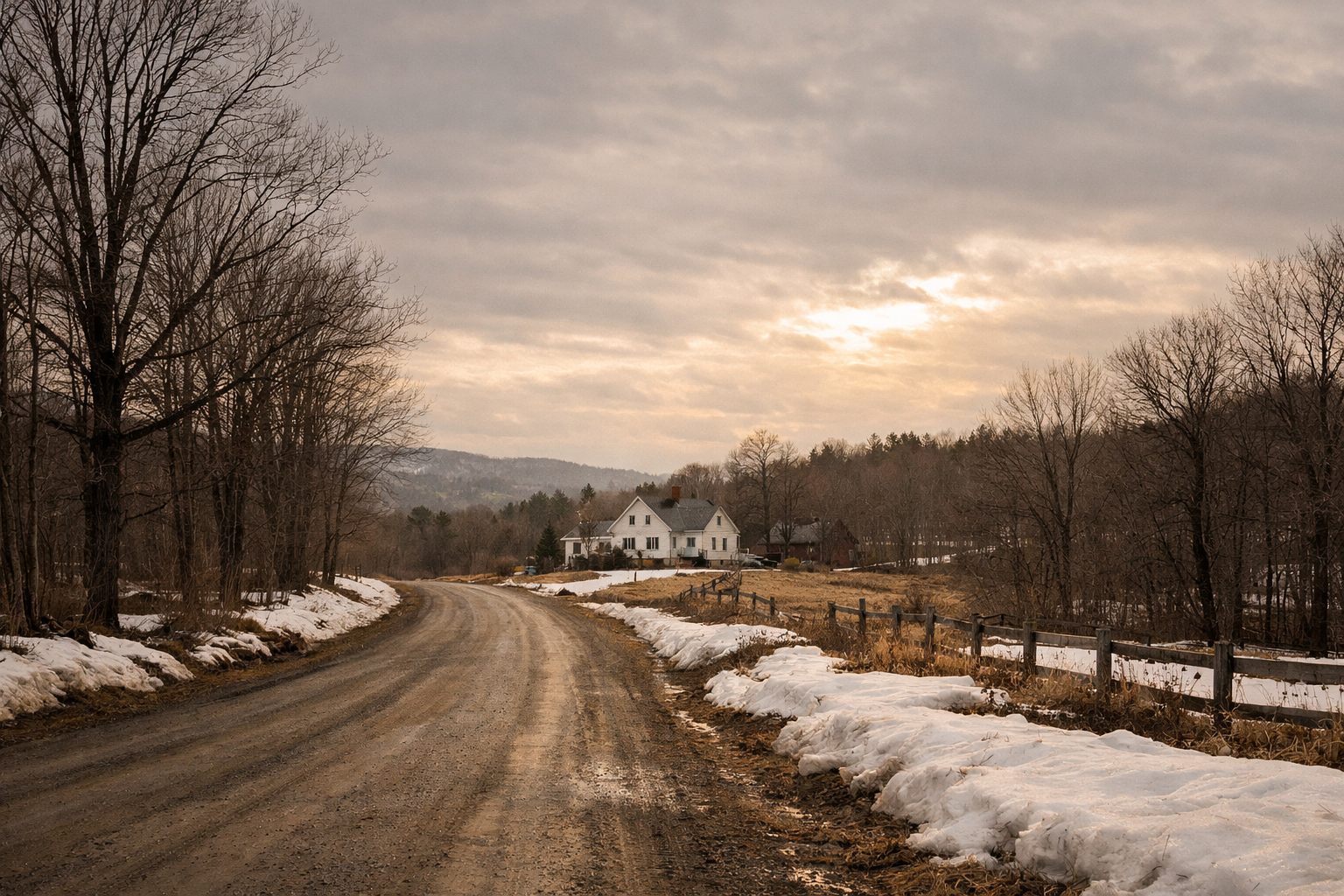
A Vermont country road in early spring — melting snow, bare maples, farmhouse in background — representing the thawing Vermont housing market of 2026
Vermont's spring market moves quietly. The data says the thaw has already started. — New England Landmark Realty (NELR)

What Changed — And the One Number That Matters

The Vermont housing market has shifted. Active listings are up 11.7% year over year, homes are sitting on the market for an average of 91 days, and sellers are getting 96.3 cents on the dollar — not the 100-plus cents they commanded two years ago. For Vermont buyers, that's the most leverage this market has offered since 2019. The move? Get pre-approved and get in front of those listings before the rest of the state figures this out.

The national housing narrative this spring is grim. Oil prices, a Middle East conflict, a Fed that's holding rates steady, and buyers who can't shake their economic anxiety. U.S. News is calling it "stuck in the deep freeze." That framing isn't wrong — nationally. But Vermont isn't a national market.

Here's what the data tells us. Vermont entered spring 2026 with more homes for sale, longer selling timelines, and sellers who are — for the first time in years — negotiating. That's a different market than the one most buyers think they're walking into.

The Data — Two Numbers, Translated

Vermont had 2,771 active listings in January 2026 — up 11.7% from a year earlier — with a median of 91 days on market. At the same time, only 13.7% of Vermont homes sold above list price, down from nearly 20% a year ago. Translation: more homes, less competition, and sellers who are open to a conversation. The national rate context — 6.22% on a 30-year fixed as of March 19 — is the one variable buyers need to calculate around, not panic about.
+11.7%
Vermont active listings
year over year (Jan 2026)
91
Median days on market
statewide (Jan 2026)
96.3%
Sale-to-list ratio
Vermont (Jan 2026)
Bar chart showing Vermont active housing inventory up 11.7% year over year alongside median days on market at 91 days, spring 2026
Vermont active listings and days on market, January 2026. Sources: Redfin Data Center; Freddie Mac PMMS.

Let's run the numbers on rate. At 6.22% on a 30-year fixed — Freddie Mac's weekly average as of March 19 — a $350,000 loan carries a principal and interest payment of roughly $2,150 per month. That's not comfortable for everyone. But it's also not 8%, and it's not moving dramatically in either direction in the near term. The Fed held its benchmark rate at 3.50%–3.75% this week. Math doesn't care about what we hoped rates would be. It only cares about what they are.

So What Does That Mean for Vermont?

In Vermont, 91 days on market combined with a 96.3% sale-to-list ratio means sellers have already blinked. Buyers entering this spring aren't fighting for a seat at a chaotic table — they're sitting down at a table where the host has been waiting. The Central Vermont market specifically, from the Waterbury corridor through Stowe and Montpelier, is seeing this dynamic play out in real time: more options, fewer competing offers, and sellers who know they have to be priced right to move.
A couple in their mid-30s standing at the front door of a Vermont home, reviewing a listing, calm and deliberate — representing the considered Vermont buyer of spring 2026
Vermont buyers in spring 2026 have time to think. That's new — and it matters. — New England Landmark Realty (NELR)

Here's the scenario where this matters most. If you've been watching the Vermont market for 12 to 18 months, waiting for a clear signal, 91 days on market is that signal. Sellers aren't desperate — Vermont prices are holding — but they're realistic. That's a different conversation than 2022, when you were lucky to get a showing.

The tradeoff is simple. Move now while inventory is up and competition is low, or wait and risk moving when the spring absorption cycle tightens things back up. Vermont inventory climbs in spring and pulls back by fall. That pattern hasn't changed. The window is real.

Bottom Line

If you're buying: Vermont is giving you the most room to negotiate it has in years. More listings, longer days on market, and sellers accepting 96.3 cents on the dollar. Get pre-approved, get specific about your target towns, and engage now — before the spring cycle compresses inventory and competition rises again.

If you're selling: Pricing to today's market isn't pessimism — it's math. Homes priced at the 96.3% sale-to-list reality are moving. Homes priced for 2022 are sitting, and 91 days on market is a long time to carry a property. The buyers are out there. They're just picky, deliberate, and well-informed.

For both: The national noise is real, but Vermont isn't national. Here's what the data tells us — local inventory, local days on market, and local sale prices are the numbers that change your decision. Everything else is background.

Illustrated map of Central Vermont towns including Waterbury, Stowe, Montpelier, and the Burlington corridor, with housing market data callouts for spring 2026
Central Vermont market geography — Waterbury, Stowe, Montpelier, Burlington corridor. Spring 2026 inventory is up across the region. — New England Landmark Realty (NELR)

What to Do Next

The spring buying season is already underway in Vermont. If you want to understand exactly how current inventory, days on market, and pricing look in your target town — not statewide, not nationally — Tony Walton and the team at New England Landmark Realty (NELR) can run that for you. No obligation. Just numbers.

Talk to New England Landmark Realty (NELR)

Office: (802) 253-4711  |  Toll-free: (866) 324-2427

Tony Walton, Principal Broker: (802) 233-4107

www.nelandmark.com

Vermont Buyer's Guide   |   Vermont Seller's Guide

Sources

Redfin Data Center — Vermont Housing Market, January 2026: redfin.com/state/Vermont/housing-market

Freddie Mac Primary Mortgage Market Survey (PMMS) — March 19, 2026: freddiemac.com/pmms

Federal Reserve FOMC Statement — March 18, 2026: federalreserve.gov

April 18, 2026

Home Equity in Vermont: The Most Powerful Asset Most Homeowners Underestimate


You’re sitting on something extraordinary. The question is whether you know what to do with it.

Jump to Key Takeaways

Nineteen years ago, I borrowed against my home to fund a real estate company I believed in. No venture capital. No silent partner. Just equity I had built, a market I trusted, and the kind of conviction that gets clarified very quickly when your house is on the line. New England Landmark Realty exists today because a lender looked at my home’s value and said yes.

That experience taught me things about home equity that no spreadsheet captures. Here is what Vermont homeowners need to understand right now.

Key Takeaways

Two-Sentence Summary

Vermont homeowners hold the highest equity-rich rate of any state in the nation — and this guide helps them decide whether, when, and how to put that equity to strategic use. Whether you are considering a HELOC for weatherization, income generation, or debt restructuring, this resource gives you the rate benchmarks, lender requirements, and decision framework to act with clarity.

If You Only Remember 3 Things

  • 85.8 percent of mortgaged Vermont homes are equity-rich — the highest rate in the country. Your equity position is stronger than almost anywhere else in the nation.
  • Borrowing capacity is not a budget. Model the full carrying cost — mortgage, HELOC payment, taxes, heating, maintenance — before you commit.
  • Go local first. Vermont credit unions consistently offer lower rates and more flexible LTV terms than national lenders, and their underwriters know this market.

Quick Facts

  • Vermont ranks first nationally for equity-rich homeownership and last for seriously underwater mortgages (ATTOM Q1 2025).
  • Current variable HELOC rates at Vermont credit unions range from 7.00 to 8.75 percent APR — typically the most competitive in the state.
  • Most Vermont lenders require a credit score of 620 to 640 minimum, with 680 or above unlocking the best available rates.

Vermont Didn’t Reward You By Accident

If you own a home in Vermont and have been here for more than five years, you are sitting on something rare. Not just equity — structural equity. The kind built on supply constraints, sustained demand, and a state that the rest of the country keeps discovering.

Consider what the data actually says. According to ATTOM’s Q1 2025 report, 85.8 percent of mortgaged Vermont homes are equity-rich — the highest rate of any state in the nation. New Hampshire is second at 60.5 percent. That is not a close race. That is a different category entirely.

85.8% of mortgaged Vermont homes are equity-rich — the highest rate of any state in the nation.
New Hampshire is second at 60.5%. It is not a close race.

In Chittenden County, the equity-rich rate reaches 91.3 percent. Only 0.7 percent of Vermont mortgaged homes are seriously underwater — the lowest rate in the country.

This did not happen by accident. Vermont has a structural housing deficit. The state needs an estimated 24,000 additional homes over the next five years. That deficit is an equity engine, and it is not going away soon.

The appreciation numbers confirm it. The statewide median sale price hit $353,000 in 2024 — a 9 percent jump year-over-year. By mid-2025 it had climbed to approximately $370,000. As of February 2026, Redfin reports the median at $412,200, up 6.9 percent year-over-year. In Chittenden County, the median has crossed $500,000. Since 2001, Vermont median home prices have increased 148 percent, compared to a 72 percent increase in median household income over the same period.

Active inventory has risen 11.6 percent year-over-year — loosening slightly from the pandemic-era freeze — but the market still carries only six months of supply. It remains a seller’s market. The pressure on prices has not reversed. It has moderated.

Vermont’s equity growth is not a reward for patience. It is the mathematical result of too few homes, too much demand, and a quality of life that keeps attracting people willing to pay for it.

You Can Borrow More Than You Should

The math is simple. The implications are not.

Home equity equals your current market value minus your outstanding mortgage balance. Most lenders will allow you to borrow against up to 80 percent of that equity.

Vermont Example

  • Home value: $450,000
  • Mortgage balance: $250,000
  • Equity: $200,000
  • Borrowing limit at 80 percent: $160,000

That $160,000 is not theoretical. In Vermont, it is a new roof before February turns your ceiling into a waterfall. It is the Airbnb conversion in Killington that pays your mortgage and funds someone else’s ski vacation. It is the barn you stop watching rot and start watching appreciate.

But here is the critical distinction: borrowing capacity is not a budget. The lender’s maximum is not your mandate.

What Smart Vermonters Actually Do With It

Vermont homeowners tend to be pragmatic. Equity is rarely spent on excess. It is deployed for improvement, resilience, and occasionally, transformation.

Weatherization and Infrastructure

Insulation, roofing, heating systems. Vermont winters are not optional, and neither are the systems required to survive them. These upgrades reduce ongoing carrying costs and increase appraised value simultaneously. That combination — spending money while strengthening the asset — is rarer than it sounds.

Income-Generating Conversions

Ski markets like Killington and Stowe, lake properties, and Mad River Valley homes are being converted into short-term rental income assets. A well-executed conversion in the right Vermont market can generate $30,000 to $60,000 annually. That changes the calculus of the original loan entirely.

Preservation and Character Enhancement

Barn conversions. Historic renovations. In Vermont, improving a home often means honoring what it already is. Properties that preserve character while modernizing systems consistently outperform generic renovations in this market.

Strategic Debt Restructuring

Replacing high-interest credit card or personal loan debt with a lower-rate home equity product makes mathematical sense. Understand the tradeoff clearly: you have converted unsecured debt into secured debt. Your home is now the collateral. This is a tool, not a trick.

Vermont Will Humble You

Vermont does not negotiate.

Property taxes are significant. Heating costs are structural — not seasonal surprises. Rural maintenance demands are real and relentless. Layering a home equity loan on top of those costs requires a level of financial discipline that a spreadsheet cannot manufacture for you.

A missed payment in a forgiving market is a setback. In Vermont — where your home is effectively irreplaceable in a constrained inventory environment, where the next comparable property may not exist at the price you would need — a missed payment is a different category of risk entirely.

Before you borrow: model the full carrying cost. Mortgage payment plus HELOC payment plus property taxes plus heating plus maintenance. Then stress-test it. What does this look like if rates rise one percent? If your income softens for a season?

I signed papers with my home on the line. I know how much that focuses the mind. That kind of clarity is worth manufacturing before the closing, not after.

Current HELOC Rates and What Vermont Lenders Actually Require

The rate environment as of late 2025 and into 2026 favors borrowers who go local. Vermont credit unions and community banks consistently offer better terms than national lenders — and their underwriters understand this market in ways that national institutions often do not.

Current Variable HELOC Rate Ranges by Lender Type

  • Vermont Credit Unions: 7.00 to 8.75 percent APR — typically the best rates in the state
  • Vermont Community Banks: 7.25 to 9.00 percent APR — strong local knowledge, flexible on non-traditional income
  • National Banks: 7.75 to 9.50 percent APR — limited Vermont market presence
  • Online Lenders: 7.50 to 9.75 percent APR — available but without local context

Vermont Federal Credit Union currently offers a fixed-rate home equity loan at 6.25 percent APR. Their variable HELOC is pegged to the Prime Rate — 6.75 percent as of late 2025 — minus 0.50 percent at 80 percent LTV.

What Vermont Lenders Actually Require

  • Credit score: 620 to 640 minimum to qualify; 680 or above for best rates; 720 or above is where lenders stop negotiating
  • Equity required: minimum 15 to 20 percent of home value
  • Maximum combined loan-to-value: 80 to 85 percent at most lenders; some Vermont credit unions extend to 90 percent for strong borrowers
  • Debt-to-income ratio: 43 percent is the standard ceiling; community banks may flex with compensating factors — important for Vermont’s significant self-employed and seasonal worker population
  • Closing costs: $219 to $1,500 depending on whether a full appraisal is required
  • Vermont-specific flag: Older housing stock — many Vermont homes were built before 1970 — can trigger appraisal scrutiny. Deferred maintenance reduces appraised value and therefore borrowing capacity. Address it before you apply.

Vermont Lenders Worth Starting With

  • Local and regional options: New England Federal Credit Union, Vermont Federal Credit Union, NorthCountry Federal Credit Union, Union Bank Vermont, Northfield Savings Bank, National Bank of Middlebury
  • National lenders active in Vermont: TD Bank, Citizens Bank, U.S. Bank

Go local first. A Vermont credit union underwriter who knows what a 1790 farmhouse on a Washington County dirt road is actually worth is not the same as an algorithm in another state. The difference in terms can be meaningful.

The Only Question That Actually Matters

The real question is not how much you can borrow. It is what the money actually does for you.

Strong Uses

  • Increasing the long-term value of your property
  • Weatherization upgrades that reduce ongoing carrying costs
  • Creating new income streams from the asset
  • Strategically replacing higher-interest debt with lower-rate secured debt

Uses That Disappoint

  • Funding lifestyle upgrades with no measurable return
  • Borrowing simply because the capacity exists
  • Underestimating long-term carrying costs
  • Treating home equity like a checking account

The difference between these two columns is not intelligence. It is intention.

Five Steps Before You Sign Anything

  1. Know Your Number. Get a current market valuation before you talk to a lender. Not an automated online estimate. An actual comparative market analysis from someone who knows your town. The gap between algorithmic estimates and appraised reality in Vermont can be significant, especially in rural markets.
  2. Pull Your Credit. Know your score before the lender does. If you are below 680, a focused period of debt reduction may unlock meaningfully better rates. The difference between a 640 score and a 720 score on a $150,000 HELOC is real money across a ten-year draw period.
  3. Go Local First. Vermont credit unions consistently offer lower rates, higher LTV flexibility, and underwriters who understand this market. Start with New England Federal Credit Union or Vermont Federal Credit Union before you talk to a national lender. The difference in terms can be substantial.
  4. Build the Real Budget. Borrowing capacity is not a budget. Run the full carrying cost: existing mortgage plus HELOC payment plus property taxes plus heating plus maintenance. Vermont rewards discipline. It does not forgive the absence of it.
  5. Have the Right Conversation. With your lender. With your accountant. And ideally with someone who has actually deployed home equity as a strategic tool in this market and lived with the results.

Leverage Is Not Luck

Vermont’s housing market did not appreciate because homeowners got lucky. It appreciated because this state is rare, supply is structurally constrained, and people are willing to pay generously for a life worth living.

That is not momentum to borrow against carelessly. It is momentum to understand deeply, protect fiercely, and — with discipline and clarity — occasionally weaponize brilliantly.

Used correctly, home equity does not just preserve wealth. It creates it. I know — because mine created this.

Thinking About Tapping Your Vermont Home Equity?

Start with a conversation. Tony Walton and the team at New England Landmark Realty have been serving Central Vermont homeowners since 2007.