New England Landmark Realty covers the Vermont real estate market 

from the inside — market data, buyer strategy, seller timing, land 

use regulation, and the policy decisions shaping what homes cost and 

who can afford them.


Tony Walton has been working Vermont real estate since 1978. 

The analysis here reflects that depth.


Browse by topic below, or use the search to find what you need.

March 3, 2026

The Listing That Stayed

A column by Harris Vexley

There was a house on Clement Road that sat on the market for two years, three months, and — if memory serves, and it mostly does — eleven days.

I know this because I showed it seventeen times. I counted. You start counting things like that when a listing gets personal, and that listing got personal somewhere around showing number six, when a retired schoolteacher from Barre walked through the kitchen, stopped, looked at me with an expression I can only describe as knowing, and said, "Harris, who are you trying to help here, exactly?"

I didn't have a good answer for that.

The house itself was fine. That was the problem, in a way. It was a cape, white, black shutters, good bones as we used to say — which is the real estate equivalent of describing a blind date as having a great personality. The lot was two and a half acres, mostly level, with a tree line on the north end that would have been genuinely beautiful if you weren't already thinking about other things. The seller had replaced the roof in '91. The well tested clean. The price was, by any reasonable standard, fair.

And yet.

In a town of twelve hundred people, and yet carries a lot of weight.

I won't tell you what everyone knew, partly because I'm not sure everyone knew the same thing, and partly because Vermont has a particular way of handling certain histories — which is to say, not handling them at all, but rather letting them settle like sediment until they become part of the geology. You don't discuss sediment. It's just there. It's been there. It will be there after you're gone.

What I will tell you is that every showing followed the same general pattern. People would arrive, usually from a bit of a distance — Montpelier, Burlington, once a couple from Middlebury who'd been looking for eighteen months and were starting to get philosophical about it. They'd walk the property with the particular optimism of people who have not yet made an offer on anything and therefore still believe real estate is a rational process. They'd nod at the roof. They'd approve of the lot. They'd stand in the kitchen and look out the window at the tree line.

And then, at some point in every single showing, they'd go quiet in a way that had nothing to do with contemplation.

"It's very peaceful," one woman said, which was technically true.

"Does it always feel this — " a man started, and then decided not to finish that sentence, which I respected.

The schoolteacher from Barre simply left without explanation, which I also respected, and which was, honestly, the most Vermont response possible.

The couple from Middlebury made an offer. I was surprised. They came back for a second look, walked through more slowly this time, and the husband stood in the back bedroom for a very long time. Then they withdrew the offer. We had a brief phone call. He said it wasn't the right fit. His wife could be heard in the background saying nothing at all, which told me everything.

It sold in the spring of 1994.

The buyer was from New Hampshire — Manchester, I believe — and he came alone, moved efficiently through the rooms, asked reasonable questions about the heating system and the septic, and signed the paperwork with the straightforward confidence of a man who had not grown up in a small town and therefore had no idea what he didn't know.

I have thought about that a lot over the years. Whether it was better or worse for him, not knowing. Whether the house noticed the difference.

Last I heard he lived there twenty years before retiring to Florida. No complaints on record. Sold it himself, eventually, to a young couple from Burlington who put in a new bathroom and started an Instagram account about rural life. They seem happy.

The house is just a house now. The sediment has had thirty years to settle.

Still. Some Tuesday mornings, driving Clement Road out of old habit, I slow down a little when I pass it. Not for any particular reason.

Just to see if it looks back.

Harris Vexley spent thirty years as a licensed real estate broker in Vermont. He is now retired, which mainly means he drives around more and talks to fewer people about it.

Where to Go Next

Talk With a Local Expert

New England Landmark Realty
Office: (802) 253-4711
Toll-Free: (866) 324-2427
Tony Walton Cell: (802) 233-4107
Website: https://www.nelandmark.com

March 2, 2026

Kitchen Remodels That Actually Work vs. Expensive Lies You're Told Will Add Value

Counter Intellegence March 2, 2026 | New England Landmark Realty

Split-screen comparison of two kitchens with identical budgets - one Instagram-perfect but dysfunctional with waterfall island and open shelving, the other understated but brilliantly functional with task lighting and proper storage
Same budget. Same footprint. Completely different priorities. One kitchen photographs well. The other one works.

I've walked through enough kitchen renovations—as a chef and as a broker—to recognize the pattern. Homeowner spends $90,000. Designer delivers a showroom. And six months later, the homeowner is still reaching into the back of a lower cabinet on their hands and knees looking for the Dutch oven because nobody thought about pull-out drawers.

Here's the problem: most kitchen renovations are designed for the listing photos, not for the human who has to cook Thanksgiving dinner in the damn thing.

Key Takeaways

Two-Sentence Summary

Most kitchen renovations chase resale value with granite and subway tile while ignoring the design choices that actually make cooking easier—and those functional fixes often cost less than the cosmetic theater. This guide separates the upgrades that earn their keep every single day from the expensive lies that look good in listings but fail in real life.

If You Only Remember 3 Things

  • Countertop material doesn't make you a better cook—counter location does. The 15 inches of landing space next to your range matters more than whether it's quartz or butcher block.
  • Storage you can reach beats storage that looks good. Pull-out drawers cost more than fixed shelves but pay dividends every single time you don't have to crawl on the floor to find a pot.
  • Lighting is the cheapest upgrade with the highest functional return. Under-cabinet LEDs and task lighting transform how you work—no one has ever said "this kitchen is amazing" because of the backsplash alone.

Quick Facts

  • Functional upgrades like task lighting and drawer storage typically cost 15-30% less than cosmetic statement pieces like waterfall islands
  • Proper range hood ventilation (600+ CFM) prevents long-term moisture damage that can cost $15,000-$40,000 to remediate in Vermont's humid climate
  • Landing space geometry (18 inches on either side of cooktop, 15 inches beside the sink) is dictated by the National Kitchen & Bath Association and affects daily usability more than any finish material

Why This Matters

Most kitchen renovations optimize for the wrong scorecard—resale value and Instagram aesthetics instead of daily function. The result: expensive choices that photograph beautifully but collapse under the demands of actual cooking. Buyers notice layout and light before they notice countertop material. Homeowners live with poor workflow every single day.

The renovation industrial complex wants you to believe that kitchen value lives in the material palette. Granite versus quartz. Shaker versus flat-panel. Subway tile versus zellige.

None of that matters if you can't fit a sheet pan on the counter next to the oven.

I've shown $800,000 homes with $120,000 kitchens that couldn't pass a basic workflow test. Gorgeous waterfall islands with nowhere to plug in a stand mixer. Six-burner ranges with 8 inches of counter space on one side and a wall on the other. Pendant lights that look incredible and cast shadows exactly where you're trying to chop onions.

Meanwhile, I've stood in 1970s kitchens with Formica counters and builder-grade cabinets where everything just worked. Because someone—probably the homeowner who actually cooked in it—prioritized task over trophy.

The Expensive Lies: Upgrades That Photograph Well But Work Poorly

Five renovation darlings that add cost without improving function: waterfall islands that sacrifice landing space, open shelving that demands curation over capacity, pro-style ranges that outpace actual cooking needs, vessel sinks that splash and fail, and wine fridges installed by default instead of intent. Each one looks great in the listing. None of them survives daily use without compromise.
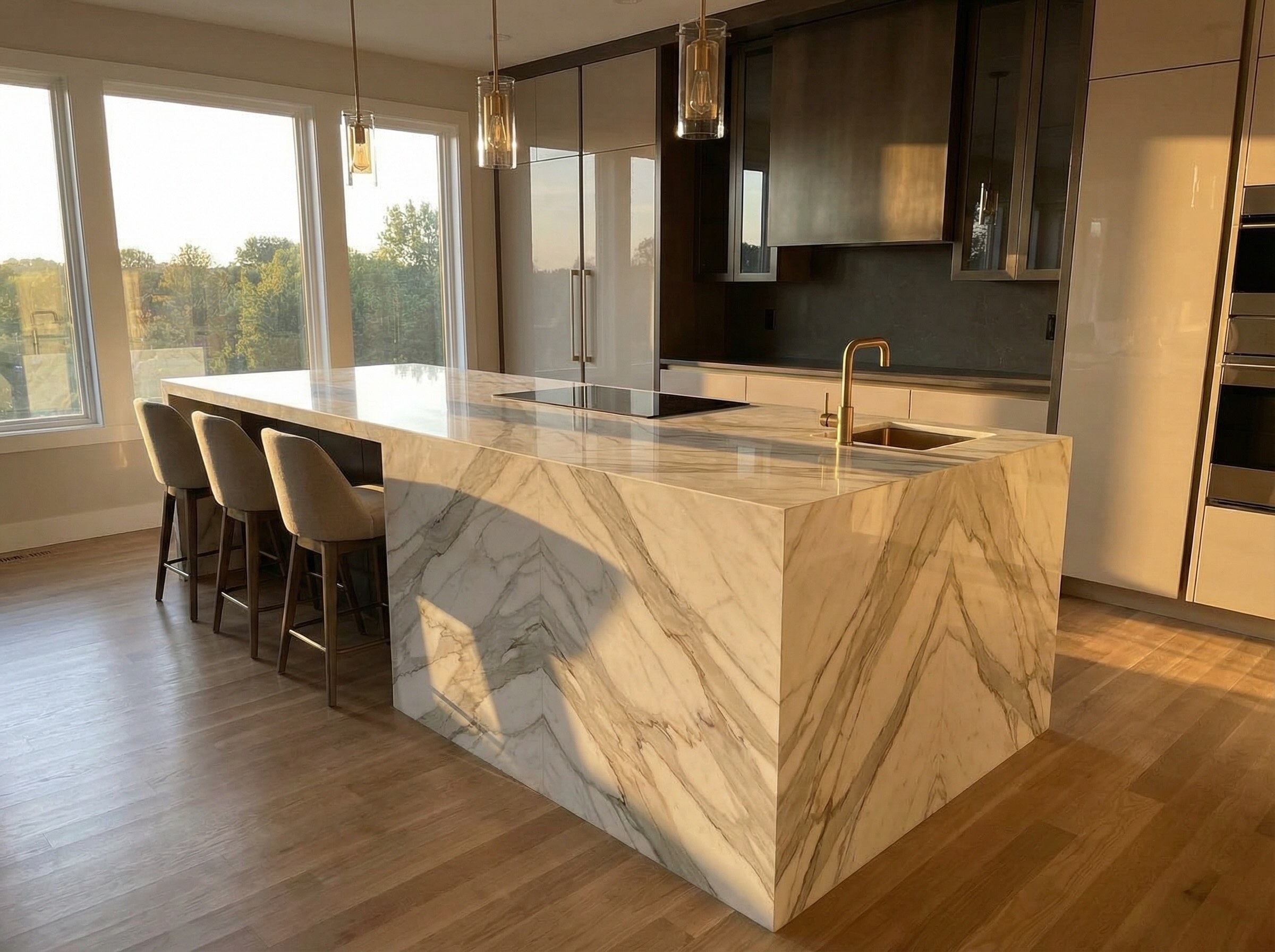
Luxury kitchen with stunning waterfall marble island showing design flaws - no outlets, inadequate landing space next to cooktop, impractical bar-height seating, and shallow prep sink
$12,000 of book-matched marble. Zero electrical outlets. Eight inches of landing space next to a 36-inch cooktop. Beautiful and completely impractical.

Waterfall islands. Stunning. Expensive. And almost always designed to showcase the stone rather than facilitate the work. The vertical edge eats counter depth. The statement steals budget from things that matter—like making sure you have 36 inches of clearance on the working side or enough space to pull out a chair without blocking the dishwasher. Cost: $3,000-$12,000 depending on material. Functional return: zero.

Open shelving. The Instagram aesthetic that only works if you (a) own six plates, (b) never cook anything that splatters, and (c) enjoy dusting. Vermont kitchens manage preserving season, bulk staples, and gear that doesn't see daily use. Open shelving is beautiful because it forces minimalism. Minimalism doesn't survive August when you've got 40 pounds of tomatoes to process and nowhere to put the canning supplies. Cost: often cheaper to install. Hidden cost: the storage you'll have to add later when you realize you have nowhere to put anything.

Pro-style ranges. Unless you're actually cooking for 12 people on a Tuesday night, that 48-inch, six-burner Viking is cosplay. You'll use two burners 90% of the time. What you will notice: the BTU output that demands a makeup air system (add $2,000-$5,000), the commercial depth that eats into your workflow triangle, and the cleaning regimen that makes you nostalgic for sealed burners. Cost: $8,000-$15,000 for the range alone. Better move: a 30-inch range with one high-BTU burner and the other $8,000 spent on lighting, storage, and ventilation.

Vessel sinks. Gorgeous in the showroom. A nightmare in year two when the faucet can't reach the edges, every hand-washing session sprays the counter, and you realize you can't fit a stockpot under the spout. Cost: $400-$2,000. What works instead: a deep undermount that disappears visually and handles a full sheet pan.

Wine fridges as default. If you drink wine twice a month, you don't need a 46-bottle dual-zone climate-controlled monument to aspiration. You need a drawer. Or a shelf. Or nothing. Cost: $1,200-$4,000. Opportunity cost: the base cabinet with pull-outs that you actually needed.

The Quiet Winners: Upgrades That Make You Faster, Safer, Smarter

Seven functional improvements that earn their cost every single day: task lighting that eliminates shadows, landing space geometry that prevents burns and breaks, deep drawer storage that ends the cabinet crawl, proper ventilation that protects your investment, dedicated circuits that prevent breaker trips, correctly placed pot fillers, and resilient flooring that survives dropped cast iron. These are the upgrades nobody photographs and everyone uses.
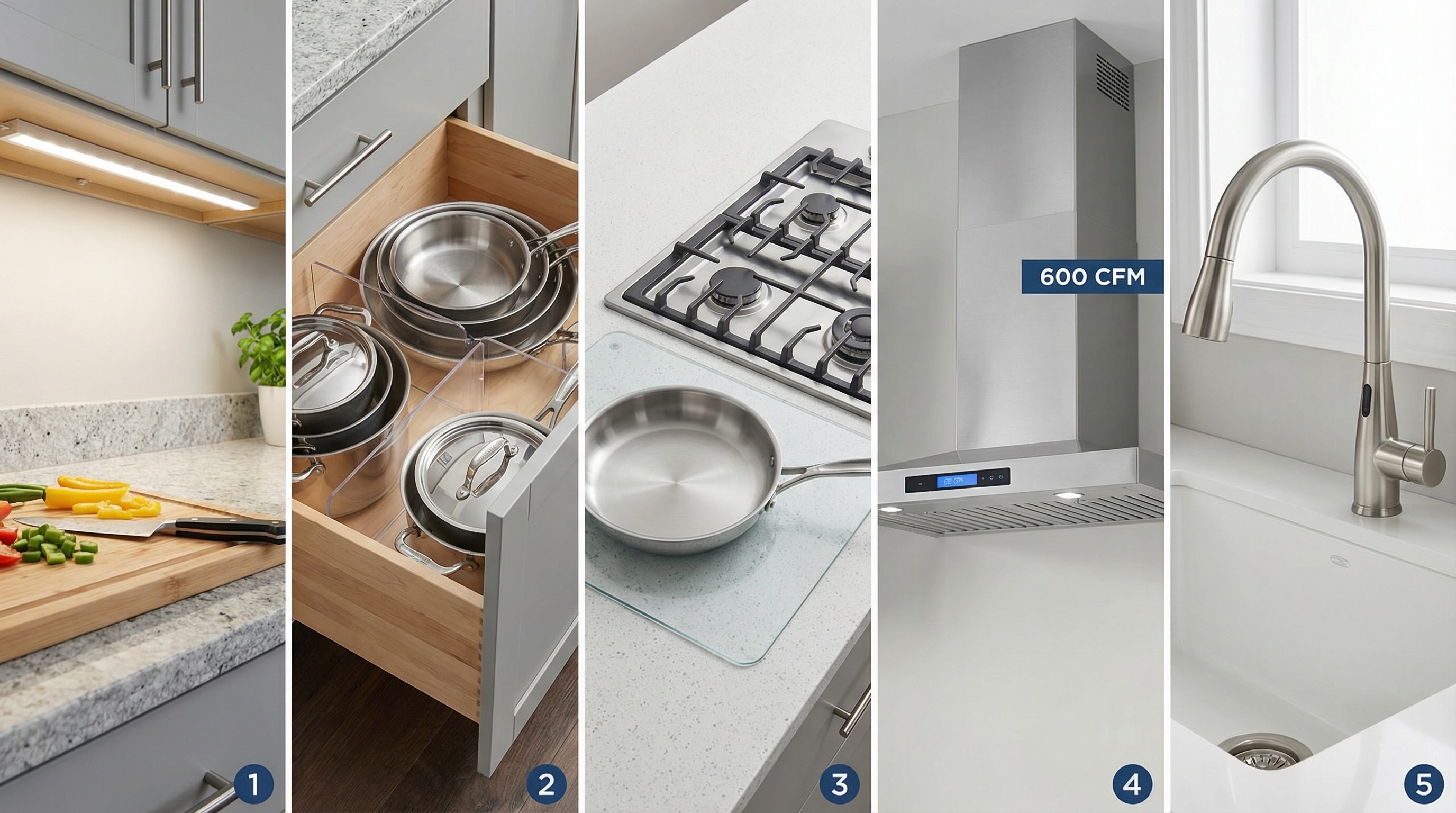
Five functional kitchen upgrades shown in detail - LED under-cabinet task lighting, organized pull-out drawer with pots, proper counter landing space beside range, range hood with 600 CFM rating, and motion-sensor faucet over deep sink
The upgrades that don't make the magazine covers but improve your life 400 times a year: light where you work, storage you can access, space where you need it, ventilation that protects the structure, and a sink that fits the tools.

Task lighting. Under-cabinet LEDs, toe-kick lights, and pendant fixtures positioned over work zones, not over voids. This is the single cheapest upgrade with the highest daily return. You cannot dice an onion in a shadow. Cost: $400-$1,500 depending on quality and coverage. Value: every single time you cook after sunset, which in Vermont is 4:30 PM for four months of the year.

Landing space geometry. Not negotiable. Eighteen inches on either side of the cooktop. Fifteen inches beside the sink. Twelve inches beside the fridge. These aren't Instagram guidelines—they're the physics of not dropping a hot pan or a full pot on your foot. If your designer is arguing with these numbers, find a different designer. Cost: $0 if planned correctly. Cost if ignored: the $90,000 kitchen that doesn't work.

Drawer storage with full-extension glides. Fixed shelves in base cabinets are where pots go to die. You will never willingly crawl into a 24-inch-deep hole to retrieve a roasting pan. Drawers bring the back to the front. Cost: $150-$400 per drawer depending on size and hardware. ROI: measured in dignity and time saved per retrieval.

Ventilation that actually moves air. Your range hood needs to move at least 600 CFM if you have a gas range, 400 CFM minimum for electric. That's cubic feet per minute—the measure of how much smoke, grease, and moisture gets pulled out instead of settling on your cabinets and walls. In Vermont, where winter cooking happens in a sealed box, inadequate ventilation isn't just annoying. It's structural rot waiting to happen. Cost: $800-$3,000 for a hood that works. Cost of ignoring it: $15,000-$40,000 in moisture remediation five years later.

Dedicated 20-amp circuits. One for the microwave. One for the countertop appliances (mixer, blender, toaster). Your renovation electrician will know this. Your designer might not ask. If you're running a stand mixer and a kettle at the same time and tripping breakers, you skipped this. Cost: $250-$500 per circuit during renovation. Cost after the fact: $800-$1,500 plus drywall repair.

Pot filler—placed correctly. This isn't about luxury. It's about not carrying 16 pounds of water and pasta pot across the kitchen. But only if it's within arm's reach of the range and you have landing space below it. A pot filler over an island cooktop with no counter space is performance art, not infrastructure. Cost: $400-$1,200 installed. Worth it: only if the geometry supports it.

Flooring with resilience. Cork, luxury vinyl plank, or engineered hardwood with a real wear layer. Ceramic tile is beautiful and unforgiving—drop a wine glass and it's over. Drop a cast-iron skillet on tile and you've got a cracked tile and a damaged pan. Vermont floors also contend with snow melt, mud season, and the grit that comes in on boots. Cost: $6-$15 per square foot installed depending on material. The test: what happens when you drop something heavy.

The Middle Ground: Upgrades That Do Both (If You Spec Them Right)

Three renovation choices that deliver both function and visual appeal—but only with chef-level planning: islands with proper dimensional discipline, double ovens for households that actually bake, and pantry buildouts that prioritize volume over aesthetics. The difference between success and expensive regret is in the details that most designers skip.

Islands. They work if you follow the rules. Four feet of length minimum (preferably five). Fifteen inches of overhang if you want seating. Thirty-six to forty-two inches of clearance on all working sides. Electrical outlets on the ends or pop-ups in the surface, not hidden underneath where you'll never use them. An island that ignores these specs is just an expensive obstacle. Cost: $3,000-$15,000 depending on size, material, and features. Functional return: high, but only if the geometry is right.

Double ovens. If you bake bread, roast vegetables, and need to run two different temperatures simultaneously—or if Thanksgiving involves more than one oven-based dish—this is defensible. If you're buying it because it "looks professional," you're spending $4,000-$8,000 on something you'll use twice a year. The test: how many times in the last three months did you wish you had a second oven? If the answer is zero, you don't need one.

Pantry buildouts. A floor-to-ceiling cabinet with pull-out shelves or a walk-in pantry with adjustable wire racks will change your life. But only if you prioritize depth, adjustability, and capacity over looking tidy. A "butler's pantry" with glass-front cabinets and decorative tile is for people who don't cook. A working pantry has closed doors, deep shelves, and room for a 25-pound bag of flour. Cost: $2,000-$8,000 depending on configuration. ROI: every time you don't have to drive to the store because you actually have space to stock staples.

Vermont Context: What Cold, Mud, and Maple Season Do to Your Choices

Three Vermont-specific realities that change the renovation math: closed storage beats open shelving in a climate with real humidity and pest pressure, heating integration matters when kitchens are cold voids or overheated saunas, and the kitchen-mudroom threshold determines whether your floors survive winter. Design for the place you actually live, not the place in the magazine.
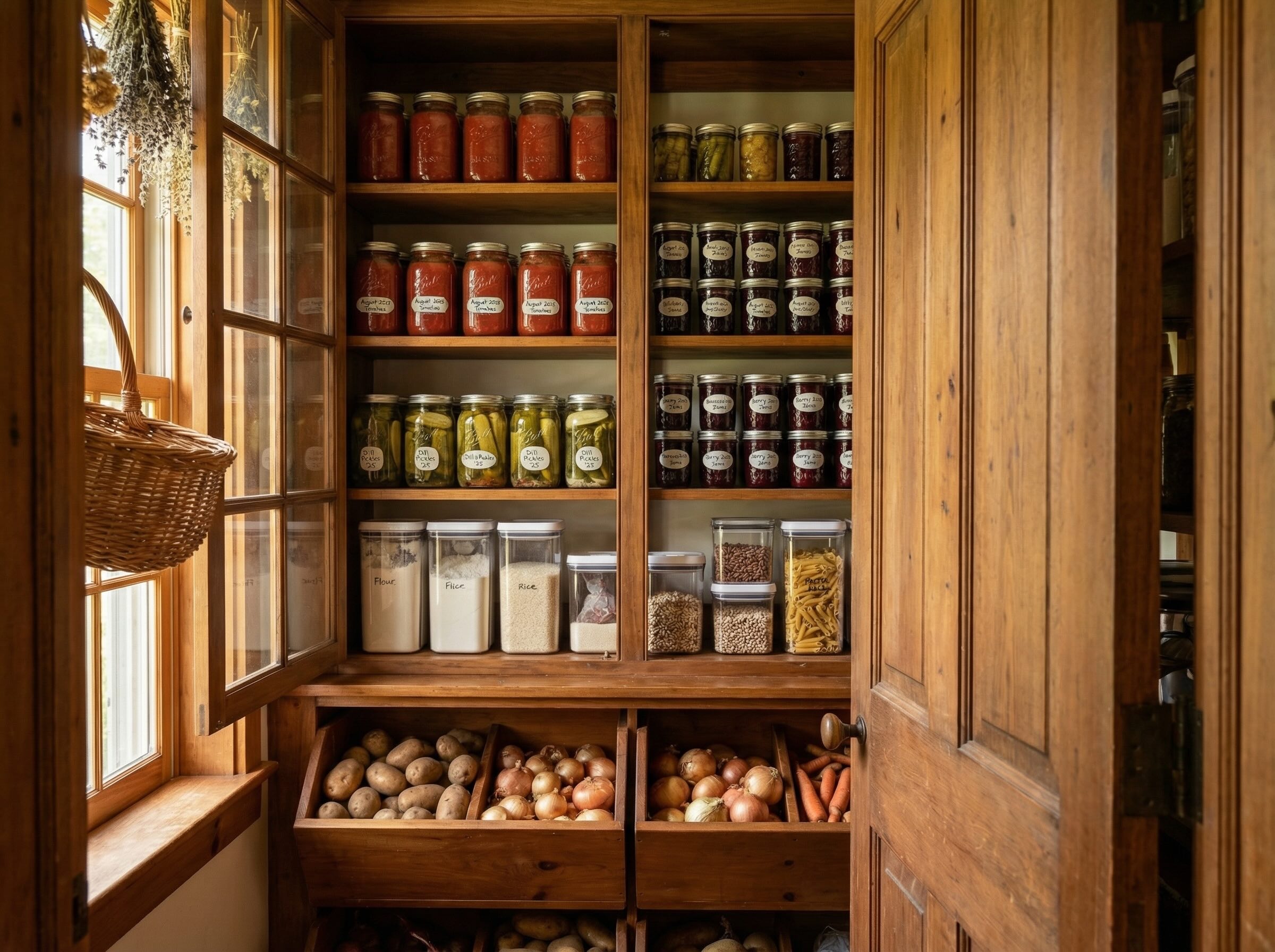
Well-organized Vermont kitchen pantry with deep shelves loaded with Ball jars of preserves, bins of root vegetables, bulk dry goods in airtight containers, and closed cabinet doors
This is what Vermont food infrastructure looks like in August. Closed storage. Serious capacity. Room for 40 quarts of tomato sauce and the 50-pound bag of flour you bought at Costco in October.

Closed storage isn't optional. Vermont has humidity. And moths. And field mice that would very much like to winter in your open-shelf pantry with the artfully arranged jars of lentils. If you cook from the garden, preserve, or buy in bulk, you need closed cabinets with actual capacity. Open shelving works in Los Angeles. It's a liability here.

Heating integration. If your kitchen is an addition or bump-out, make sure the HVAC plan accounts for it. I've seen $100,000 kitchens that are 58 degrees in January because the designer focused on the pendant lights and forgot to add a heating zone. Radiant floor heat is glorious. Forced air works if the ducts are properly sized and placed. Either way, verify the plan before the walls close up.

Mudroom threshold. Vermont kitchens need a hard boundary between "outside dirt" and "cooking space." Whether that's a dedicated mudroom, a tiled entry zone, or a boot bench with a drain tray, plan for the transition. Your beautiful hardwood floors will thank you. Cost: $500-$3,000 depending on scope. Value: the floor you don't have to replace in five years.

The Renovation Hierarchy: How to Spend $30K vs. $80K vs. $150K

Budget tiers with functional priorities at each level: $30K fixes workflow and appliances, $80K adds quality materials and custom storage, $150K buys space reconfiguration and premium everything. At every level, the rule is the same—invest in the invisible systems first, the visible finishes last. Skip the upgrades you won't use weekly. Never cheap out on ventilation, lighting, or structural work.

$30,000 budget: Paint cabinets or reface them. Replace countertops with quartz or butcher block (skip the exotic stuff). Upgrade to a good range hood (600 CFM minimum). Add under-cabinet LED lighting. Replace the sink and faucet with workhorses (undermount sink, pull-down faucet). Install pull-out shelves in existing base cabinets. One good appliance upgrade—either the range or the refrigerator, whichever is failing. This budget doesn't buy you a showroom. It buys you a kitchen that works better than it did.

$80,000 budget: Everything above, plus new cabinets (not custom, but quality stock with soft-close hardware). Rework the layout if the footprint allows (add an island, improve the triangle, fix the landing space problems). Upgrade both the range and refrigerator. Add a pantry if you don't have one. Invest in real task lighting—not just under-cabinet strips, but strategically placed pendants and recessed cans. Solid flooring—engineered hardwood or luxury vinyl plank that'll last 20 years. At this level, you can have some visual personality (tile backsplash, cabinet details), but function still leads.

$150,000+ budget: Now you're buying space and systems. Move walls if the flow is broken. Add square footage if the kitchen is too small. Custom cabinetry with drawer organizers, pull-out spice racks, and appliance garages. Premium appliances across the board—but spec'd for how you actually cook, not for the brand badge. A proper pantry—walk-in if space allows. Stone counters if you want them (but seriously consider butcher block for work zones). High-end lighting design with dimmers and zones. And you still prioritize ventilation, electrical, and storage before you prioritize the statement tile.

What to never cheap out on: Ventilation, electrical, plumbing rough-in, structural work, and cabinet hardware (soft-close hinges and full-extension glides). These are the bones. If the bones are wrong, the skin doesn't matter.

What to defer: Exotic tile, high-end appliance packages you won't use, furniture-quality cabinetry in a basement or rental.

What to skip entirely: Anything you can't name a weekly use case for. If the answer to "when will I use this?" is "when we entertain," and you entertain twice a year, strike it from the budget.

Bottom Line: The 3-Question Test Before You Sign Anything

If your designer, contractor, or architect can't answer these three questions with specifics, walk away: Does this make a particular task easier, and which one? Will I use this weekly or just show it off once? What's the Vermont failure mode—cold, humidity, rodents, dust, or something else? Function earns its cost every day. Theater earns it never.

Question 1: Does this make a specific task easier? Which one? If the answer is vague ("it'll make the kitchen feel more open") or aesthetic ("it's a stunning focal point"), it's not a functional upgrade. Push for specifics. "This adds 18 inches of landing space next to the range so you're not balancing a hot pan on the corner of the sink" is a real answer.

Question 2: Will I use this weekly, or just show it off once? Pot filler you'll use weekly if you make pasta, stock, or soup regularly. Wine fridge you'll show off when guests visit twice a year. Be honest about the cadence. Weekly use justifies cost. Annual use does not.

Question 3: What's the Vermont failure mode? Open shelving fails in humidity and dust. Inadequate ventilation fails in moisture damage. Poor heating design fails in frozen pipes. Exotic tile fails when you drop a cast-iron pan. If your designer can't name the climate-specific risk and the mitigation strategy, they're not designing for Vermont. They're designing for a magazine.

Planning a Kitchen Renovation—Or Evaluating One?

I've walked through hundreds of Central Vermont kitchens as a chef and as a broker. I know what works, what fails, what costs too much, and what pays back. Whether you're planning a remodel or trying to figure out if the kitchen in that listing is worth the asking price, let's talk.

Contact Tony Walton
Principal Broker, New England Landmark Realty
Cell: (802) 233-4107
Office: (802) 253-4711 or (866) 324-2427
www.nelandmark.com

Helpful Resources:
Vermont Home Buying Guide | Selling Your Vermont Home

Where to Go Next

Posted in Design Build
Feb. 22, 2026

39 Million Homeowners Locked Below 5%—What Vermont Sellers Need to Know


By The Numbers Guy | February 5, 2026

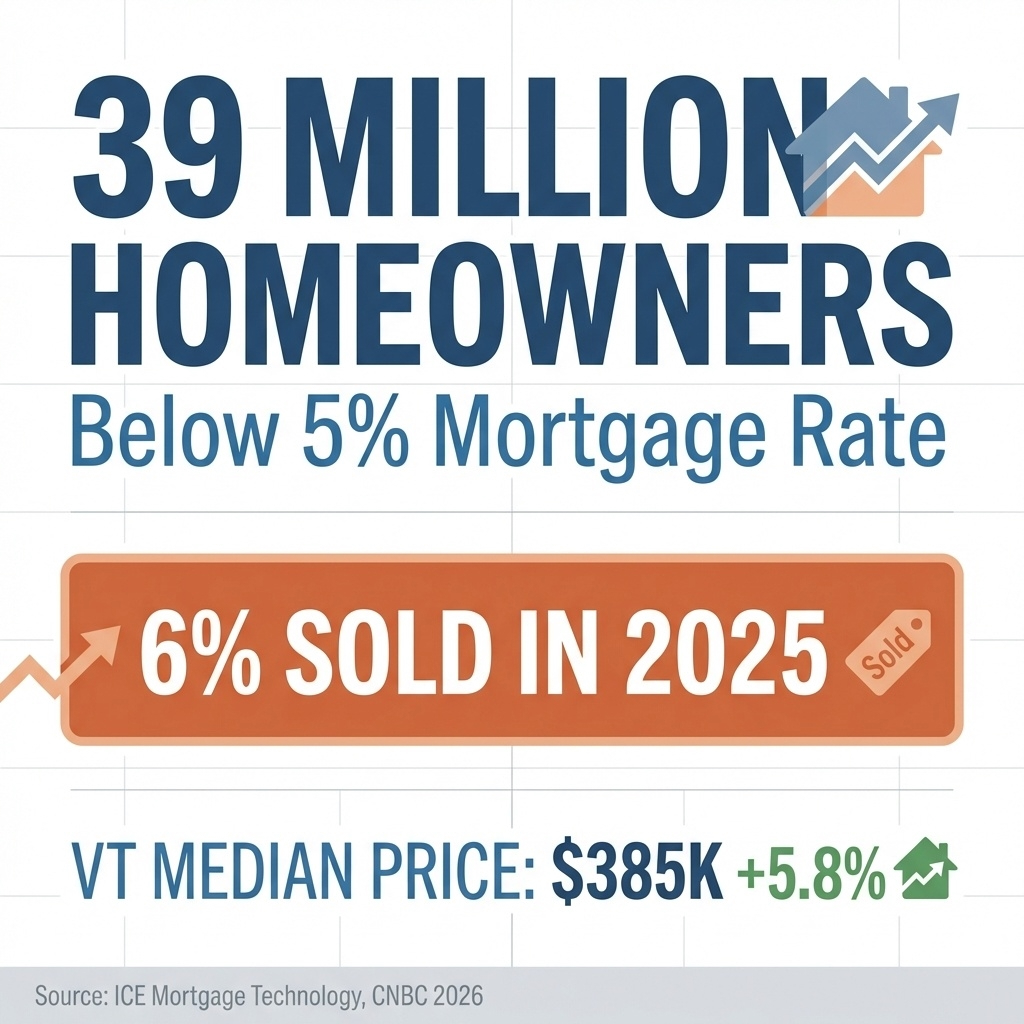
Thirty-nine million U.S. homeowners still hold mortgage rates below 5%, and only 6% gave up those rates in 2025—but Vermont home prices rose 5.8% last year to a median of $385,000, meaning sellers sitting on low rates are also sitting on significant equity gains. If you're a Vermont homeowner weighing whether to sell now or wait for rates to drop further, the math suggests that waiting may cost you more than moving does.

If You Only Do 3 Things

  1. Calculate your equity gain: If you bought before 2022, your Vermont home likely appreciated 15–25% or more—run the numbers on what you'd net after sale.
  2. Model your next purchase payment at 6%: A 6% rate isn't 3%, but it's workable if your equity covers a larger down payment or the home you actually want.
  3. Get a professional market analysis: Early 2026 sellers have negotiating power before competition ramps up—but that advantage shrinks as more sellers test the market in March–April.
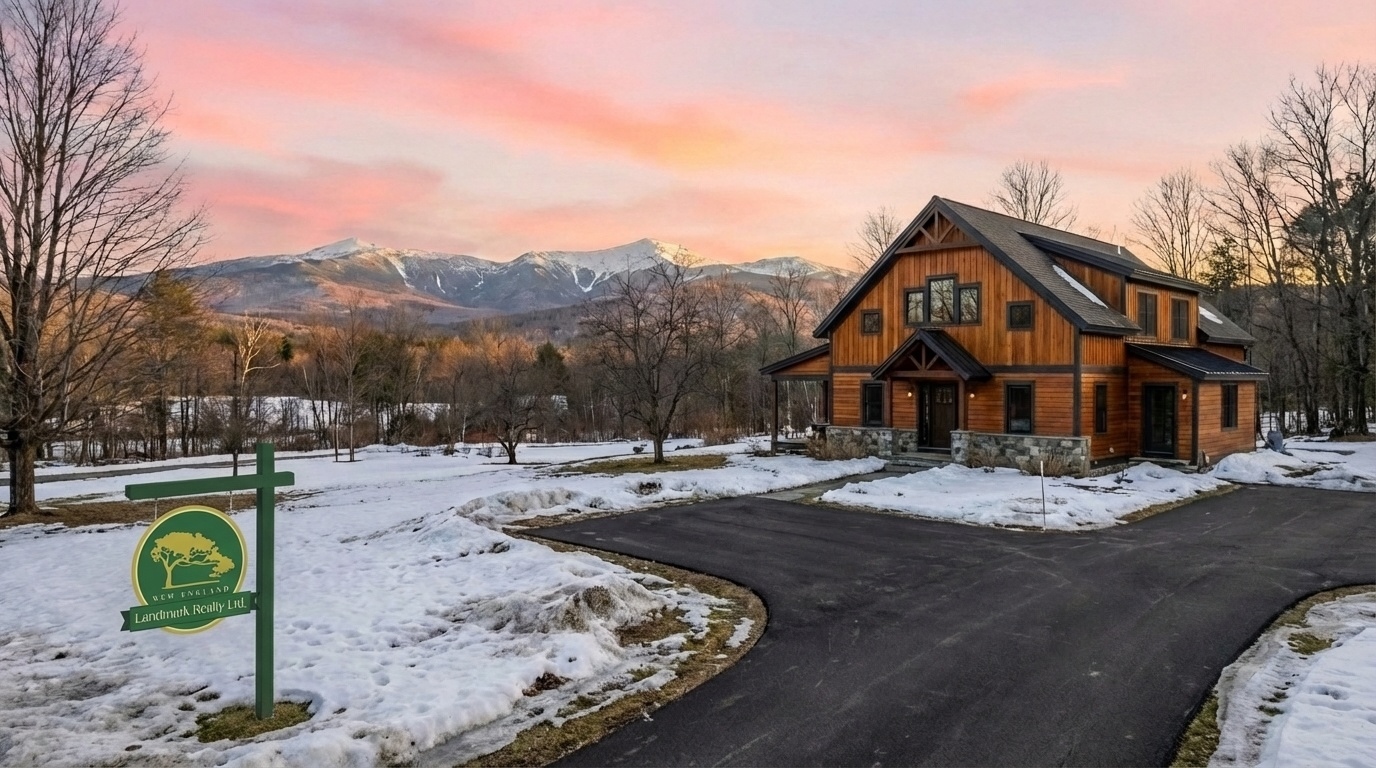
Vermont home with For Sale sign in late winter with mountains in background during golden hour
Early 2026 sellers have a window—but it won't stay open forever.

What Changed (and the One Number That Matters)

Direct Answer: Thirty-nine million U.S. homeowners still hold mortgage rates below 5%, and last year only 6% of them gave up those rates to sell or refinance (ICE Mortgage Technology, February 2026). In Vermont, that lock-in effect is colliding with a 5.8% year-over-year price increase—meaning your low rate is valuable, but so is the equity you've built. The trade-off: hold the rate and stay put, or sell now and use your gains to buy what you actually need at 6%.

Let's run the numbers.

If you locked in a rate below 4% anytime between 2020 and early 2022, that rate feels like a golden handcuff. You're not wrong. Math doesn't care about feelings, but it does care about opportunity cost.

Here's what the data tells us: CNBC reported this week that roughly 39 million homeowners nationwide are sitting on rates below 5%. Another 12 million are below 3%. Last year, only about 6% of those folks sold or pulled cash out. Translation: 94% stayed put.

In Vermont, that same psychology is playing out—but with a wrinkle. While the rest of the country saw modest or flat appreciation, Vermont's median sale price hit approximately $385,000 by year-end 2025, up 5.8% from 2024. If you bought in Central Vermont in 2020 for $300,000, you're likely sitting on $385,000 to $400,000+ in value today. That's real money.

The Data (What the Numbers Actually Say)

Direct Answer: Three numbers define the decision: 39 million homeowners below 5% (the lock-in cohort), a Vermont median price of $385,000 (up 5.8%), and a current 30-year mortgage rate around 6.10%. For a Vermont seller who bought at $300,000 in 2020 with a 3.5% rate, selling now and buying a $450,000 home at 6% with $100,000 down (from equity) yields a monthly payment around $2,098—higher than the old $1,347, but you're in the home you want, not the home you settled for.
Infographic showing 39 million homeowners below 5 percent mortgage rates, only 6 percent sold in 2025, Vermont median price 385K
The lock-in effect is real—but so is Vermont's equity surge.

Here are the three numbers that matter:

1. Thirty-nine million homeowners hold rates below 5%. That's the national baseline. According to ICE Mortgage Technology and reported by CNBC on February 4, 2026, this cohort represents the vast majority of homeowners who refinanced or bought during the 2020–2021 rate environment. They're not moving unless forced.

2. Vermont's median sale price is approximately $385,000, up 5.8% year-over-year. That's from year-end 2025 data compiled by Vermont brokerages including Catalyst Realty. In Central Vermont specifically, some towns are seeing medians closer to $400,000 or higher. If you bought before the surge, you've captured that gain—but only on paper until you sell.

3. The current 30-year fixed mortgage rate is around 6.10%. As of late January 2026, Freddie Mac's Primary Mortgage Market Survey pegged the average 30-year fixed rate at 6.10%, down from over 7% a year ago. That's not 3.5%, but it's also not 8%. It's workable—especially if you're bringing $80,000 to $120,000 in equity to the table.

Translation: If you're sitting on a $300,000 home you bought in 2020 at 3.5%, your monthly principal and interest payment is roughly $1,347. If you sell that home today for $385,000, net $100,000 after costs, and buy a $450,000 home at 6% with 20% down ($90,000), your new payment is approximately $2,098. That's $751 more per month.

But here's the question nobody's asking: Is the $300,000 home still the home you want? Or are you staying because the rate feels too good to give up?

So What Does That Mean for Vermont?

Direct Answer: Vermont's inventory rose 11.7% in late 2025 as more sellers tested the market, but transaction velocity remains slow because most buyers are also locked-in sellers who haven't made the leap yet. If you sell in early 2026—before spring competition peaks—you'll face fewer competing listings and can negotiate from strength. Wait until April or May, and you're swimming in a more crowded pool. The math favors moving now if the equity allows you to buy what you need, not just what you can afford.
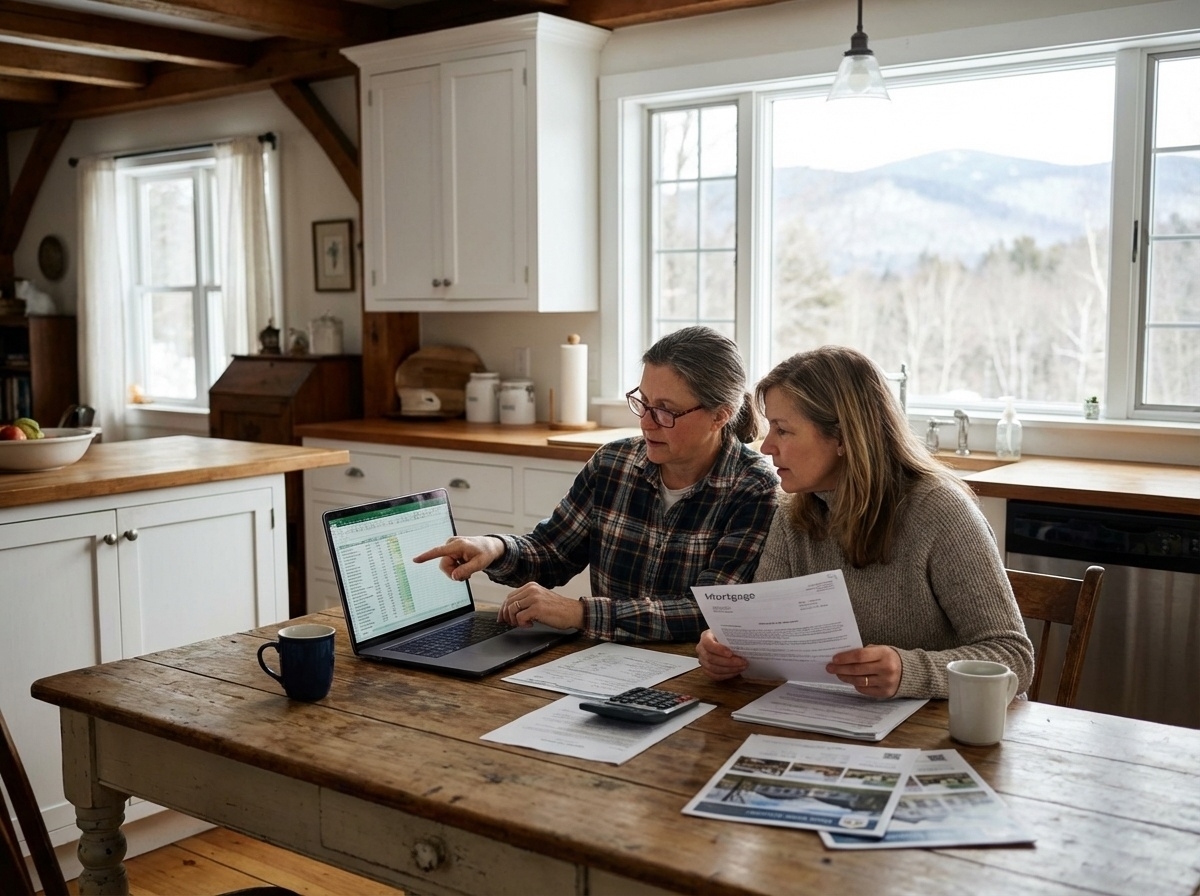
Vermont homeowner sitting at kitchen table with calculator and mortgage paperwork, contemplating selling decision
The decision isn't about the rate—it's about the home.

Vermont operates on its own rhythm. Inventory traditionally drops in winter, then surges in March and April as sellers prep for the spring market. In 2025, inventory rose 11.7% by November—a sign that more homeowners were willing to test the waters. But sales velocity stayed slow. Why?

Because the buyers are also sellers. They're locked in at 3.5% or 4.25%, and they're doing the same math you are. The breakthrough happens when someone says, "I'm leaving money on the table by staying in a home I've outgrown."

Here's the Vermont-specific angle: If you list in February or early March 2026, you're ahead of the spring rush. Buyers who are serious right now aren't window-shopping—they're committed. You'll face less competition from other sellers, and you can price strategically without getting undercut by ten other listings in your zip code.

Wait until late April, and you're one of forty listings in a five-town radius. The advantage evaporates.

The other factor: Vermont's equity gains are sticking. Unlike some sunbelt markets where prices spiked then corrected, Vermont's appreciation has been steady and supported by real demand—remote workers, second-home buyers, and retirees who want land and access to outdoor life. That demand isn't reversing. Your equity is real.

Bottom Line (The Gain Frame)

Direct Answer: Holding a 3.5% rate on a home you've outgrown isn't financial discipline—it's inertia. If your Vermont home has gained $80,000+ in equity and you can use that to buy the home you actually want at 6%, the higher rate is the cost of getting your life unstuck. Run the numbers with a professional, model the payment, and decide whether you're staying for the right reasons or just because the rate feels too good to lose.

That 3.5% rate isn't a golden ticket. It's a sunk cost.

If the home still works—if the bedrooms fit your family, if the commute makes sense, if the town is where you want to be—then by all means, hold the rate. But if you're staying because you can't stomach giving up 3.5%, you're making a $750-per-month decision that's costing you quality of life.

Here's the play if you're a Vermont seller:

Step 1: Calculate your net proceeds. Take your current estimated home value (use Zillow, Redfin, or get a professional comparative market analysis). Subtract 6–8% for closing costs and commission. That's your equity war chest.

Step 2: Model your next purchase at 6%. Find the home you want. Run the mortgage payment at 6.10% with your equity as the down payment. If the payment is workable, you've just bought permission to move.

Step 3: List before the spring surge. February and early March sellers in Central Vermont have leverage. Use it.

The math won't get dramatically better if you wait. Rates may drop another quarter-point by summer—maybe. But Vermont inventory will definitely rise, and your negotiating position will definitely weaken. The window is open now. It won't stay open.

What to Do Next

If you're a Vermont homeowner sitting on equity and a low rate, the first step is to stop guessing and start calculating. A professional comparative market analysis can show you what your home is worth today—not what Zillow thinks, but what buyers in your town are actually paying.

From there, model the next move. What does a 6% payment look like on the home you want? What's the monthly cost of staying versus moving? Most importantly: What's the cost of staying in a home that no longer fits?

The 39 million homeowners locked below 5% aren't all making the wrong choice. But some of them are staying for the wrong reasons. Don't be one of them.

Contact New England Landmark Realty:
Office: (802) 253-4711 or (866) 324-2427
Tony's Cell: (802) 233-4107
Website: www.nelandmark.com
Vermont Home Buying Guide | Selling Your Vermont Home

Where to Go Next

Sources

Posted in Numbers Guy
Feb. 20, 2026

2074 Winter Olympics Snow Crisis: Vermont vs Western Resorts


Classic Rock & Fresh Powder

Where Will the Snow Be in 2074?

Vermont's Climate Advantage Over Western Ski Resorts
 
Milano-Cortina 2026 Olympics artificial snow operations compared to Vermont natural snowfall climate reliability comparison for ski real estate investors

The Opening Riff: Italy's €22 Million Snow Job

The 2026 Winter Olympics in Milano-Cortina opened with a spectacle the world hasn't quite seen before: 2.4 million cubic meters of artificial snow—enough to cover 960 football fields three feet deep—manufactured using 250 million gallons of water. That's the daily drinking supply for 900 million people.

The equipment cost? €22 million. The annual snowmaking budget for Italian Alps resorts? €50 to €100 million, representing 30 to 40 percent of their total energy costs.

Let that sink in. The birthplace of alpine skiing—the Dolomites, Cortina d'Ampezzo, the Italian Alps—cannot host the Winter Olympics without industrial fake snow.

Meanwhile, Cortina property values climbed 10 percent annually in the run-up to the Games, according to the Knight Frank Alpine Report. Those gains came with hidden infrastructure: €50 million in annual snowmaking costs just to keep the slopes white. By 2050, when temperatures rise another 2°C and the snow stops falling even with €100 million budgets, what happens to those €2 million chalets?

The Olympics have become a snow casino. And the house always wins—until it doesn't.

Satirical Developer's Playbook showing the unsustainable cycle of Olympic winter sports hosting and artificial snowmaking investments

Bring It Home: The US Snow Crisis Is Here

While Europe makes headlines, the American West is quietly unraveling.

Vail Resorts—the largest ski resort operator in North America—reported in January that snowfall in the Rockies was 60 percent below the 30-year average for November and December 2025. Vail Mountain recorded its worst snowpack in 47 years: just 4.4 inches of snow-water equivalent. Only 11 percent of terrain was open as of January 4, 2026. The company cut its 2026 earnings outlook and used the phrase "historically low early-season snowfall" three times in the press release.

Park City hit a 30-year record low for snowpack in January 2026.

Palisades Tahoe—after logging a record 723 inches in the 2022-23 season—is tracking 50 percent below normal for 2025-26.

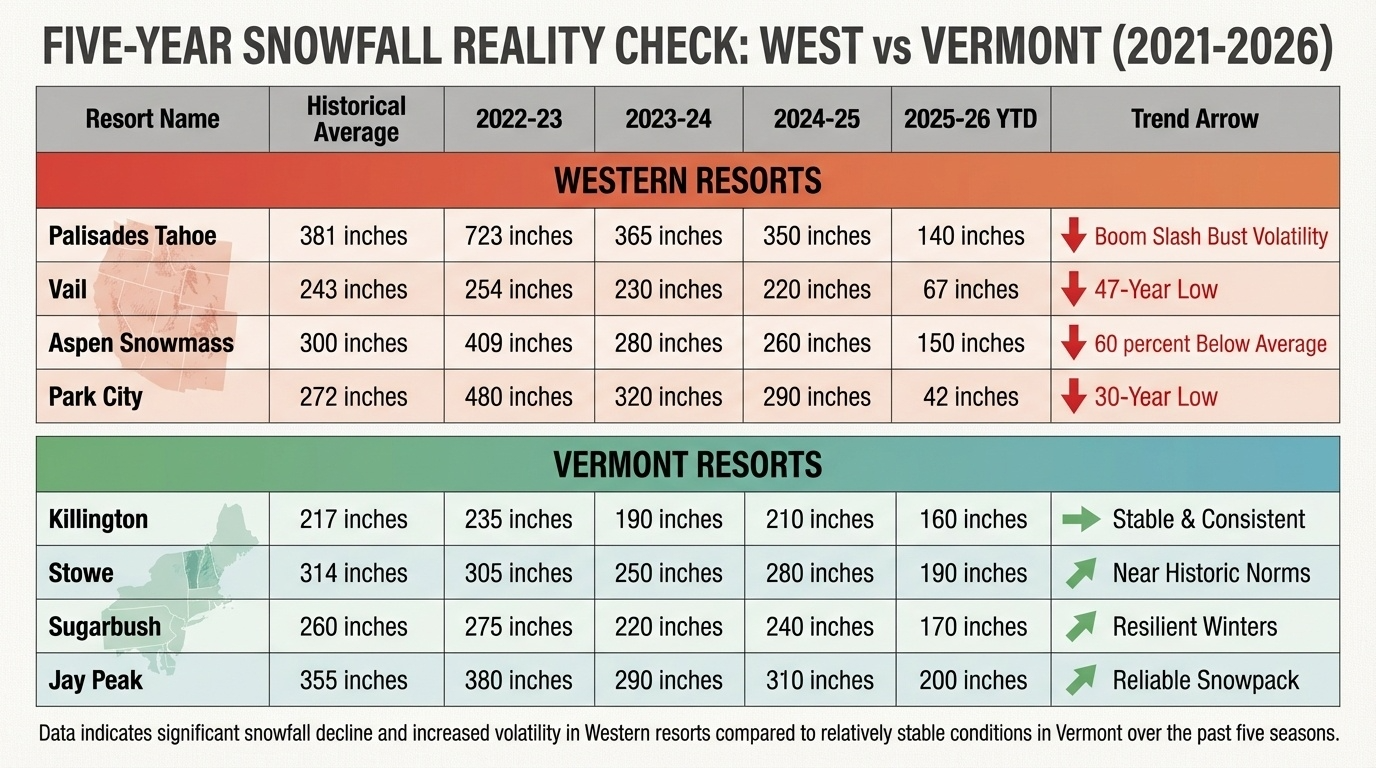
Here's what five years of snowfall data looks like when you stop believing the marketing brochures:

Five-year snowfall comparison 2021-2026 showing Western US ski resorts declining while Vermont maintains consistent natural snow totals

The pattern is clear. The West had one epic year in 2022-23—record-breaking snow that made everyone forget the drought years before it. Then two mediocre years. Then a crisis year in 2025-26.

Vermont? No boom. No bust. Just snow. Every 72 hours, like clockwork, driven by lake-effect systems off the Great Lakes that don't care about El Niño, La Niña, or shareholder earnings calls.

Jay Peak logged 257 inches by early February. Stowe has 218 inches. Killington is tracking toward ~320 inches for the season. Boring. Predictable. Bankable.

The 2074 Winter Olympics: Where Will They Be?

If current trends hold, the 2074 Winter Olympics will have exactly four options: Niseko (Japan), Terskol (Russia), Val d'Isère (France), and Courchevel (France).

Notice what's missing? The entire United States.

Not Vail. Not Aspen. Not Park City. Not Jackson Hole. None of them will have reliable natural snow by mid-century, according to projections from Climate Central and a 2024 study published in Nature Climate Change.

Of the 93 cities with Olympic-level winter sports infrastructure, 94 percent are "climate reliable" today. That number drops to 44 percent by the 2080s. The Rockies won't make the cut.

Vermont won't host the Olympics either—we don't have the infrastructure, the hotels, or the half-pipes. But we'll have something better: snow. And when you're a second-home buyer in 2026 looking at a 30-year hold, "boring and reliable" suddenly sounds like the best investment thesis on the mountain.

Follow the Money: The 30-Year Real Estate Math

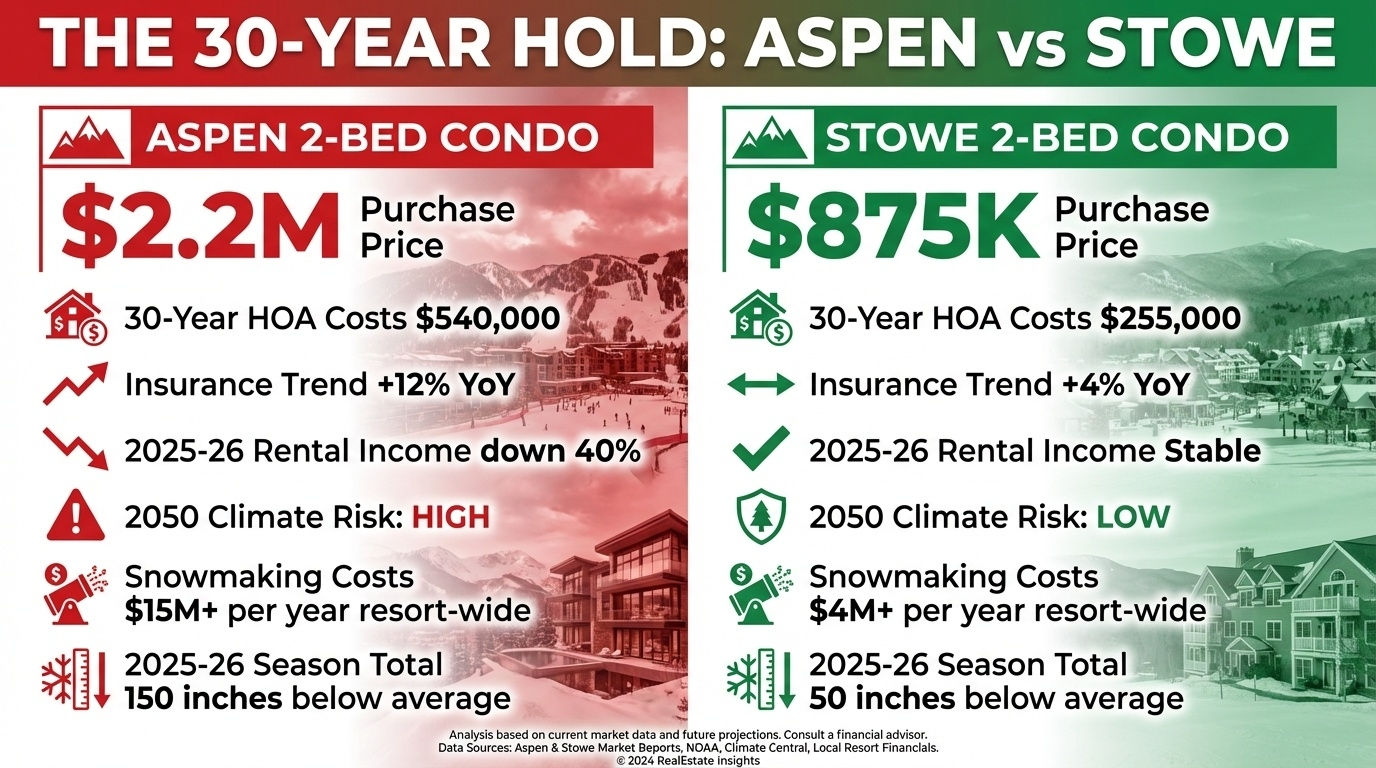
Let's compare two buyers in 2026 making 30-year holds:

30-year financial comparison Aspen ski condo versus Stowe Vermont showing 1.6 million dollar savings and lower climate risk

Buyer A: Aspen 2-Bed Condo

  • Purchase price: $2.2M

  • Annual HOA dues: $18,000 ($540,000 over 30 years)

  • Insurance premium trend: +12% YoY (climate risk)

  • Rental income (2025-26): Down 40% (shorter season, fewer bookings)

  • 2050 resale risk: High (potential 30% depreciation if snowfall continues declining)

Buyer B: Stowe 2-Bed Condo

  • Purchase price: $875K

  • Annual HOA dues: $8,500 ($255,000 over 30 years)

  • Insurance premium trend: +4% YoY

  • Rental income (2025-26): Stable (218" season total, predictable bookings)

  • 2050 resale risk: Low (climate models show Vermont stable through mid-century)

Net difference over 30 years:

  • Aspen: $1.325M more upfront + $285K more in HOA dues + unknown climate depreciation

  • Stowe: Lower entry, lower carry cost, climate hedge built in

Total savings: ~$1.6 million, plus you actually get to ski.

You're not buying Vermont because you can't afford Aspen. You're buying Vermont because Aspen won't have snow.

This Week's Tracks

🎸 Classic Rock & Fresh Powder Playlist (on Spotify)

  1. Public Enemy – "Don't Believe the Hype"
    (Aspen marketing vs. 67 inches of snow)
  2. Bob Dylan – "The Times They Are A-Changin'"
    (Climate isn't negotiable)
  3. Neil Young – "Mother Earth (Natural Anthem)"
    (Lake-effect snow doesn't need a press release)
  4. The Clash – "Should I Stay or Should I Go"
    (Tahoe vs. Vermont)
  5. R.E.M. – "It's the End of the World as We Know It (And I Feel Fine)"
    (Vermont's fine)

© 2026 New England Landmark Realty | Classic Rock & Fresh Powder Newsletter

Feb. 20, 2026

The Anatomy of a Con: What a Tuesday Morning Scam Attempt Reveals About Real Estate Fraud in 2026


Pattern Recognition, Digital Predators, and Why FSBO Sellers Are Sitting Ducks

By Tony Walton, New England Landmark Realty |

Jump to Key Takeaways ↓

Hi,

That's what the email said. Not "Hi Tony." Just "Hi."

And that's where I stopped chewing my bagel.

The Setup

Tuesday morning. Standard inbox chaos. Then this:

"I came across your profile on Zillow and I'm interested in purchasing a property in Vermont. I'll be relocating soon, so I'm ideally looking for something move-in ready."

Polite. Professional. Generic.

No name. No town. No budget. No timeline. Just vague interest that could have been sent to 500 agents across six states. Which it probably was.

The first tell? My name wasn't used.

If you found me on Zillow—where my name, photo, brokerage, and phone number are visible—you'd use it. Real people personalize. Scammers template.

Then came the pivot:

"We would like to discuss this on Zoom... my husband is not currently with me and is in military camp. Zoom would work best so we can both join the call together."

Perfect. Let me decode:

  • Military spouse = instant credibility + sympathy
  • Husband unavailable = explains vagueness and delays
  • Zoom preference = avoids in-person verification
  • Future tense = "would like to discuss" is a probe, not a commitment

This isn't how real buyers communicate. This is social engineering.

Key Takeaways

Two-Sentence Summary

Real estate scams in 2026 rely on social engineering, vague language, and artificial urgency to exploit sellers—especially FSBO owners who lack institutional protection and pattern recognition. Vermont broker Tony Walton decodes a Tuesday scam attempt and shows how specificity, verification, and professional friction dismantle fraud before it starts.

If You Only Remember 3 Things

  • Scammers avoid specificity. Real buyers use your name, reference towns and price ranges, and answer concrete questions. Vague inquiries with artificial urgency are red flags.
  • FSBO sellers face exponentially higher fraud risk. Without pattern recognition, institutional firewalls, or verification tools, they are primary targets for wire fraud, title theft, and phishing scams.
  • Professional friction stops scams cold. Require written details, verify all wiring instructions by phone, insist on in-person meetings, and never share financial info until identity is independently confirmed.

Quick Facts

  • Real estate fraud resulted in over $170 million in losses across 9,359 cases in 2025, with wire fraud up 30% year-over-year.
  • FSBO sellers are disproportionately targeted because they lack institutional protection, have public contact info, and often lack pattern recognition.
  • Scammers use AI-powered deepfake technology in 2026 to impersonate buyers, attorneys, and title company representatives via voice and video.

How Modern Scams Actually Work

These aren't smash-and-grab operations. They're relationship development. The goal isn't to steal your wallet on day one—it's to become familiar over days or weeks, then introduce a transaction that requires your help.

Sometimes you're not even the target. You're the legitimacy layer. Your name and brokerage get attached to emails sent to other victims: "Our agent Tony Walton is handling this." Now I'm the credibility shield for fraud I didn't know existed.

The Five-Step Pattern:

  1. Broad outreach – Generic message to hundreds of targets
  2. Rapport building – Polite, flattering, appeals to helpfulness
  3. Constraint introduction – Spouse unavailable, military/overseas, virtual-only
  4. Information extraction – They stay vague, you give details
  5. The pivot – Documents, third parties, wiring instructions (the danger zone)

The FSBO Multiplier: Why Going It Alone Is Exponentially Riskier

If this is scary for a licensed agent with twenty years of experience, it's catastrophic for For Sale By Owner (FSBO) sellers.

Why FSBO Sellers Are Primary Targets

1. Zero Pattern Recognition

I spotted this in three seconds. FSBO sellers are experiencing their first (maybe only) property sale. They don't know what normal looks like, so they can't identify abnormal.

2. No Institutional Firewall

When scammers contact me, they're contacting New England Landmark Realty—a brokerage with legal counsel and E&O insurance. FSBO sellers? One email address. One phone number. Solo.

3. Emotional Vulnerability

FSBO sellers often go this route to save commission, which usually signals financial pressure or high motivation. Scammers exploit this. They create artificial urgency:

  • "We're military relocating in two weeks."
  • "We're cash buyers but need to close fast."
  • "Our financing expires Friday."

4. Public Contact Info, Zero Verification

List FSBO on Zillow and your contact information goes live to the entire internet—with zero fraud screening. Zillow doesn't vet who contacts you. No lead qualification. Just raw inquiries from anyone.

As one Reddit user noted in 2018: "FSBO's are targets for three aggressive groups—Realtors who want the listing, wholesalers, and scammers." That was eight years ago. It's exponentially worse now.

5. More Sophisticated Scams

FSBO sellers face scams agents rarely see:

  • Fake cashier's check scams – "Buyer" overpays, asks you to wire back difference. Check bounces. You're out tens of thousands.
  • Title fraud/deed theft – Scammers pose as buyers, gain access to property info, fraudulently transfer the deed or borrow against the property. Vacant land and second homes are particularly vulnerable.
  • Phishing for personal info – "Buyer" requests SSN, bank details, deed copies "for the title company." Data gets sold or used for identity theft.
  • Virtual closing wire fraud – Scammer impersonates your attorney or title company via email, sends "updated wiring instructions," steals your proceeds.

The numbers: In 2025, real estate fraud resulted in over $170 million in losses across 9,359 cases. FSBO sellers represented a disproportionate share of victims. Average loss per scam: $18,000+. Wire fraud is up 30% year-over-year.

New threat: AI-powered deepfake scams now use voice cloning and video manipulation to impersonate buyers, attorneys, and title reps.

Why Zillow and FSBO Platforms Are Hunting Grounds

Zillow isn't the villain, but their platform creates an ecosystem scammers exploit.

Zillow's business model: They make money from Premier Agent subscriptions, not from vetting FSBO inquiries. Zero friction for scammers—anyone can create an account and contact sellers. No identity verification. No credential checking.

The illusion of safety: FSBO sellers think they're protected because they're on a "legitimate" platform. They don't realize Zillow is just a bulletin board. Zillow's warning page essentially says: "Buyer beware. We can't protect you."

Which is sound advice—but it comes after you've already exposed yourself.

The Red Flags (How to Spot a Ghost)

Real buyers:

  • Use your name
  • Reference specific towns, listings, or price ranges
  • Answer concrete questions without defensiveness
  • Accept normal process boundaries
  • Will meet in person or via verified video
  • Provide verifiable pre-approval or proof of funds

Scammers:

  • Stay abstract
  • Redirect instead of answering
  • Emphasize circumstances over facts
  • Insist on virtual-only interaction
  • Create artificial urgency
  • Avoid details in writing

One of these is explainable. All of them together is a pattern.

What to Do (The Defense Playbook)

For Agents:

Apply professional friction. I sent this:

"Before scheduling a Zoom, I need basic context: How you found my profile, general price range, anticipated timing, and whether you're financing or paying cash. Once I have that, I'm glad to coordinate."

Real buyers answer immediately. Scammers disappear or push harder.

For FSBO Sellers:

  • Never share financial info until you've verified identity – No SSN, bank details, or driver's license until you've independently confirmed the buyer, attorney, or title company through a number you looked up.
  • Insist on in-person verification – Real buyers will meet you. If someone insists on virtual-only because they're "relocating/military/overseas"—end the conversation.
  • Use your own title company or attorney – Don't let the "buyer" choose. You choose. Call them directly. Verify all wiring instructions by phone.
  • Never wire money based on email alone – Email is the weakest link. Always verify wiring instructions via phone to a known, trusted number.
  • Trust your instincts – If a buyer is too eager, offering above asking without seeing the property, pressuring you to move quickly, or avoiding meetings—stop. Get a second opinion from a local attorney or agent.

The secret: Specificity is kryptonite to fraud. Scammers rely on momentum and vagueness. Slow down. Require written details. The con collapses.

The Bottom Line

Not everyone who contacts you is real. Not every "buyer" is a buyer.

For FSBO sellers especially, the risk is exponentially higher. You're navigating a professional transaction without professional tools, institutional backing, or pattern recognition. From a scammer's perspective, you're visible, vulnerable, and profitable.

Real relationships still matter. Real people still need real help. But scammers can't fake specificity, context, and human connection.

So when you get a lead that feels too smooth, too vague, too eager for Zoom without answering basic questions—pause. Ask. Verify.

And if they don't use your name? That's not an oversight. That's a tell.

Stay sharp.

Tony Walton
Founding Partner, New England Landmark Realty
Waterbury, Vermont
802-233-4107 | www.nelandmark.com

P.S. — If you're a FSBO seller thinking "Maybe I should hire an agent after all"—that's wisdom, not paranoia. We don't just market properties. We filter noise, spot red flags, and stand between you and people who want to steal your money. That commission you're saving? It's cheaper than the $180,000 a Wichita seller lost to wire fraud last year.

P.P.S. — Simple verification test: Ask for a price range, timeline, and how they found you. Real buyers answer. Scammers deflect. That deflection is your answer.

Where to Go Next

Ready to Buy or Sell with Confidence?

New England Landmark Realty provides institutional protection, pattern recognition, and transaction security for Vermont buyers and sellers.

Contact Tony Walton directly:
Cell: (802) 233-4107
Office: (802) 253-4711
Toll-Free: (866) 324-2427

Download the Vermont Buyer Guide | Downl

Posted in Agent Resources
Feb. 18, 2026

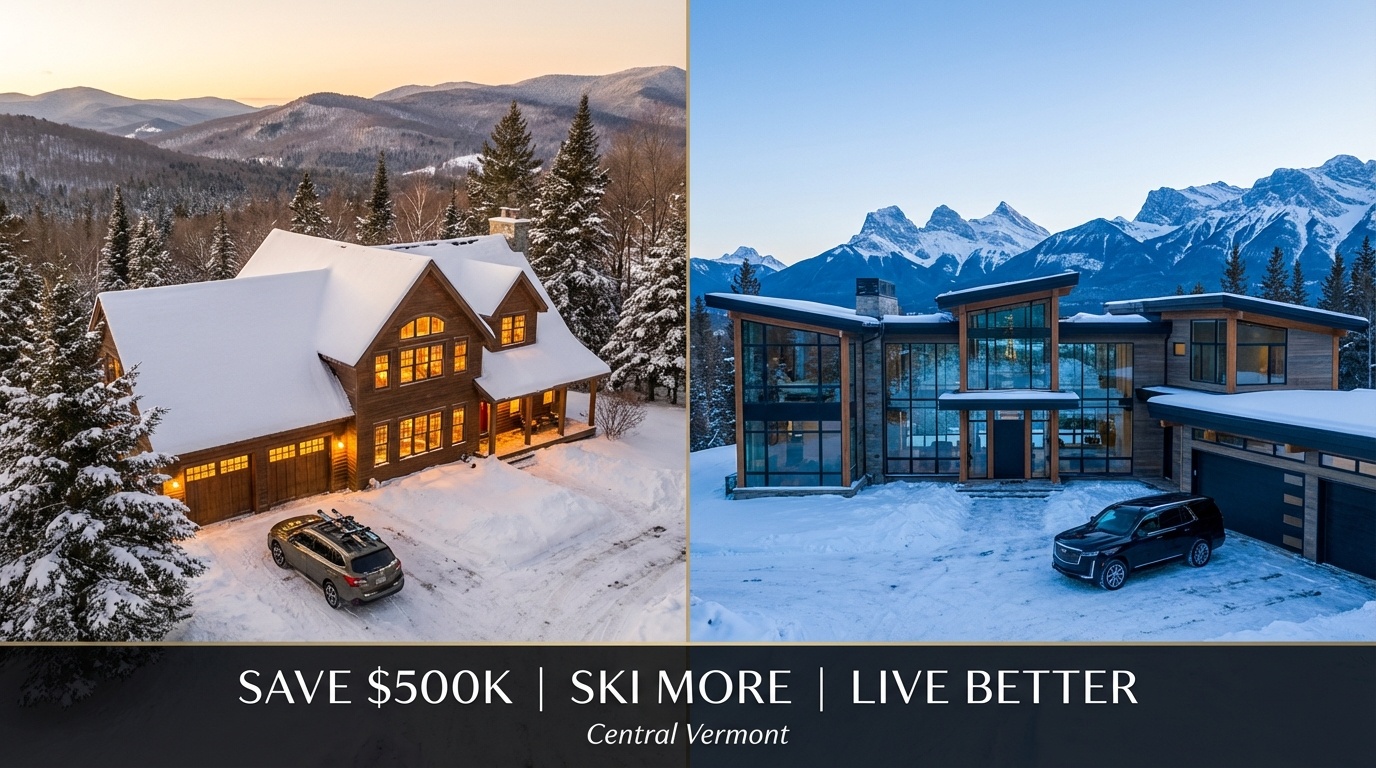
Why Winter Sports Lovers Keep Choosing Central Vermont Over Aspen (And Saving $500K)

When geography, lifestyle, and equity converge—and why ski-town real estate in Vermont is still printing money.

Vermont vs Aspen ski home comparison

The math is ugly and beautiful at the same time.

Aspen median home price: $850K–$1.2M+
Stowe median home price: $994K–$1.2M
Mad River Valley median: $450K–$1.2M+
Killington area: $385K–$650K

Translation: You can buy a four-bedroom ski chalet in Central Vermont with equity left over for the same price as a 1,200-square-foot condo in the Rockies. And that's before we talk about drive times.

But here's the thing winter-sports buyers—especially second-home buyers from Boston, New York, and Montreal—have figured out: the best ski towns aren't the ones with the biggest Instagram followings. They're the ones you can actually reach on a Friday night.

The 3-Hour Advantage: Access Is Equity

Central Vermont sits in the sweetest real estate arbitrage zone on the East Coast:

  • Boston → Killington: 2h 45min
  • Boston → Sugarbush: 3h 30min
  • NYC → Killington: 5 hours
  • NYC → Sugarbush: 6 hours
  • Denver → Aspen: 3.5 hours (plus you flew cross-country first)

What buyers tell me: "I can leave Boston at 5 p.m. Friday and be on the slopes by 9 a.m. Saturday—without missing my kid's soccer game or burning vacation days on travel."

That access premium is translating directly into price appreciation. According to recent market data, Stowe home values climbed 41% year-over-year, while Mad River Valley properties in the $450K–$1.2M range saw steady rental demand and resale strength.

When your ski home is a weekend commute instead of a cross-country expedition, you use it more. You rent it more. You love it more. And the market rewards that.

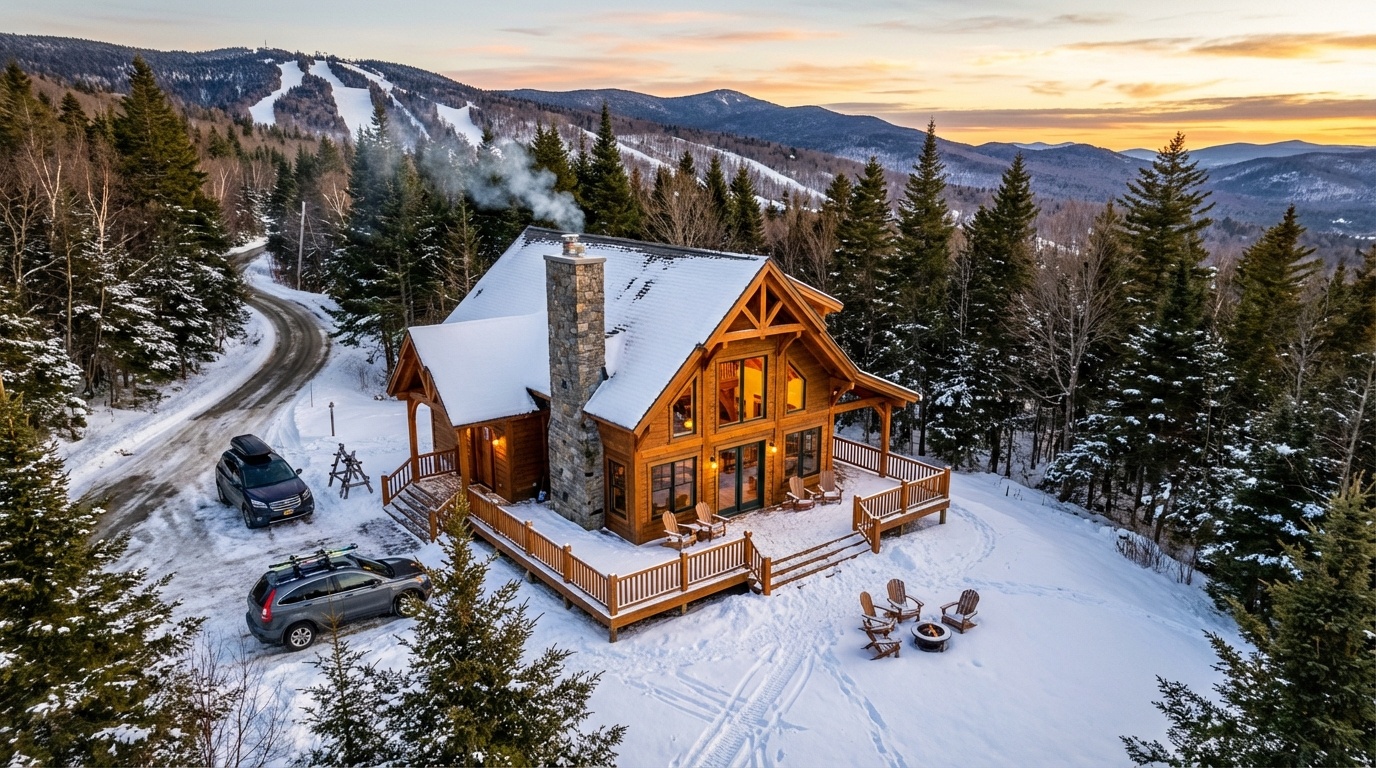
Aerial view of Vermont ski chalet at sunset

Snow + Terrain: Vermont Is the Top-Ranked Non-Western Ski State

Let's talk performance metrics.

This season (2025–26):

  • Stowe: 168 inches and counting
  • Jay Peak: ~470 inches (2024–25 season total)
  • Mount Mansfield: Hit 100 inches on March 2, 2025—the third time in 60 years

Skier visits: Vermont logged 4.16 million skier visits in 2024–25, up 1.1% year-over-year (Ski Vermont).

And here's the kicker: Vermont is ranked the #1 ski state outside the Rockies. East Coast terrain? Sure. But Killington's 1,509 acres, Sugarbush's 508 acres, and Stowe's 485 acres—backed by aggressive snowmaking infrastructure—mean you're skiing more days per season than most Western resorts promise.

What that means for real estate: Ski-home buyers aren't just betting on lifestyle. They're betting on consistent rental income. Killington alone generates an average $35K–$50K annually in short-term rental revenue for well-positioned properties (Steadily, 2026).

More snow = more bookings = stronger resale value = smarter equity play.

The Design Edge: What Ski-Home Buyers Actually Pay For

Here's where Vermont sellers win—or lose—on listing day.

Winter-sports buyers aren't just buying square footage. They're buying a turnkey mountain experience. And the properties that sell fastest (and for the highest premiums) are the ones that nail these details:

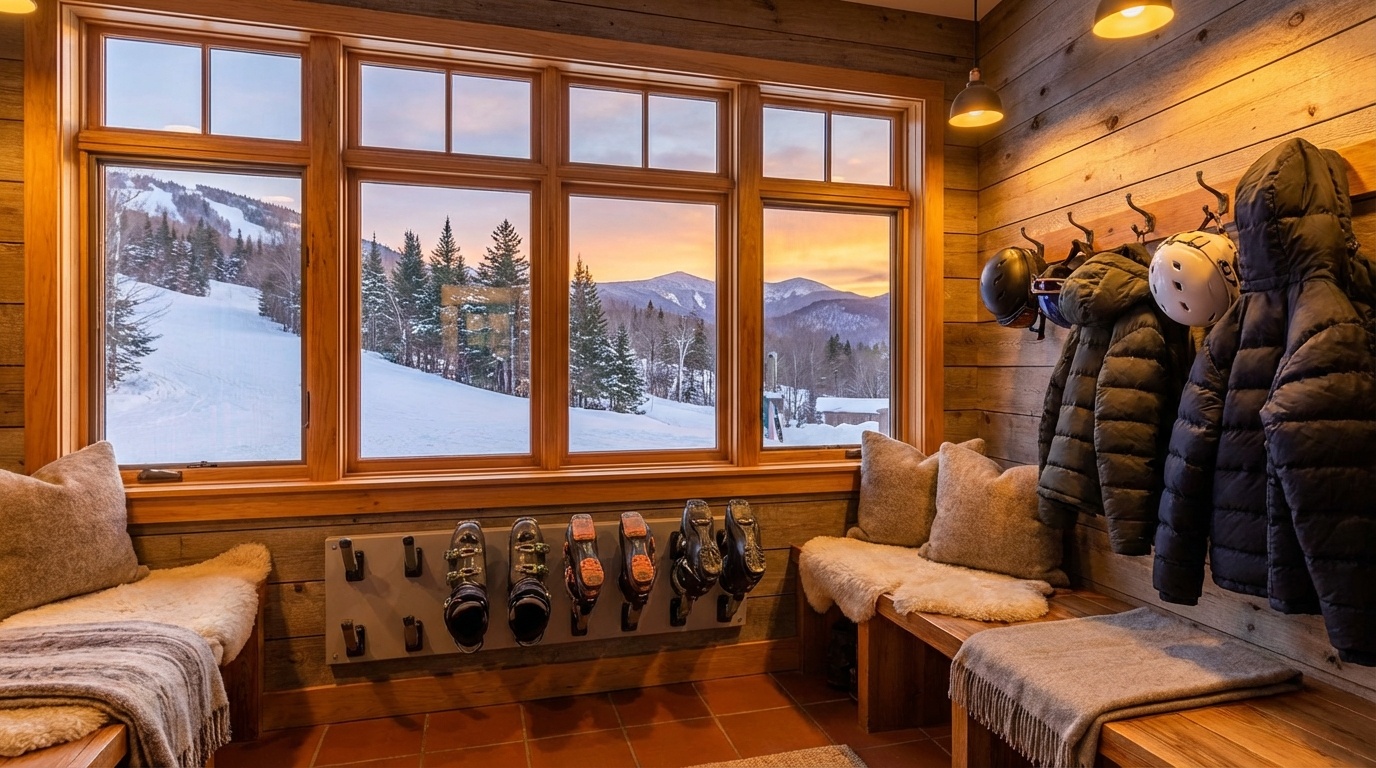
1. The Mudroom (AKA the $20K ROI Move)

A heated, well-lit mudroom with built-in boot dryers, gear hooks, and a bench signals to buyers: "This seller understands what it's like to come home from the mountain."

Vermont ski home mudroom with mountain views

Properties with dedicated gear storage and drying zones sell 15–20% faster than comparable homes without them. Cost to retrofit? $8K–$20K. Value add on resale? $30K–$50K.

2. Energy Efficiency (Because Winter Is Expensive)

Vermont winters are cold. Buyers know this. What they want to know is: How much will it cost to heat this place in January?

Homes with new insulation, modern HVAC, and efficient windows get more offers—and fewer post-inspection re-negotiations. Bonus: Energy efficiency is now a financing factor for some buyers using green mortgages.

3. Four-Season Appeal (Because Ski Homes Can't Just Be Ski Homes Anymore)

The smartest Vermont ski-home buyers—especially second-home and rental investors—are asking: "What happens in July?"

Properties near mountain biking trails, lakes, and summer festivals (looking at you, Mad River Valley and Killington) hold value better because they generate year-round rental income. Design for this: outdoor decks, fire pits, easy trail access.

Why Central Vermont Ski Homes Are Still a Smart Equity Play in 2026

Here's the real estate truth no one wants to say out loud: Vermont ski-town inventory is still tight, and demand from out-of-state buyers is not slowing down.

Key numbers:

  • Inventory up 33% statewide (but still below pre-pandemic levels)
  • Median sale price: $406,100 statewide (up 3% year-over-year; December 2025 data)
  • Average sale price in high-demand ski towns (e.g., Stowe, Killington, Mad River Valley): $540K+
  • Jay Peak area: Average home value ~$413K, up 2% YoY

Translation: Prices are holding. Inventory is expanding just enough to give buyers options—but not enough to crater values.

And here's the demographic tailwind: Vermont remains the #1-ranked state in the U.S. for quality of life (CNBC, 2025), which means migration pressure from coastal buyers isn't going away. They're just getting pickier about where they land.

The Bottom Line: Geography Beats Glamour

The ski towns that win in 2026 aren't the ones with the fanciest lodges or the most celebrity sightings. They're the ones where buyers can actually build a life—and a rental income stream—without sacrificing half their net worth or burning weekends in transit.

Central Vermont offers:

  • Access: 3–6 hours from Boston/NYC
  • Terrain: Top-ranked East Coast skiing with 400+ inches of annual snowfall
  • Value: $300K–$500K less than comparable Western resort towns
  • Equity: Appreciation rates holding steady; rental income potential strong
  • Lifestyle: #1 U.S. quality of life; four-season appeal; safe, tight-knit communities

And the design opportunities? They're everywhere. A $15K mudroom retrofit, a $10K energy audit and insulation upgrade, and a $5K outdoor deck refresh can turn a "nice Vermont home" into a six-figure equity gain on resale.

So here's the question: Are you buying a ski home because it looks good on Instagram—or because the numbers actually work?

The answer will determine whether you're still smiling in 2030.

What's Next?

If you're thinking about buying—or selling—a ski home in Central Vermont, let's talk. The market is shifting, but it's shifting toward buyers and sellers who understand the fundamentals: access, design, and year-round value.

Or just call me. I've been helping buyers and sellers navigate Central Vermont's ski-town markets since before "remote work" was a thing.

Tony Walton
Principal Broker, New England Landmark Realty

📞 Office: (802) 253-4711 | (866) 324-2427
📱 Cell: (802) 233-4107
✉️ Email: tony@nelandmark.com
🌐 Website: nelandmark.com

SOURCES:

  1. Zillow — Stowe, VT Housing Market: 2026 Home Prices & Trends — https://www.zillow.com/home-values/397783/stowe-vt/
  2. Mad River Valley Real Estate — 2026 January Market Data — https://www.mrvre.com/blog/2026-january---mad-river-valley-real-estate-driven-by-data
  3. Ski Vermont — 4.16 million skier visits in 2024–25 — https://skivermont.com/ski-vermont-2025-annual-meeting
  4. PeakRankings — USA Ski States Ranked 2025–26 — https://www.peakrankings.com/content/usa-ski-states-ranked-2025-26
  5. Catalyst Realty Collaborative — Vermont Real Estate Market Update January 2026 — https://catalystrealtycollaborative.com/vermont-real-estate-market-update-january-2026/
  6. CNBC — Vermont ranked #1 for quality of life in 2025 — https://www.cnbc.com/2025/07/14/americas-10-best-places-quality-of-life-top-states-for-business.html
  7. Your Vermont Homesearch — What Vermont Ski Town Should You Buy a Home In? — https://www.yourvermonthomesearch.com/blog/best-vermont-ski-town-to-buy-a-home/
  8. New England Landmark Realty — Will Vermont Home Prices Drop in 2026? — https://www.nelandmark.com/blog/will-vermont-home-prices-drop-2026-what-data-actually-says/
Feb. 16, 2026

The Staging Trend That's Actually Turning Buyers Off in 2026

By Kore's Design Eye | New England Landmark Realty

What This Article Is About

Who this is for: Vermont home sellers preparing winter listings—and buyers wondering why so many homes feel cramped online but spacious in person.

What you'll learn: Why the 2026 staging trend ("add warmth and personality") backfires in Vermont's smaller, darker homes—and the 40% subtraction rule that helps sellers get more showings, better photos, and higher offers.

If You Only Remember 3 Things:

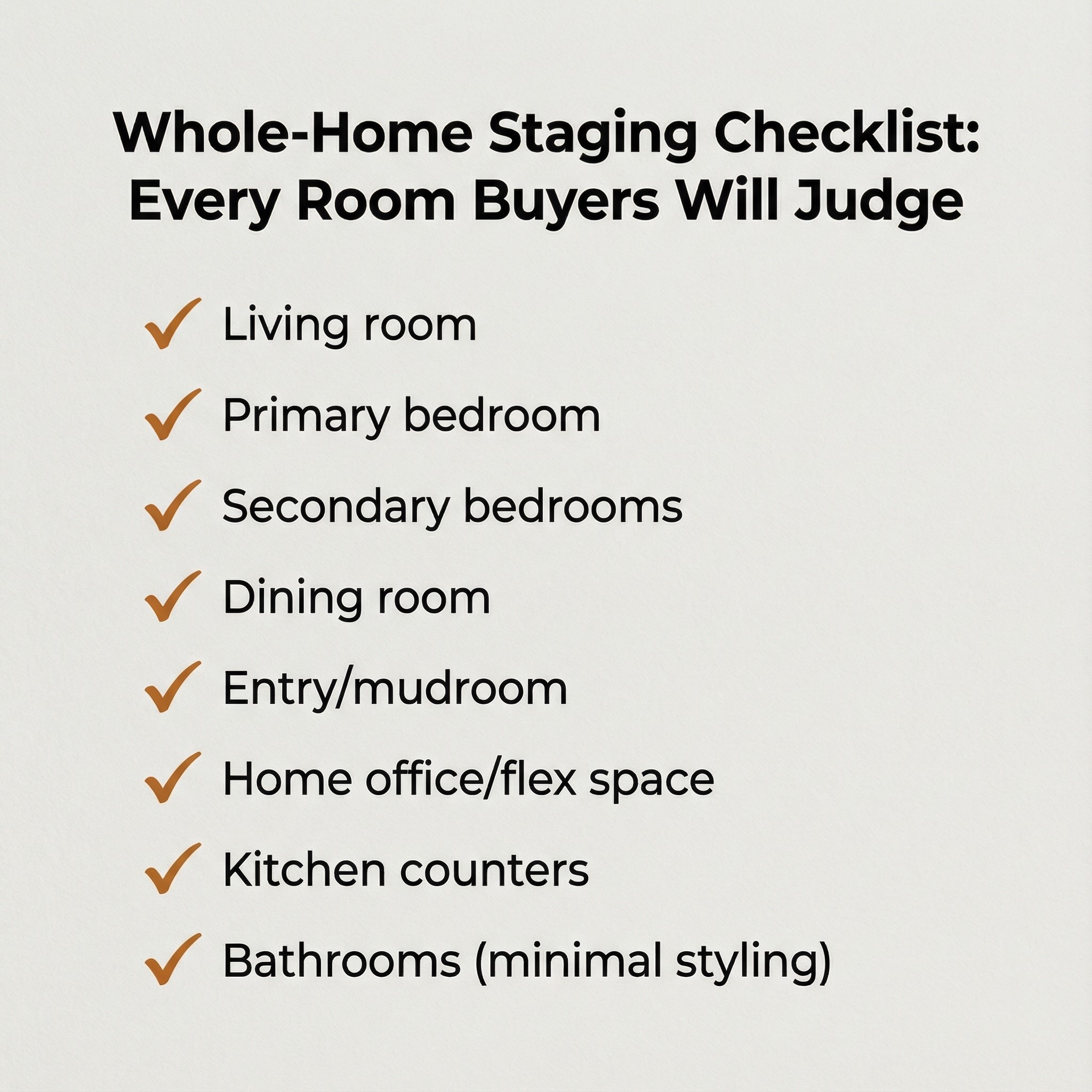
  1. The 2026 staging trend ("add warmth and personality") works in theory—but in Vermont's smaller, darker homes, it's backfiring. Buyers want space to imagine their own lives, not navigate yours.
  2. The fix is subtraction: Remove about 40% of your furniture, pack personal photos and collections, and edit surfaces to 1–2 intentional objects per room. Rooms photograph ~30% larger, and buyers see the bones—not the clutter.
  3. Three staging tiers: Weekend Purge ($0–$200, 2 days), One-Week Upgrade ($200–$800, 5 days), or Full Send ($800–$2,500, 2 weeks). Even the free option can add 5–10% to your sale price and cut days on market by 30–50%.

Quick Facts: Vermont Housing Context

  • Median Central Vermont home: 1,400–1,800 sq ft (vs. 2,200+ nationally)
  • Typical ceilings: 7.5–8 feet (vs. 9–10 in newer builds)
  • February daylight in Vermont: ~10 hours (best listing photos: 10 a.m.–2 p.m.)
  • North-facing windows are common—winter light is blue-toned and unforgiving

📊 Check current Central Vermont inventory and pricing →

Jump to Key Takeaways ↓

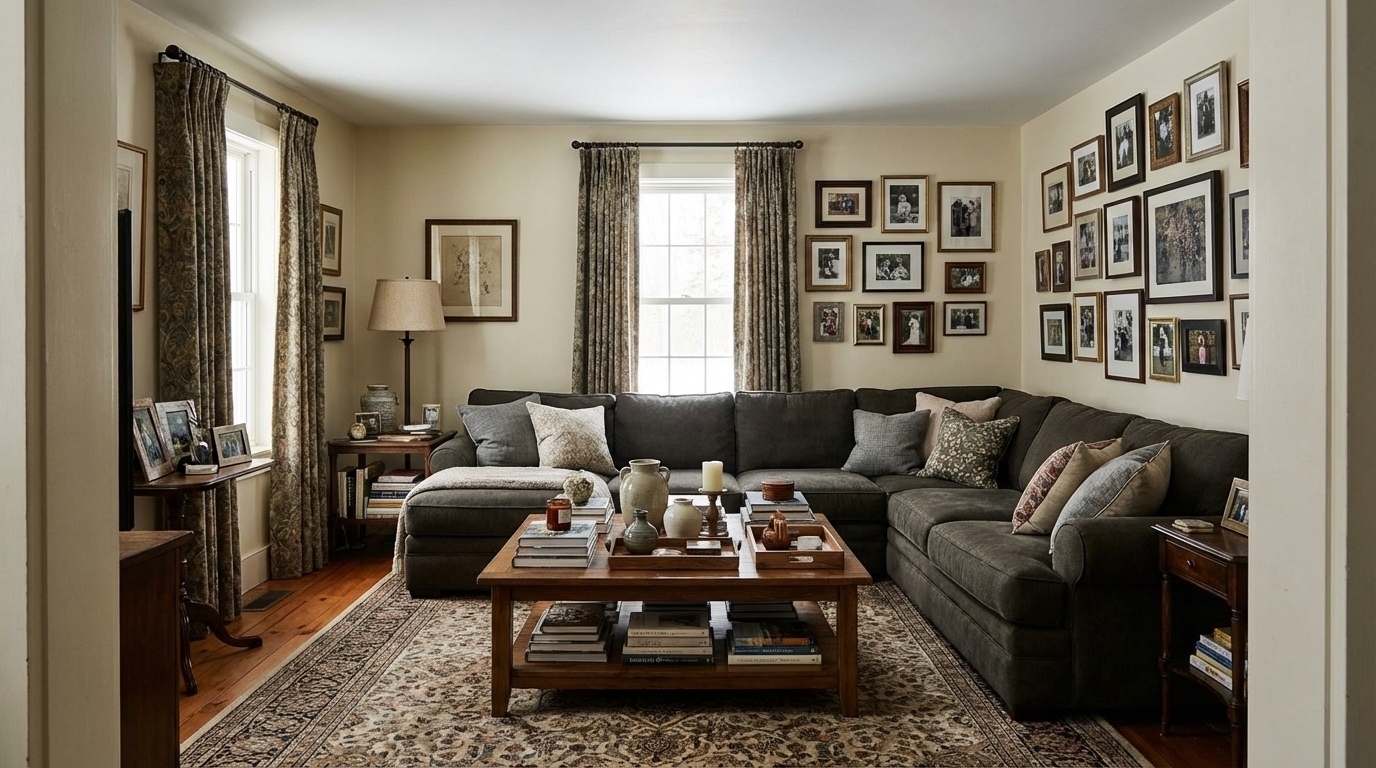
Over-staged Vermont living room with too much furniture, personal photos, and cluttered surfaces—a common staging mistake

The Problem: When "Warm" Becomes "Whoa"

Here's the thing about 2026 staging advice: it's not wrong—it's just written for homes that don't exist in Vermont.

You've seen the headlines: "Buyers want warmth! Add personal touches! Show how you live!" And sure, in a 2,400-square-foot suburban colonial with vaulted ceilings and wall-to-wall southern light, that works.

But in a 1,600-square-foot Vermont farmhouse with 7.5-foot ceilings, three small bedrooms, and windows that face north? That advice is a liability.

Buyers scrolling Zillow at 11 p.m. don't want to see your life. They want to imagine theirs.

And right now? Your staging is getting in the way.

Key Takeaways: What's Actually Turning Buyers Off

The Problem:

Sellers are adding more—more throw pillows, more gallery walls, more "cozy touches"—because that's what the staging blogs say to do. But in Vermont's smaller, darker homes, "cozy" reads as "cramped." Buyers can't see the hardwood floors. They can't imagine their couch in that corner. They're clicking to the next listing before they finish scrolling your photos.

The Fix:

Subtract. A lot.

Remove about 40% of your furniture. Box up every family photo, every personal collection, every "conversation piece." Edit every surface—kitchen counters, coffee tables, nightstands—to 1–2 intentional objects. Max.

Let the bones of your home do the work: the wide pine floors, the original trim, the light (however limited) coming through those north-facing windows.

Why It Works:

Rooms photograph ~30% larger when you remove excess furniture. Light penetrates deeper. Buyers see potential, not inventory. And in Vermont's winter market—where every listing competes with shorter days and buyers' Seasonal Affective Disorder—space and light win every time.

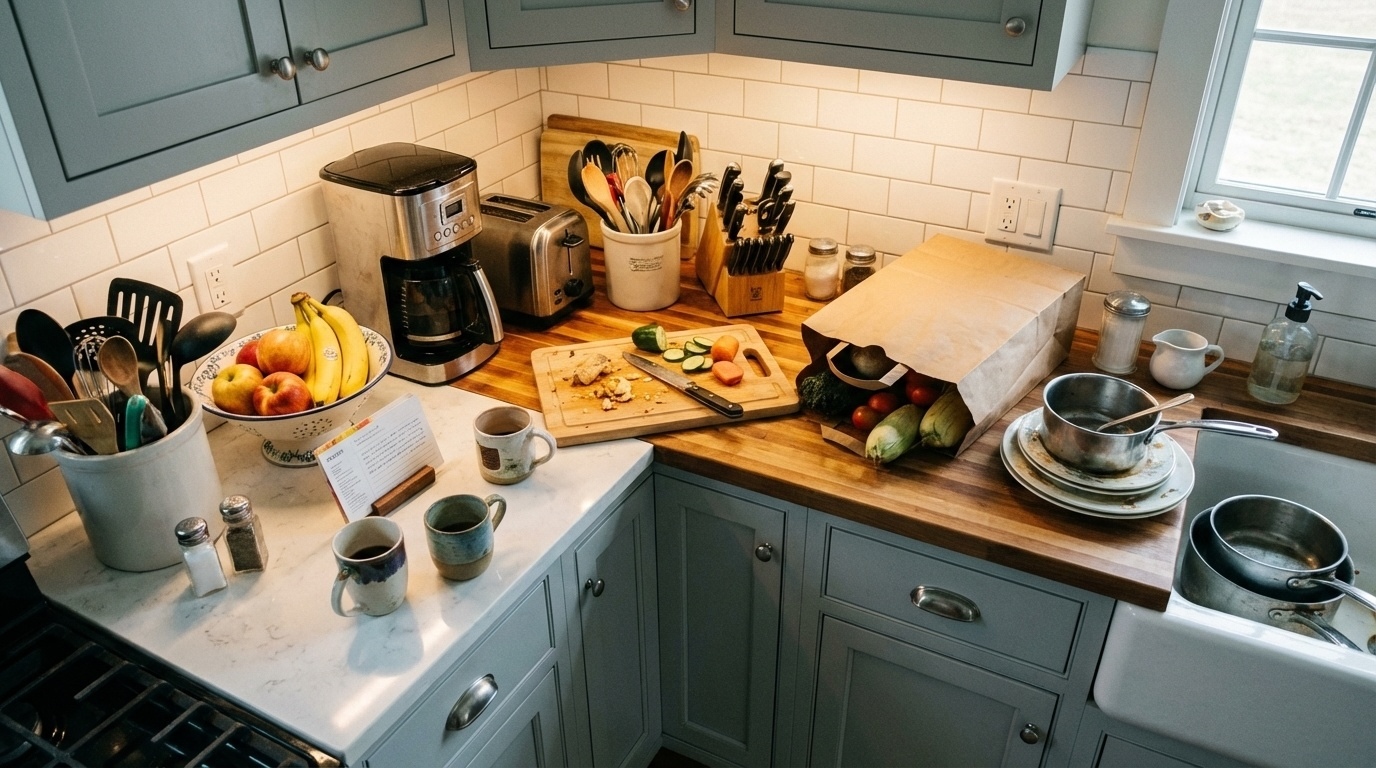
Cluttered Vermont kitchen counter with too many appliances and personal items—a staging mistake that turns buyers off

Three Ways to Fix It (Budget + Timeline)

You don't need a $10,000 staging budget. You need a weekend, some muscle, and the discipline to subtract.

Option 1: The Weekend Purge

Cost: $0–$200
Time: 1 weekend
What You're Doing: Removing ~40% of furniture, boxing all personal items, clearing all surfaces to 1–2 objects per room, storing everything in the basement/garage/a friend's barn.

ROI: Rooms look ~30% bigger in photos. Light hits walls instead of clutter. Buyers stop scrolling past your listing.

Option 2: The One-Week Upgrade

Cost: $200–$800
Time: ~5 days
What You're Adding: After the purge, add 2–3 pieces of neutral abstract art, swap out old lampshades for linen or light-filtering neutrals, add one or two task lamps (warm 2700K–3000K bulbs), and hang simple linen or light-filtering window treatments.

ROI: Buyers see warmth and space. Your listing photos look intentional, not empty.

Option 3: The Full Send

Cost: $800–$2,500
Time: ~2 weeks
What You're Getting: Professional staging consult, rental furniture (if needed), fresh neutral paint, updated light fixtures, minor flooring refresh (if necessary), and photos that look like they belong in a design blog.

ROI: Staged homes sell for 5–10% more and spend 30–50% less time on market. In Central Vermont's median price range ($450K–$650K), that's $22K–$65K in your pocket—and 30–60 fewer days of carrying costs.

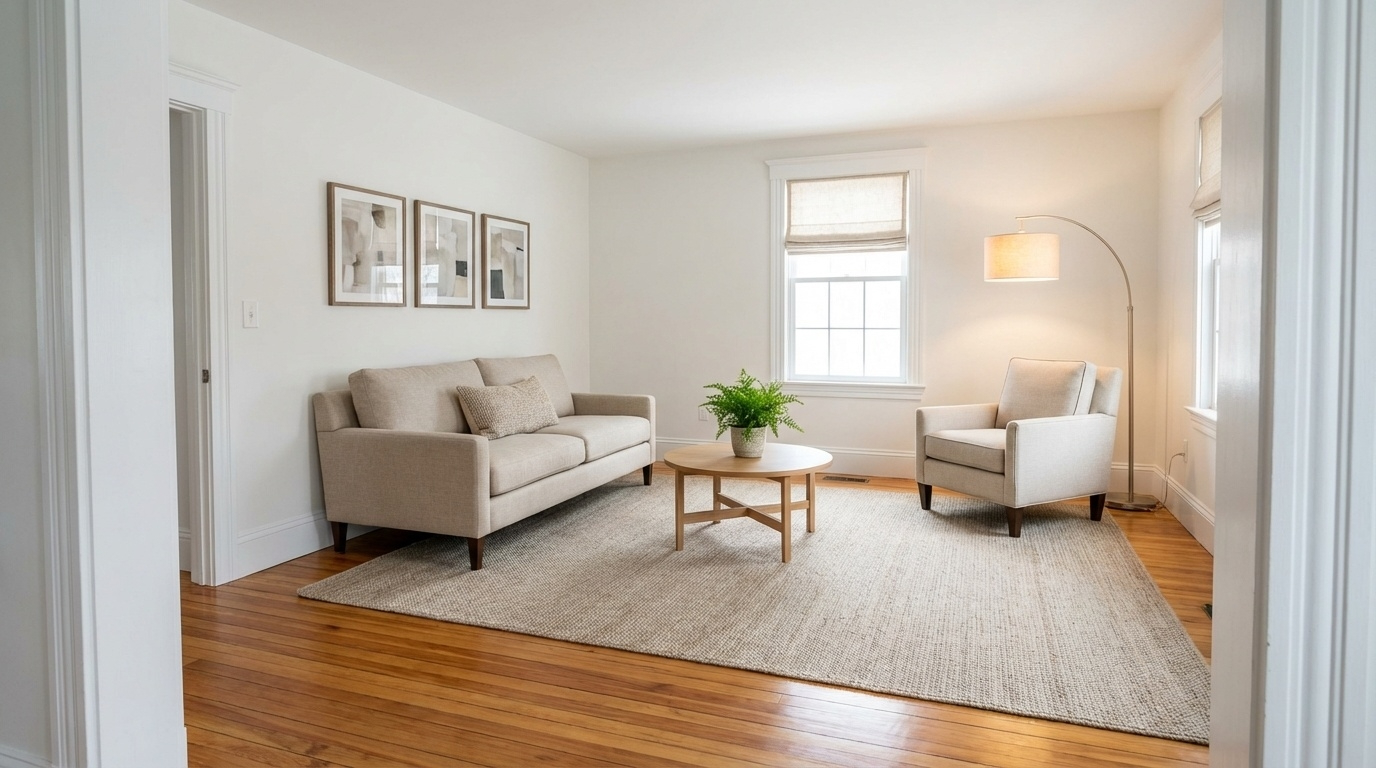
Just-right staging in a Vermont living room—minimal furniture, clear surfaces, and visible hardwood floors that help buyers imagine their own lives

Why This Matters in Vermont Specifically

Let's talk numbers:

  • Median Central Vermont home: 1,400–1,800 sq ft (national average: 2,200+)
  • Typical ceilings: 7.5–8 feet (newer builds: 9–10 feet)
  • Common window orientation: North-facing (translation: minimal direct sunlight, especially in winter)
  • February daylight: ~10 hours total (prime listing photo window: 10 a.m.–2 p.m.)

Small rooms + low ceilings + limited light = every piece of clutter is amplified.

A sectional sofa that works fine in a 16×18 living room in Raleigh will eat a 12×14 Vermont farmhouse living room. A gallery wall of 12 family photos that feels "homey" in your daily life will read as "I can't see the walls" in your listing photos.

Buyers aren't rejecting your taste. They're rejecting the feeling that there's no room for them.

The Bottom Line

Show the space, not your life.

In Vermont's smaller, darker homes, subtraction is the strategy. Remove 40% of your furniture. Box the personal items. Edit every surface to 1–2 objects. Schedule your listing photos between 10 a.m. and 2 p.m. when the winter light is at its best.

And if you're not sure where to start? I'm happy to walk through your home and flag the stuff that's costing you showings.

Next Steps for Winter Listings:

  • Remove ~40% of furniture (start with the biggest pieces)
  • Box all personal photos, collections, and "conversation pieces"
  • Edit all surfaces to 1–2 intentional objects
  • Schedule listing photos between 10 a.m.–2 p.m. (midday winter light)
  • Call Tony for a staging walkthrough and honest feedback on your current setup

Where to Go Next:

Let's Talk Staging

Tony Walton
Principal Broker, New England Landmark Realty

📞 (802) 253-4711 (Office) | (866) 324-2427 (Toll-Free)
📱 (802) 233-4107 (Cell)
✉️ tony@nelandmark.com

🔗 Vermont Ski Home Guide
🔗 Seller's Guide

Kore's Design Eye is a regular feature from New England Landmark Realty, translating Vermont home design, staging, and buyer psychology into ROI-driven strategies for sellers and smart buyers.

Posted in Home Staging
Feb. 13, 2026

Stowe STR Ban: What Buyers & Sellers Need to Know Now

Jump to Key Takeaways

Classic Rock & Fresh Powder | Week of February 6, 2026

THE OPENING RIFF

"This land is your land, this land is my land" — Woody Guthrie, "This Land Is Your Land" (1944)

Except in Stowe, where the town's trying to figure out whose land it actually is. Last month, Stowe proposed regulations that would eliminate all short-term rentals unless the owner lives there full-time. Not restrict them. Not cap them. Eliminate them. If you own a second home in Stowe and rent it on Airbnb, your business model just became a town meeting agenda item. Meanwhile, Spruce Peak—Vail's crown jewel in Vermont—is lobbying for carveouts. Workers can't find housing. Buyers are doing math. And everyone's pretending this is about parking.

Key Takeaways

If You Only Remember 3 Things

  • Stowe's owner-occupancy requirement would eliminate STR income for non-primary-residence owners, creating immediate valuation questions for $875K+ condos
  • Killington's stable STR environment (registration-only) is driving faster inventory movement than Stowe's uncertainty-taxed market
  • Every Vermont ski town with 25%+ STR penetration is on the same regulatory curve—Stowe's just further along

Quick Facts

  • 1,200+ active STRs in Stowe represent ~35% of housing stock
  • Worker affordability ceiling ($250K) sits $625K below median Stowe condo prices
  • Jay Peak's 257" season total vs. Stowe's 218" as of early February 2026

THE WIDE SHOT: WHAT'S HAPPENING EVERYWHERE ELSE

Stowe isn't inventing this fight. Aspen, Tahoe, Park City, Jackson—every ski town in North America is wrestling with the same question: Do we want workers or do we want Airbnbs? You can't have both when a two-bedroom condo pencils out better as a vacation rental than as workforce housing.

Here's the Stowe version: The town's considering a short-term rental ordinance that would require owner-occupancy as a primary residence. Translation: If you don't live in Stowe full-time, you can't rent short-term. Period. No grandfather clause for existing STRs. No phase-in. Just done.

Spruce Peak—where Vail owns The Lodge and manages hundreds of condos within the resort complex—is quietly lobbying for exemptions. VTDigger reported in January that fewer than 20% of Spruce Peak's condos outside The Lodge are registered as STRs. But if the ordinance passes as written, that number goes to zero unless owners relocate to Stowe full-time.

The Vermont translation: Stowe's housing crisis is acute. Restaurant and retail workers are commuting 45 minutes because there's nowhere to live. The town sees 1,200+ STRs and connects the dots. Whether they're right is a different question than whether they have the political will. Right now, they have the will.

The real estate play: If you bought a Stowe condo assuming STR income would cover 40–60% of your annual costs, that assumption just became a policy debate. Buyers making offers this winter need to model two scenarios: one with rental income, one without. Sellers holding STR-dependent properties might want to close before this vote happens.

BY THE NUMBERS: STOWE'S HOUSING MATH

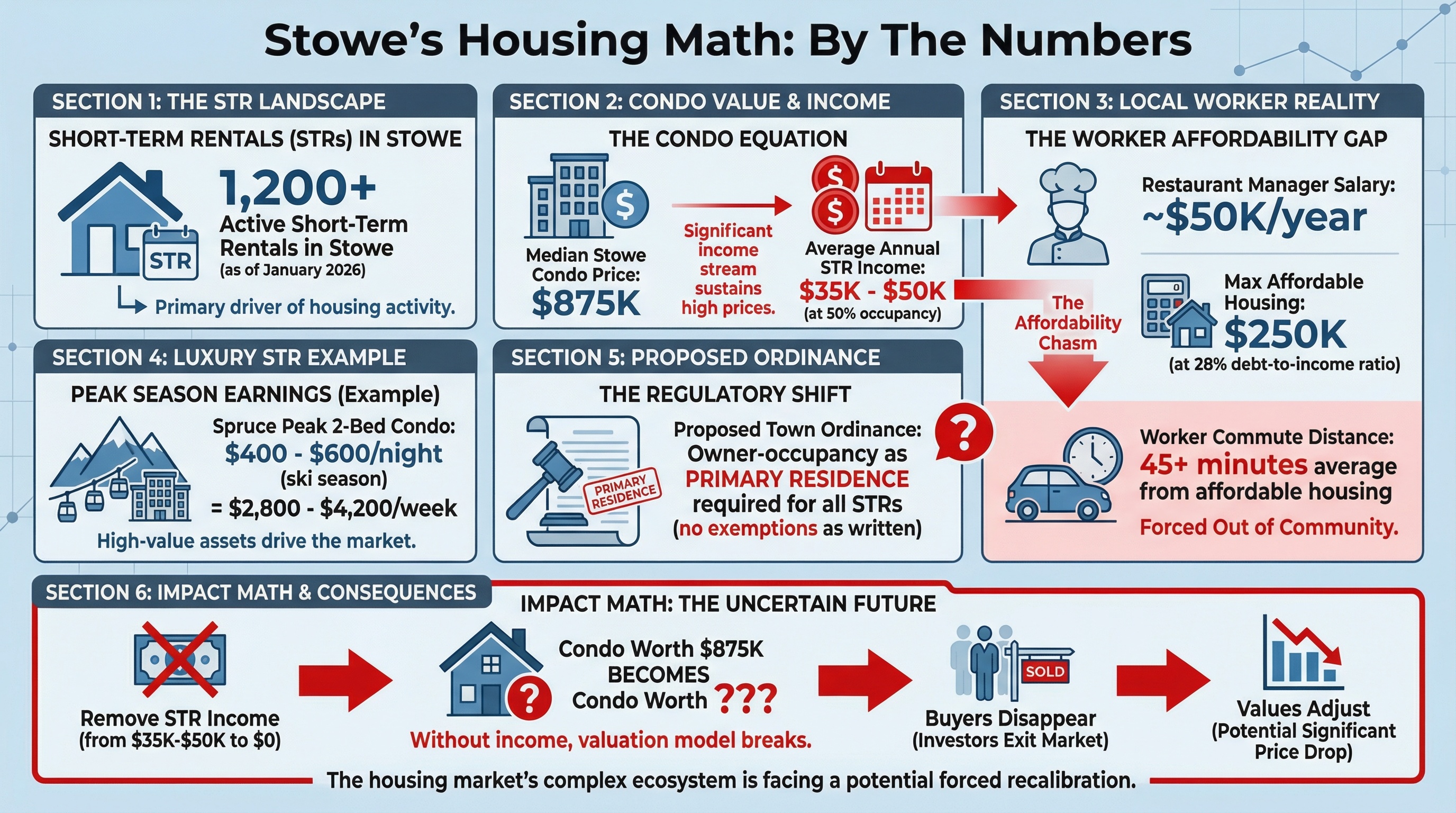
Stowe's Housing Math: By The Numbers - Infographic showing 1,200+ STRs, $875K median condo prices, and $250K worker affordability ceiling

The numbers don't lie. They just make everyone uncomfortable.

1,200+ short-term rentals in a town where the median condo costs $875K and restaurant managers make $50K. The math problem isn't complicated: Workers can afford housing around $250K. Housing costs $875K. Someone's got to bend, and it's not going to be the laws of arithmetic.

Remove STR income from the equation, and that $875K condo becomes worth… less. How much less depends on who you ask. Sellers will say 10%. Buyers will say 30%. The town will say "not our problem." All three are probably wrong.

POWDER REPORT: VERMONT GROUND TRUTH

The Snow

Stowe: 218" season total as of February 2. 21" in the past seven days. Conditions firm but fast midweek, packed on weekends. The snow's here. The parking fee's still $50. Make of that what you will.

Jay Peak: 257" season total as of mid-January—still the snowfall king of the East. Resort's own report called early February "spectacular." No exaggeration. No drama. No parking fees. Jay's having the kind of season that makes people remember why they bought up there in the first place.

Killington: Holding steady around 240" for the season. Coverage is excellent across all peaks. Crowds manageable except Saturday mornings. Still the Beast of the East, still delivering.

Sugarbush: Season's tracking above average. South-facing terrain skiing better than it has any right to in early February. Lincoln Peak coverage edge-to-edge. Mad River Valley quietly having a very good winter.

Mad River Glen: Because someone has to ask—yes, the single chair's running. No, they still don't allow snowboards. Yes, that's still the whole point. If you have to ask why, you'll never understand.

The Buzz

Jay Peak's having a stealth great season. No drama. No controversies. No town meetings about who gets to live where. Just 257 inches of snow and blue skies in early February. While Stowe's fighting about STRs and parking fees, Jay's… skiing.

It's a quiet reminder that sometimes the best marketing is just being a place people want to go. No press releases. No lobbying. Just snow.

The Controversy Nobody's Naming Out Loud

Let's talk about Spruce Peak's lobbying for STR carveouts while the town tries to figure out where to house the people who make the beds at Spruce Peak.

Vail's position is that resort-managed properties should be exempt from owner-occupancy requirements because they're "integral to the resort experience." Which is one way to describe a $1.2M condo that gets rented 60 nights a year while a lift operator sleeps in a van. The resort experience, apparently, requires short-term rentals. The lift that takes you to the resort experience? That person can figure it out.

Here's what's actually happening: Those Spruce Peak condos were sold with a very specific pitch. Buy here, ski here, rent it out when you're not here, rental income covers 40–60% of your costs, everybody wins. It was a beautiful story. Buyers believed it. Banks financed it. And now the town's saying, "Cool story. We're shutting it down."

Vail's argument—that banning STRs at Spruce Peak would tank condo values—is completely correct. Those buyers paid a premium for ski-in/ski-out and rental income. Take away the income, and suddenly that $900K condo is worth… less. Probably a lot less. Turns out people don't love paying a million dollars for something they use 15 days a year if it doesn't also pay for itself.

But the town's argument is also correct: 1,200+ STRs in Stowe, and restaurant workers are commuting from the next county. Something's gotta give.

So Vail's lobbying for carveouts. Because if resort-managed STRs get exempted but owner-managed STRs don't, well, that's just the free market rewarding operational excellence. Definitely not a two-tiered system where Vail wins and individual condo owners eat the loss.

The outcome? Probably a compromise where everyone's equally unhappy. The town passes something. Spruce Peak gets some carveout that's smaller than they wanted. Condo owners outside the resort complex lose rental income or sell at a loss. Workers still commute from Morrisville, but now there are fewer Airbnbs and more empty second homes.

Progress.

THE B-SIDE: WHAT NOBODY'S SAYING OUT LOUD

Here's the part nobody wants to talk about: Stowe's STR fight isn't really about housing. It's about who gets to live in Stowe.

The math is simple. A two-bedroom condo at Spruce Peak rents for $400–600/night during ski season. That's $2,800–4,200/week. Over a 16-week season, that's $45K–67K in gross rental income. Even at 50% occupancy, you're clearing $22K–33K before expenses.

Now do the workforce housing math. A local restaurant manager making $50K/year can't afford a $2,500/month mortgage. But a second-home owner from Boston can, because the condo pays for itself.

The question isn't whether Stowe needs workforce housing. It does. The question is whether eliminating STRs creates workforce housing or just eliminates STRs. Because if those condos don't convert to long-term rentals—if they just sit empty or sell to full-time retirees—then Stowe gets fewer STRs but no more workers.

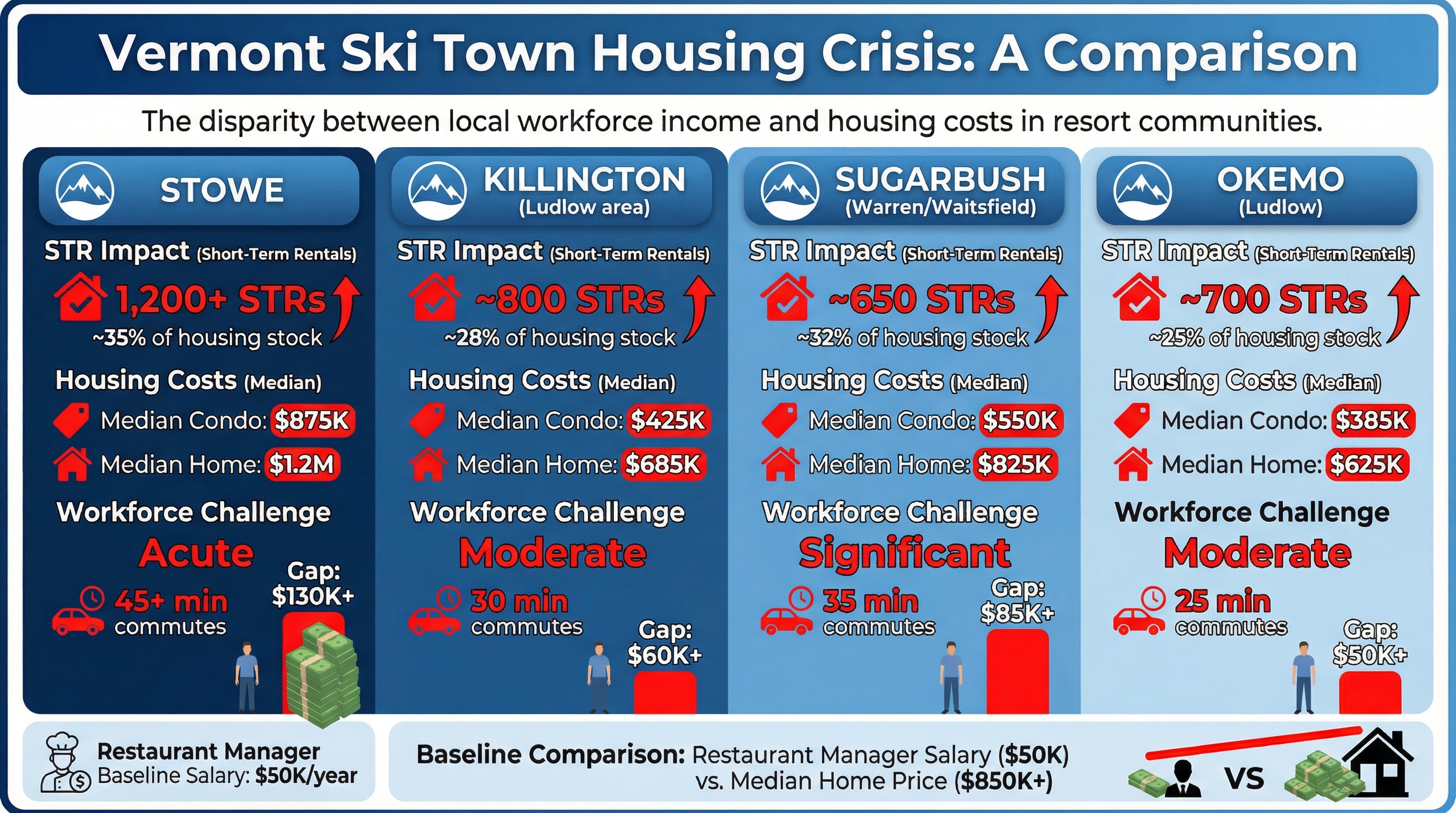
Vermont Ski Town Housing Crisis Comparison - Stowe vs Killington vs Sugarbush vs Okemo STR percentages, median prices, and workforce gaps

And Stowe's not alone. The chart above tells the story: Every major Vermont ski town is dealing with this. Stowe just has the highest STR percentage (35% of housing stock), the highest prices ($875K median condo), and the longest worker commutes (45+ minutes). Sugarbush is a few years behind. Killington and Okemo are watching nervously.

The uncomfortable truth: Ski towns need workers. Workers need housing. But housing that pencils as an STR doesn't pencil as workforce housing. The numbers are too far apart. So either buyers eat the loss, or sellers do, or the town subsidizes the gap. Somebody's paying for this. The only question is who.

FOLLOW THE MONEY

Mount Snow (Dover): Fractional ownership condos at Grand Summit Way—these are quarter-shares, not full ownership—are sitting. One unit listed at $11,000 has been on the market 91 days. Another at $23,500 for 76 days. These are weeks, not properties. Buyers doing the math: $23,500 buys you 13 weeks of access… or a season of weekend trips to an Airbnb with no HOA fees. The fractional model made sense when it was the only way to own ski access. Now it's competing with Airbnb flexibility and losing.

Stowe: A Villa Drive condo—these are hotel-condos near Spruce Peak—listed at $22,000 has been sitting for 639 days. Not a typo. Twenty-two thousand dollars, nearly two years on market, no takers. Why? Because the buyer's not buying real estate. They're buying a week in a resort-managed unit with HOA fees, rental pool splits, and now the looming threat of an STR ban. That's a lot of friction for a week in Stowe. Every day that ordinance sits on the town clerk's desk, that DOM number climbs.

Killington: Movement here. Jackson Gore Inn condos—resort-managed, ski-in/ski-out—are moving in the $46K–71K range with 36–118 days on market. Not fast, but not stalled. The difference? Killington's STR environment is more stable. Buyers can still model rental income with some confidence. That matters. Boring stability is starting to look like a competitive advantage.

The pattern: Buyers are gun-shy on anything where the income model depends on short-term rental regulations that might not exist in six months. Stowe's uncertainty is a tax on every listing in town. Mount Snow's fractional model is losing to Airbnb flexibility. Killington's boring stability is starting to look like a feature, not a bug.

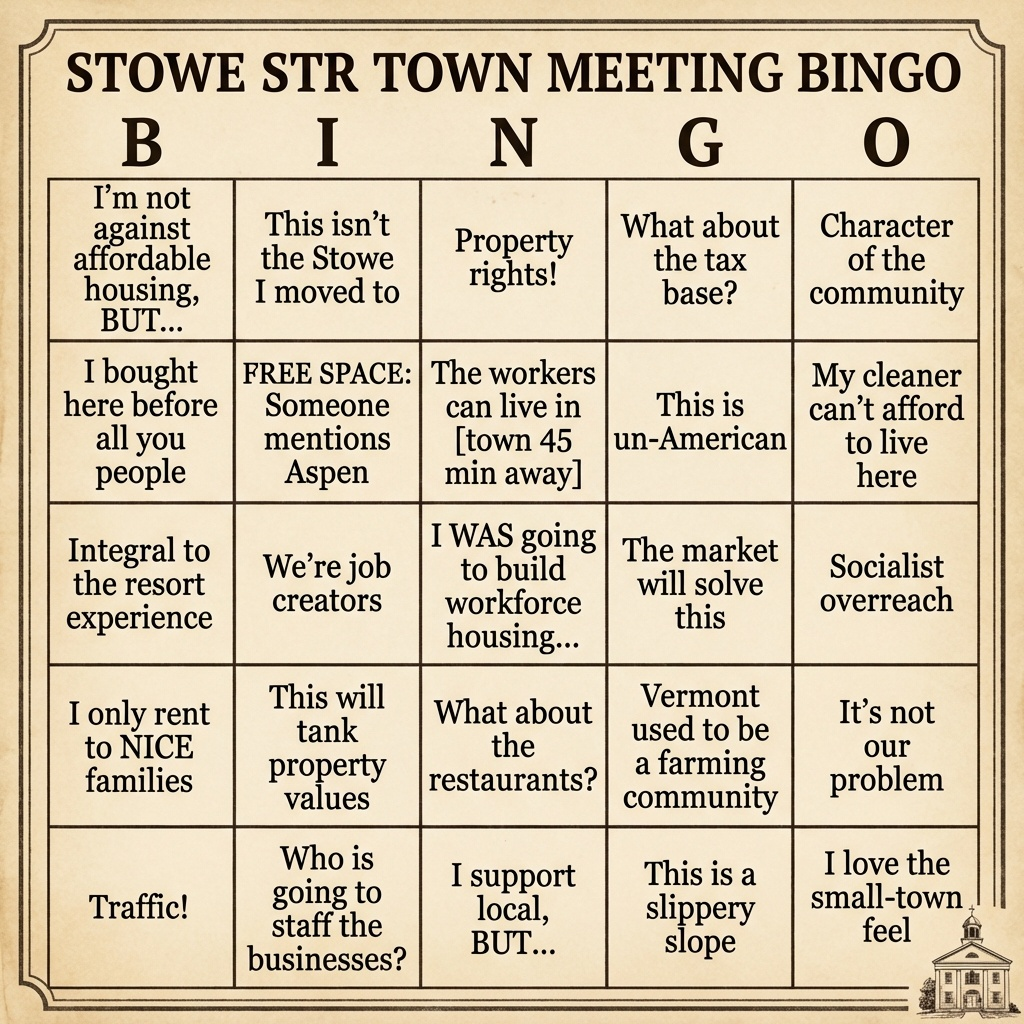
BONUS: TOWN MEETING BINGO

Stowe STR Town Meeting Bingo Card - Satirical bingo card with predictable phrases from STR debates

Print this. Bring it to the next town meeting. Report back on how fast you filled the card. My bet? 47 minutes.

THIS WEEK'S TRACKS

Listen on Spotify: Classic Rock & Fresh Powder - Week of February 6, 2026

Bruce Springsteen – "My Hometown" (1984)
For the Stowe locals watching their town get rezoned one ordinance at a time. It's not the town they remember, and they're not sure what it's becoming.

The Rolling Stones – "You Can't Always Get What You Want" (1969)
Buyers wanted ski-in/ski-out and rental income and no regulations. Stowe's deciding which one they keep.

Tom Petty and the Heartbreakers – "The Waiting" (1981)
For the 639 days that Villa Drive condo has been sitting. And the buyers waiting to see what the town meeting decides before they make an offer.

Fleetwood Mac – "The Chain" (1977)
Workers, owners, developers, the town—everyone's connected whether they like it or not. And right now, nobody's loving it. But the chain won't break, even when it wants to.

Dire Straits – "Sultans of Swing" (1978)
A reminder that sometimes the best move is to just play your game and let everyone else figure out theirs. Jay Peak got 257 inches while Stowe fought about parking. That's the whole story.

Got a track suggestion for next week? Hit me: tony@nelandmark.com

Ready to Talk Ski-Home Strategy?

Whether you're watching Stowe's STR fight from the sidelines or trying to figure out what it means for your property, let's talk. I've been working Central Vermont ski real estate for 20 years. I've seen markets shift. I've seen regulations change. And I've helped buyers and sellers navigate both.

If you're thinking about buying, we need to model two scenarios: one with STR income, one without. If you're thinking about selling, timing matters more this year than it has in a decade.

Tony Walton | Principal Broker
New England Landmark Realty
(802) 253-4711 (Office) | (866) 324-2427 (Toll-Free) | (802) 233-4107 (Cell)
tony@nelandmark.com

Vermont Ski Home Guide: https://www.nelandmark.com/vermont-home-buying-guide/
Seller's Guide: https://www.nelandmark.com/selling-your-vermont-home/

Where to Go Next

Classic Rock & Fresh Powder is a bi-weekly newsletter covering Vermont ski conditions, real estate trends, and the intersection of powder and property. Published every other Thursday during ski season.

Posted in Community Insights
Feb. 10, 2026

Apparently, I've Been Trendy for Thirty Years. Nobody Told Me.

Harris Vexley

Waterbury, Vermont | Thermos owner since 1991

I walked into Martha's general store last Tuesday morning with my thermos and a shopping list written on the back of an envelope—same as I've done every Tuesday since the first Bush administration—and found myself surrounded by what I can only describe as a vintage clothing convention.

Seven people. All under thirty. All wearing clothes that looked simultaneously brand new and forty years old. One young woman was photographing a thermos on the counter. Not photographing with a thermos. Photographing the thermos itself. Like it was a museum piece.

I recognized the model immediately. Stanley 1.1 quart classic. Same one I've had since 1991. Except hers didn't have any dents, and mine looks like it survived three tours of duty and a domestic dispute.

The price tag was still attached to hers: $87.

I paid $9 for mine. At Sears. When Sears still existed.

"Excuse me," I said, trying to reach the coffee pot without disrupting what appeared to be a photo shoot for Thermoses Quarterly.

A young man with an extremely deliberate mustache—the kind that takes more maintenance than my entire grooming routine—turned to me with the expression you'd expect if I'd just materialized from a time portal.

"Oh my god," he said. "Are you living the analog lifestyle?"

I blinked at him through my slightly smudged wire-rims. "I'm trying to get coffee."

"No, but look at you." He gestured at my general existence like I was an art installation. "The vintage thermos. The handwritten list. The—wait, is that a pocket watch?"

"It's a chain for my reading glasses."

"Brilliant."

The Trend I Didn't Know I Was

Turns out, I'm fashionable. At 58. For the first time in my life.

According to the assembled youth of Waterbury, 2026 is "the year of analog living." It's a movement. There are hashtags. CNN reports that sales of craft kits jumped 86% last year, with another 30-40% increase expected this year. Film photography is back. Vinyl records are having a renaissance. People are buying fountain pens on purpose.

I've been using a fountain pen since 1994 because I bought a box of twelve at a yard sale for three dollars and I'm not wasteful. Still have seven left.

Apparently, this makes me a pioneer.

The young woman with the pristine thermos looked at my actual thermos—scarred, dented, held together by stubbornness and what I suspect is sheer molecular confusion—and asked if it was "vintage or vintage-inspired."

"It's from 1991," I said.

"From the actual year 1991?"

"I was there when I bought it."

She gasped. Actually gasped. Like I'd just announced I'd discovered fire.

"It's authentic," she whispered to her friends.

I wanted to point out that "authentic" just means "old and still working" but they seemed so excited that I didn't have the heart.

The Great Irony

I got my coffee—terrible, as always; Martha's been making the same weak pot since Carter—and settled into my usual spot by the window. The analog lifestyle crew continued their discussion, and I couldn't help but overhear.

They were planning their "unplugging." Screen-free Sundays. Digital detoxes. One woman had a twelve-month roadmap for reducing her social media use, complete with milestones and accountability checkpoints.

Another was learning to knit. Using YouTube tutorials.

Let me repeat that: She was learning an analog hobby by watching digital videos about it.

Martha caught my eye from behind the counter. She's been running this store for thirty-seven years. She's seen trends come and go—the low-fat craze of the '90s, the Atkins thing in the 2000s, that year everyone suddenly needed coconut oil for everything including their cars. She was smiling the way you smile when you're watching someone try to teach a cat to swim.

The irony wasn't lost on these kids, to their credit. One of them actually said, "I know it's weird that we're organizing our analog lifestyle on Instagram, but how else do you build community?"

I thought about the thirty years I'd been coming to this store. Same time, same day, same terrible coffee. The way Jerry saves me the local paper before it sells out. How Martha asks about my boys without me having to bring them up. The community that built itself slowly, like ice forming on a lake—you don't watch it happen, but one day it's solid enough to walk on.

"You just show up," I said. "Regularly. In person."

She wrote that down in her leather journal. Which probably cost more than my first car.

Distressed Aesthetic

By the time I'd gathered my groceries—real milk, bread from the bakery down the street, cheese that comes in blocks like God intended—the group had moved on to discussing their favorite "offline hobbies."

Jigsaw puzzles were mentioned. Knitting. Bread baking. One fellow had just bought a typewriter for $240 to "reconnect with tactile writing."

I have a typewriter. It's in my basement, next to my old skis and several boxes I've been meaning to sort through since Clinton's second term. I paid $15 for it at a yard sale in 1996. It seemed expensive.

As I approached the counter, Martha rang up my purchases with barely contained amusement.

"You're trendy now, Harris," she muttered.

"I don't feel trendy."

"That's what makes it authentic." She bagged my groceries in paper—the store's been using paper since Eisenhower, long before it was environmentally conscious. "Your thermos is probably worth a fortune now. I saw one online marked 'distressed aesthetic.'"

I looked at my thermos. Each dent has a name. The big one is from the Ice Fishing Disaster of 2003. The scrape along the bottom is from being dragged behind my truck for three miles. The crater near the cap is from when my youngest son—he was seven—dropped it off the porch trying to bring me coffee.

It's not distressed. It's experienced.

"Mine's too distressed," I said.

"That's not how this works," Martha replied. "More authentic damage means higher price. They want the story without the time."

And there it was. The thing that had been bothering me since I walked in.

Skipping to the End

Look, I don't blame these kids. They're exhausted. They grew up with smartphones surgically attached to their palms. They've been optimized and content-ified and engagement-maxed since before they could vote. The digital detox trend is real because the fatigue is real.

But they want to skip to the end. They want the patina without the years. The wisdom without the winters. The dented thermos without the three decades of Tuesday mornings.

I didn't choose to live "analog." I just lived. The analog part is what other people called it later, after they'd tried everything else.

I don't have a smartphone because I never needed one, not because I made a brave stand against technology. I use a paper map because I bought it in 1989 and it still shows where the roads are. I write shopping lists on envelopes because envelopes are free if you're already getting mail.

It's not a philosophy. It's just... life. Unoptimized. Unbranded. Undocumented.

Apparently, this is now revolutionary.

The Photo Shoot

As I headed for the door, the photographer stopped me.

"Could we get a picture? For our analog lifestyle documentation project?"

I paused. "You want to document analog living by taking pictures?"

"With film," he said, like this solved the paradox.

I thought about saying no. But he was earnest, and you can't be cruel to earnest. Earnest is how we got the Hoover Dam and the polio vaccine. You have to respect earnest, even when it's confused.

So I stood by the window while they posed me. Someone adjusted my collar. Someone else told me to "look contemplative."

I looked like I always look: mildly confused, slightly rumpled, patiently waiting for whatever's happening to be over.

The photographer clicked the shutter. Then did it three more times.

"Perfect," he said. "That's going to be so authentic."

I nodded, picked up my groceries, and walked home. Half a mile. No podcast, no phone call, no GPS telling me to turn left onto the road I've lived on for forty-three years.

Just boots on snow. Breath in cold air. Coffee at the right temperature.

Behind me, through the window, they were probably already planning their next authentic experience. Choosing which vintage item to acquire. Which handicraft to learn via tutorial. Which piece of slow living to schedule into their optimized calendars.

I'm not judging. Not really.

They'll get there eventually. You can't buy your way to the end of becoming. You just start, keep going, and let the dents accumulate.

Thirty years from now, their thermoses might look like mine.

And by then, I figure, I'll probably be hopelessly outdated again.

Which suits me fine.

Epilogue: Influencer, Apparently

Two weeks later, Martha sent me a text. My grandson had to help me open it—took fifteen minutes because my flip phone isn't really designed for links and he kept getting distracted.

It was a photo. Me in the general store. Soft light. Thoughtful expression. Battle-scarred thermos.

The caption: "Met this incredible human who's been living the analog lifestyle for DECADES. No social media. No smartphone. Just pure, intentional existence. He didn't even know it was a trend. That's the goal. 💚 #analoglife #authenticity #2026yearofanalog"

47,000 likes.

I stared at it, then handed the phone back.

"You're famous, Grandpa," he said.

"I'm the same as I was yesterday."

"Yeah, but now people know about it."

Which is, I suppose, the entire problem in miniature. The idea that a thing only matters once it's been seen. That living only counts if it's documented. That authenticity requires an audience.

I still don't know what an influencer is. My grandson tried to explain. I nodded at appropriate intervals and understood nothing.

Then, because it was Tuesday, I made dinner the same way I've made it every Tuesday for thirty years: from scratch, without a recipe, using ingredients that don't have their own apps.

The analog lifestyle.

Also known as: living.

The kids will figure it out eventually. Or they won't. Either way, my thermos will still hold coffee, and hot coffee will stay hot.

That remains the entire point.
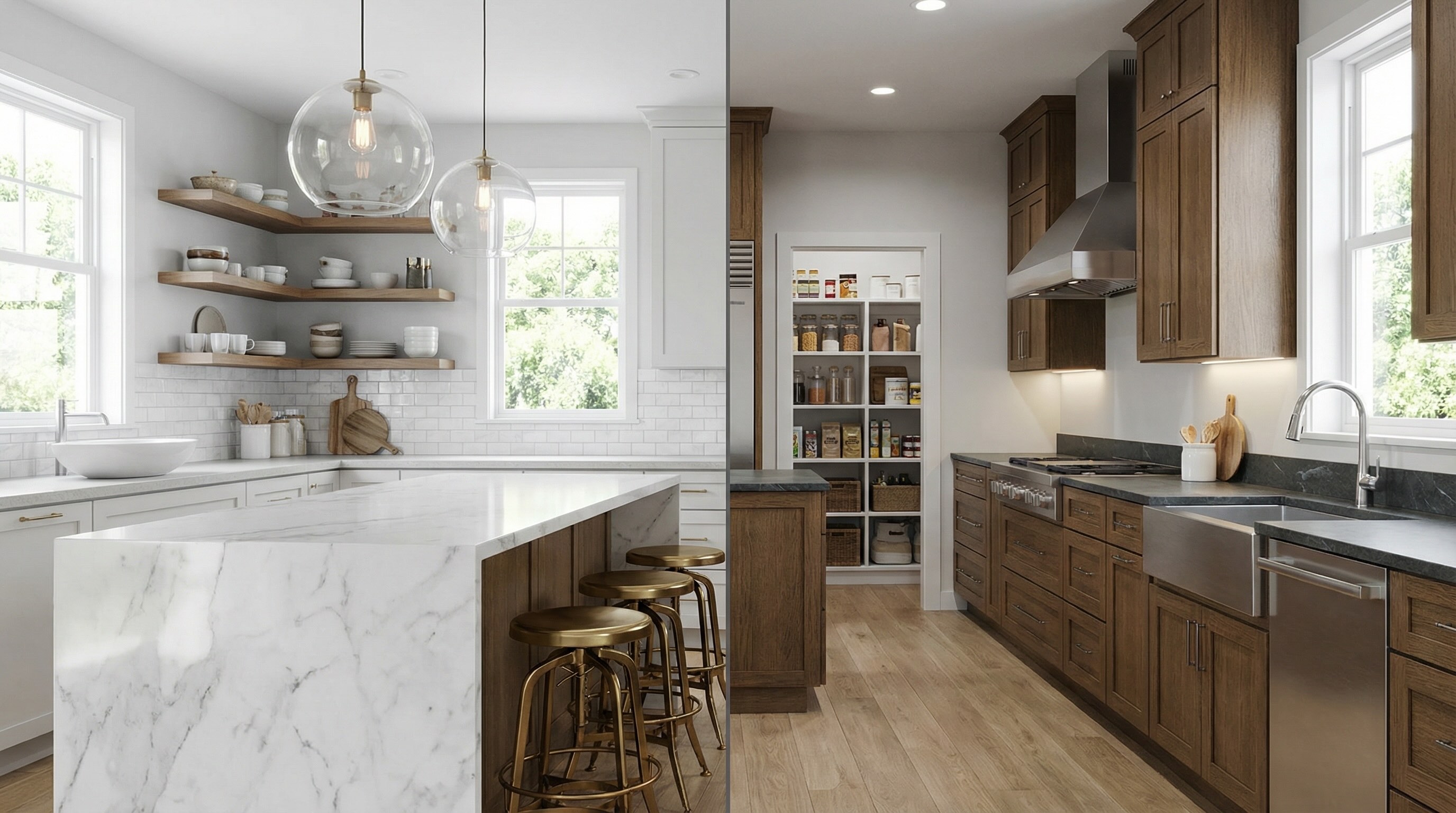
Jan. 31, 2026

The Staging Mistake That Cost You $15K (And You'll Never Hear About It)

Two-Sentence Summary

Most Vermont sellers stage their living room and primary bedroom beautifully, then leave secondary bedrooms, dining rooms, and entries looking bare or neglected—and buyers mentally dock the price by thousands without ever telling you why. Cohesive whole-home staging in 2026 isn't optional; it's the difference between your asking price and a low offer you can't explain.

If You Only Do 3 Things

  • Stage every room a buyer will open a door to—not just the "hero" spaces; secondary bedrooms, dining rooms, home offices, and entries must look intentional, not abandoned.
  • Add warm, layered textiles and lighting throughout—a single throw pillow on a gray couch in the living room doesn't create warmth if the rest of the house feels cold and sparse.
  • Create "lifestyle moments" in every space—a coffee setup on the kitchen counter, books on the nightstand, a coat hook with a scarf in the entry; buyers need to see themselves living there, room by room.
Beautifully staged Vermont living room with warm neutral furniture, layered textiles, and inviting lighting

The Moment Buyers Decide

Buyers make their real decision in the first eight minutes of a showing—not in the living room you spent $2,000 staging, but in the moments after, when they open the guest bedroom door and see a bare mattress, a folding chair, and your 1987 exercise bike. The living room told them you care. The guest bedroom just told them you ran out of budget—or interest. In a 2026 Vermont market where inventory is up and buyers have choices, that disconnect costs you thousands in perceived value.

You won't hear about it in the feedback. The buyer's agent will say something polite like "they're still considering options" or "they want to see a few more homes." What they won't say: your incomplete staging made the house feel half-committed, and buyers don't pay full price for half-effort.

Here's the quiet problem. You think staging is about making the living room look good for photos. It's not. Staging is about maintaining buyer confidence as they move through every single space. The second they open a door and feel doubt—whether it's a cluttered office, a sad dining room with no table, or an entry that screams "we gave up here"—they start negotiating in their head.

The Quiet Problem (What's Actually Turning People Off)

Buyers in 2026 expect cohesive, whole-home staging—not just two showcase rooms and a bunch of "we'll let the buyer imagine it" spaces. When the living room is styled like a Pottery Barn catalog but the second bedroom looks like a storage unit, buyers read it as deception or neglect. Their mental script shifts from "I can see us here" to "what else are they hiding?" And in Vermont's current balanced market, where buyers can afford to be selective, that script kills deals.
Unstaged secondary bedroom with bare mattress and minimal furniture showing incomplete staging

This isn't about taste. It's about perception. Buyers don't consciously think "this unstaged bedroom is worth $15,000 less." They just feel uneasy. The house starts to feel like a project instead of a home. And projects get discounted.

The math is cruel but simple. If a buyer walks through five homes in a weekend and four of them have cohesive staging throughout, yours is the one that feels incomplete. Even if your bones are better. Even if your kitchen is newer. The emotional gap is what they remember.

Buyers don't say it. They just leave.

The Fix (Three Budget Options)

Whole-home staging doesn't mean spending $10,000. It means creating intentionality in every space a buyer will see—secondary bedrooms, dining rooms, entries, home offices—so there's no "confidence drop" as they move through the house. You can do this affordably by borrowing furniture, adding minimal textiles and lighting, and staging "lifestyle moments" that help buyers visualize living there. Even a $500 investment in completing neglected spaces typically protects $10,000–$20,000 in perceived value.

Budget Fix: Under $500, One Week

What to do: Borrow furniture from family or move existing pieces to fill gaps in secondary bedrooms and dining rooms. Add inexpensive neutral bedding ($80–$120 per bed at Target or HomeGoods), a pair of matching nightstands with lamps ($150–$200), and area rugs ($60–$100 each) to secondary bedrooms. Stage the dining table with simple white place settings and a centerpiece (greenery or candles, $40–$60). Add a coat hook, basket, and small bench or chair to the entry ($80–$120).

Time investment: One weekend of shopping and arranging.

Payoff: Photos now show complete, lived-in spaces instead of empty or neglected rooms. Buyers stay emotionally engaged through the full walkthrough. You protect your asking price by eliminating the "project feel."

Mid Fix: $1,500–$3,000, 1–2 Weeks

What to do: Rent furniture for unfurnished rooms (approximately $300–$600/month for bedroom sets and dining furniture). Hire a professional stager for a full-home consultation (typically $400–$800 in Central Vermont; they'll audit every space and provide a room-by-room plan). Invest in warm textiles throughout—throws, pillows in rust/ochre/warm grays, curtains that frame windows without blocking light ($500–$800). Do cohesive paint touch-ups in rooms that feel dated or cold (greige, warm whites; $300–$600 in materials and labor for 2–3 rooms).

Time investment: 1–2 weeks to coordinate rentals, staging consult, and minor updates.

Payoff: The house now reads as cohesive and complete in every photo and every showing. Buyers don't mentally dock the price. You're competing at the same level as other well-staged homes in your price range. This typically protects $15,000–$25,000 in negotiating position.

Do It Right: $4,000–$6,000, 2–3 Weeks

What to do: Hire a professional stager for whole-home staging—not just a consultation. They'll bring furniture, art, layered textiles, greenery, and accessories to create "lifestyle moments" in every room (coffee setup on the counter, books and reading glasses on the nightstand, throws draped just right, Vermont-appropriate touches like a vintage snowshoe or ski decor that feels intentional, not cluttered). Include cohesive styling in entries, home offices, flex spaces, and even laundry rooms if they're visible. Budget for 4–8 weeks of rental if needed.

Time investment: 2–3 weeks for full staging coordination, installation, and photography.

Payoff: Your listing becomes the one buyers remember. Photos are scroll-stopping. Showings convert to offers at a higher rate. You're not just protecting your asking price—you're often creating competitive tension that pushes final sale price above list. In Vermont's 2026 balanced market, this is the difference between "nice house" and "the one we want."

Professionally staged secondary bedroom with neutral bedding, nightstands, lamps, and cohesive warm styling

Vermont Context (Why This Matters Even More Here)

Vermont's housing stock skews older, with quirky layouts, small secondary bedrooms, and awkward spaces that buyers already worry about—so leaving those rooms unstaged amplifies doubt instead of resolving it. In Central Vermont's January 2026 market, where inventory is up 8.9% and buyers are selective, cohesive whole-home staging is what separates homes that sell at asking price from homes that sit and get discounted. Winter light is unforgiving in photos; if a room isn't staged, it photographs as a dark, cold void—and buyers scroll past.

Vermont homes weren't built with open-concept staging in mind. You've got small dining rooms, secondary bedrooms that are actually 10x10, mudrooms that double as laundry rooms, and offices carved out of former sewing rooms. Buyers know this. They're fine with it. What they're not fine with is feeling like you didn't try.

When a buyer tours a 1920s Waterbury farmhouse, they're already managing mental questions: "Is that second bedroom big enough for a queen bed and dressers?" "Can we actually use the dining room or is it just a pass-through?" If those rooms are bare or styled like an afterthought, the answer becomes "probably not"—even if the room is perfectly functional.

And in winter, this problem gets worse. Vermont's January light is flat and gray. An unstaged room doesn't just look empty—it looks cold, dark, uninviting. The buyer's brain registers it as a space they'll never want to spend time in. Staging with warm textiles, layered lighting, and intentional furniture placement overrides that reptile-brain response.

Whole-home staging checklist showing every room buyers will judge including living room, bedrooms, dining room, entry, and office

Here's what buyers aren't telling you: when they walk through a Vermont home in winter and every room feels considered—even the small ones, even the weird ones—they relax. They stop problem-solving and start imagining. That shift is worth $15,000 in your pocket.

Bottom Line

Incomplete staging tells buyers you ran out of effort, budget, or care—and they price that doubt into their offer or walk away entirely. In 2026, when Vermont buyers have more inventory to choose from and expect cohesive, whole-home presentation, staging every space a buyer will see isn't extra credit. It's the baseline for protecting your asking price. The fix is cheaper than the discount you'll take if you don't do it.

You spent years living in this house. You know the guest bedroom is charming once there's a bed and a lamp. You know the dining room works beautifully when there's a table in it. But buyers don't know that. And in the 90 seconds they spend deciding whether to make an offer, they're not giving you the benefit of the doubt.

Let's make it easy for them to say yes.

Let's Talk Before You List

If you're thinking about selling this winter or spring, send me your current listing photos (or a walk-through video). I'll tell you exactly which rooms need attention and give you a realistic one-weekend plan to close the staging gaps—before you spend money on the wrong things or take a discount you didn't need to take.

Tony Walton, Principal Broker
New England Landmark Realty (NELR)
Office: (802) 253-4711 or (866) 324-2427
Cell: (802) 233-4107
nelandmark.com

Where to Go Next